Thank you for visiting SNEWPapers!
Sign up free
Daily National Intelligencer
Washington, District Of Columbia
What is this article about?
An anonymous U.S. Army officer writes to the National Intelligencer in November 1815, arguing that brevet rank should be confined to its legal limits as an honorary distinction, applicable only in specific detachments and courts martial, not overriding lineal rank in routine duties or commands. He cites articles of war, regulations, and military dictionary definitions to critique abuses and propose Senate confirmation for brevets to prevent disruptions to military order and republican governance.
Merged-components note: Merged continuation of the letter to the editor on brevet rank across pages 2 and 3.
Clippings
1 of 2
OCR Quality
Full Text
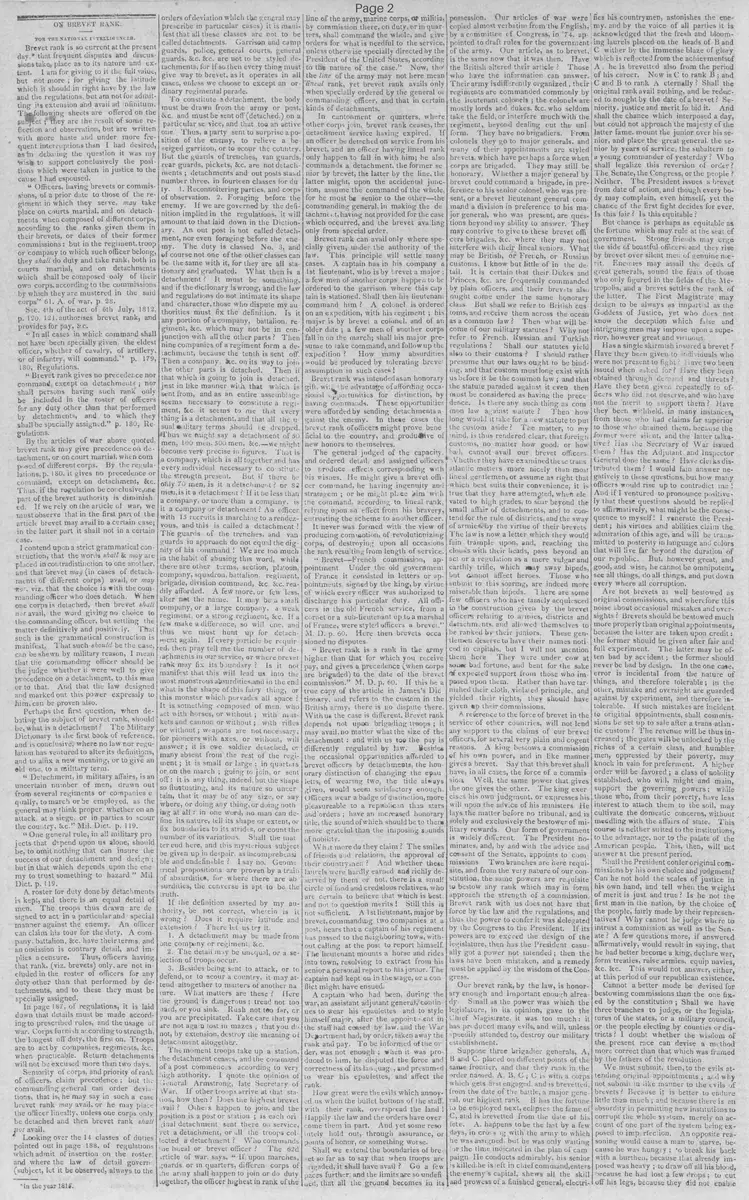
FOR THE NATIONAL INTELLIGENCER.
Brevet rank is so current at the present day, that frequent disputes and discussions take place as to its nature and extent. I am for giving to it the full value, but not more; for giving the latitude which it should in right have by the law and the regulations, but am not for admitting its extension and avail ad infinitum.
The following sheets are offered on the subject; they are the result of some reflection and observation, but are written with more haste and under more frequent interruptions than I had desired, as in debating the question it was my wish to support conclusively the positions which were taken in justice to the cause I had espoused.
"Officers, having brevets or commissions, of a prior date to those of the regiment in which they serve, may take place on courts martial, and on detachments when composed of different corps, according to the ranks given them in their brevets, or dates of their former commissions: but in the regiment, troop or company to which such officer belongs, they shall do duty and take rank, both in courts martial, and on detachments which shall be composed only of their own corps, according to the commissions by which they are mustered in the said corps." Art. of war, p. 28.
Sec. 4th of the act of 6th July, 1812, p. 120, 121, authorises brevet rank, and provides for pay, &c.
"In all cases in which command shall not have been specially given, the eldest officer, whether of cavalry, of artillery, or of infantry, will command." p. 179, 180, Regulations.
"Brevet rank gives no precedence nor command, except on detachments; nor shall persons having such rank only be included in the roster of officers for any duty other than that performed by detachments, and to which they shall be specially assigned." p. 180, Regulations.
By the articles of war above quoted, brevet rank may give precedence on detachment, or on court martial, when composed of different corps. By the regulations, p. 180, it gives no precedence or command, except on detachment, &c.
Thus, if the regulation be conclusive, one part of the brevet authority is diminished. If we rely on the article of war, we must observe that in the first part of the article brevet may avail in a certain case; in the latter part it shall not in a certain case.
I contend upon a strict grammatical construction, that the words shall & may are placed in contradistinction to one another, and that brevet may (in cases of detachments of different corps) avail, or may not, viz. that the choice is with the commanding officer who does detach. When one corps is detached, then brevet shall not avail, the word giving no choice to the commanding officer, but settling the matter definitively and positively. That such is the grammatical construction is manifest. That such should be the case, can be shewn by military reason, I mean that the commanding officer should be the judge whether it were well to give precedence on a detachment, to this man or to that. And that the law designed and marked out this power expressly to him, can be proven also.
Perhaps the first question, when debating the subject of brevet rank, should be, what is a detachment? The Military Dictionary is the first book of reference, and is conclusive, where no law nor regulation has ventured to alter its definitions, and to affix a new meaning, or to give an old one, to a military term.
"Detachment, in military affairs, is an uncertain number of men, drawn out from several regiments or companies equally, to march or be employed, as the general may think proper whether on an attack, at a siege or in parties to scour the country, &c." Mil. Dict. p. 119.
"One general rule, in all military projects that depend upon us alone, should be, to omit nothing that can insure the success of our detachment and design; but in that which depends upon the enemy to trust something to hazard." Mil. Dict. p. 119.
A roster for duty done by detachments is kept, and there is an equal detail of men. The troops thus drawn are designed to act in a particular and special manner against the enemy. An officer can claim his tour for the duty. A company, battalion, &c. have their terms, and an omission is contrary detail, and implies a censure. Thus, officers having that rank, (viz. brevets) only, are not included in the roster of officers for any duty other than that performed by detachments, and to these they must be specially assigned.
In page 187, of regulations, it is laid down that details must be made according to prescribed rules, and the usage of war. Corps furnish according to strength, the longest off duty, the first on. Troops are to act by companies, regiments, &c. when practicable. Return detachments will not be excused more than two days. Seniority of corps, and priority of rank of officers, claim precedence; but the commanding general can order deviations, that is, he may say in such a case brevet rank may avail, or he may place the officer lineally, unless one corps only be detached and then brevet rank shall not avail.
Looking over the 14 classes of duties pointed out in page 188, of regulations which admit of insertion on the roster and where the law of detail govern (subject, let it be observed, always to the orders of deviation which the general may prescribe in particular cases) it is manifest that all these classes are not to be called detachments. Garrison and camp guards, police, general courts, general guards, &c. &c. are not to be styled detachments, for if so then every thing must give way to brevet, as it operates in all cases, unless we choose to except an ordinary regimental parade.
To constitute a detachment, the body must be drawn from the army or post, &c. and must be sent off (detached,) on a particular service, and that too an active one. Thus, a party sent to surprise a position of the enemy, to relieve a besieged garrison, or to scour the country. But the guards of trenches, van guards, rear guards, pickets, &c. are not detachments; detachments and out posts stand number three, in fourteen classes for duty. 1. Reconnoitering parties, and corps of observation. 2. Foraging before the enemy. If we are governed by the definition implied in the regulations, it will amount to that laid down in the Dictionary. An out post is not called detachment, nor even foraging before the enemy. The duty is classed No. 3, and of course not one of the other classes can be the same with it, for they are all stationary and graduated. What then is a detachment? It must be something, and if the dictionary is wrong, and the law and regulations do not intimate its shape and character, those who dispute my authorities must fix the definition. Is it any portion of a company, battalion, regiment, &c. which may not be in conjunction with all the other parts? Then nine companies of a regiment form a detachment, because the tenth is sent off. Then a company, &c. on its way to join the other parts is detached. Then if that which is going to join is detached, just in like manner with that which is sent from, and as an entire assemblage seems necessary to constitute a regiment, &c it seems to me that every thing is a detachment, and that all the usual military terms should be dropped.
Thus we might say a detachment of 50 men, 100 men, 500 men, &c. we might become very precise in figures. That is a company, which is all together and has every individual necessary to constitute the strength present. But if there be only 70 men, is it a detachment? or 82 men, is it a detachment? If it be less than a company, or more than a company, is it a company or detachment? An officer with 15 recruits is marching to a rendezvous, and this is called a detachment! The guards of the trenches, and van guards in approach do not equal the dignity of his command! We are too much in the habit of abusing this word, while there are other terms, section, platoon, company, squadron, battalion, regiment, brigade, division command, &c. &c. readily afforded. A few more, or few less, alter not the name. It may be a small company, or a large company, a weak regiment, or a strong regiment, &c. If a few make a difference, so will one, and thus we must hunt up for detachment again. If every particle be required, then pray tell me the number of detachments in our service, or where brevet rank may fix its boundary? Is it not manifest that this will lead us into the most monstrous absurdities, and in the end what is the shape of this fairy thing, or this monster which pervades all space? It is something composed of men, who act with horses, or without; with muskets and cannon or without; with rifles or without; weapons are not necessary; for pioneers with axes, or without, will answer; it is one soldier detached, or many absent from the rest of the regiment; it is small or large; in quarters or on the march; going to join, or sent off: it is any thing, indeed, but the shape so fluctuating, and its nature so uncertain, that it may be of any size, or any where, or doing any thing, or doing nothing at all: in one word, no man can define its nature, tell its shape or extent, or fix boundaries to its strides, or count the number of its variations. Shall the matter end here, and this mysterious subject be given up in despair, as incomprehensible and undefinable? I say no. Geometrical propositions are proven by a train of absurdities, for where there are absurdities, the converse is apt to be the truth.
If the definition asserted by my authority, be not correct, wherein is it wrong? Does it require latitude and extension? There let us try it.
1. A detachment may be made from one company or regiment, &c.
2. The detail may be unequal, or a selection of troops occur.
3. Besides being sent to attack, or to defend, or to scour a country, it may attend altogether to matters of another nature. What matters are these? Here the ground is dangerous; tread not too hard, or you sink. Rush not too far, or you are precipitated. Take care that you are not again lost in mazes, that you do not, by extension, destroy the meaning of detachment altogether.
The moment troops take up a station, the detachment ceases, and the command of a post commences according to very high authority. I quote the opinion of General Armstrong, late Secretary of War. If other troops arrive at that station, how then? Does the highest brevet avail? Others happen to join, and the position is a post or station; is each original detachment sent there on service, yet a detachment, or all the troops collected a detachment? Who commands the local or brevet officer? The 62d article of war, says, "If, upon marches, guards or in quarters, different corps of the army shall happen to join or do duty together, the officer highest in rank of the line of the army, marine corps, or militia, by commission there, on duty, or in quarters, shall command the whole, and give orders for what is needful to the service, unless otherwise specially directed by the President of the United States, according to the nature of the case." Now, tho the line of the army may not here mean lineal rank, yet brevet rank avails only when specially ordered by the general or commanding officer, and that in certain kinds of detachments.
In cantonment or quarters, where other corps join, brevet rank ceases, the detachment service having expired. If an officer be detached on service from his brevet, and an officer having lineal rank only happen to fall in with him; he also commands a detachment, the former senior by brevet, the latter by the line, the latter might, upon the accidental junction, assume the command of the whole, for he must be senior to the other-the commanding general, in making the detachment, having not provided for the case which occurred, and the brevet availing only from special order.
Brevet rank can avail only where specially given, under the authority of the law. This principle will settle many cases. A captain has in his company a 1st lieutenant, who is by brevet a major; a few men of another corps happen to be ordered to the garrison where this captain is stationed. Shall then his lieutenant command him? A colonel is ordered on an expedition, with his regiment; his major is by brevet a colonel, and of an older date: a few men of another corps fall in on the march: shall his major presume to take command, and follow up the expedition? How many absurdities would be produced by tolerating brevet assumption in such cases!
Brevet rank was intended as an honorary gift, with the advantage of affording occasional opportunities for distinction, by having commands. These opportunities were afforded by sending detachments against the enemy. In these cases the brevet rank of officers might prove beneficial to the country, and productive of new honors to themselves.
The general judged of the capacity, and ordered detail, and assigned officers to produce effects corresponding with his wishes. He might give a brevet officer command, he having ingenuity and stratagem; or he might place him with the command, according to lineal rank, relying upon an effect from his bravery, entrusting the scheme to another officer.
It never was formed with the view of producing commotion, of revolutionizing corps, of destroying upon all occasions the rank resulting from length of service.
"Brevet--French commission, appointment. Under the old government of France it consisted in letters or appointments, signed by the king, by virtue of which every officer was authorized to discharge his particular duty. All officers in the old French service, from a cornet or a sub-lieutenant up to a marshal of France, were styled officers a brevet." M. D. p. 60. Here then brevets occasioned no disputes.
"Brevet rank is a rank in the army higher than that for which you receive pay, and gives a precedence (when corps are brigaded) to the date of the brevet commission." M. D. p. 60. If this be a true copy of the article in James's Dictionary, and refers to the custom in the British army, there is no dispute there. With us the case is different. Brevet rank depends not upon brigading troops; it may avail, no matter what the size of the detachment: and with us too the pay is differently regulated by law. Besides the occasional opportunities afforded to brevet officers by detachments, the honorary distinction of changing the epaulettes, of wearing two, the title always given, would seem satisfactory enough. Officers wear a badge of distinction, more pleasurable to a republican than stars and orders; have an increased honorary title, the sound of which should be to them more grateful than the imposing sounds of nobility.
What more do they claim? The smiles of friends and relations, the approval of their country, men? And whether these laurels were hardly earned and richly deserved by them or not, there is a small circle of fond and credulous relatives, who are certain to believe that which is best, and not to question merits! Still this is not sufficient. A 1st lieutenant, major by brevet, commanding two companies at a post, hears that a captain of his regiment has passed to the neighboring town, without calling at the post to report himself. The lieutenant mounts a horse and rides into town, resolving to extract from his senior a personal report to his junior. The captain had kept on in the stage, or a conflict might have ensued.
A captain who had been, during the war, an assistant adjutant general, continues to wear his epaulettes and to style himself major, after the appointment in the staff had ceased by law, and the War Department had, by order, taken away the rank and pay. To be informed of the order, was not enough; when it was produced to him, he disputed the force and correctness of its language, and presumed to wear his epaulettes, and affect the rank.
How great were the evils which annoyed us when the bullet buttons of the staff, with their rank, overspread the land! Happily the law and the orders have overcome them in part. And yet some resolutely hold out, through assurance, or points of honor, or something worse.
Shall we extend the boundaries of brevet so far as to say that when troops are brigaded, it shall have avail? Go a few paces further, and the limits are so undefined, that all the ground becomes in its possession. Our articles of war were copied almost verbatim from the English, by a committee of Congress, in 74, appointed to draft rules for the government of the army. Our article, as to brevet, is the same now that it was then. Have the British altered their article? Those who have the information can answer.
Their army is differently organized; their regiments are commanded commonly by the lieutenant colonels; the colonels are mostly lords and dukes, &c. who seldom take the field, or interfere much with the regiment, beyond dealing out the uniform. They have no brigadiers. From colonels they go to major generals, and many of their appointments are styled brevets, which have perhaps a force when corps are brigaded. They may still be honorary. Whether a major general by brevet could command a brigade, in preference to his senior colonel, who was present, or a brevet lieutenant general command a division in preference to his major general, who was present, are questions beyond my ability to answer. They may contrive to give to these brevet officers brigades, &c. where they may not interfere with their lineal seniors. What may be British, or French, or Russian customs, I know but little of in the detail. It is certain that their Dukes and Princes, &c. are frequently commanded by plain officers, and their brevets also might come under the same honorary class. But shall we refer to British customs, and receive them across the ocean as a common law? Then what will become of our military statutes? Why not refer to French, Russian and Turkish regulations? Shall our statutes yield also to their customs? I should rather presume that our laws ought to be binding, and that custom must long exist with us before it be the common law; and that the statute paraded against it even then must be considered as having the precedence. Is there any such thing as common law against statute? Then how long would it take for a new statute to put the custom aside? The matter, to my mind, is thus rendered clear, that foreign customs, no matter how good, or how hard, cannot avail our brevet officers. Whether they have examined these transatlantic matters more nicely than most lineal gentlemen, or assume as right that which best suits their convenience, it is true that they have attempted, when elevated to high grades, to soar beyond the small affair of detachments, and to contend for the rule of districts, and the sway of armies, by the virtue of their brevets. The law is now a letter which they would fain trample upon, and, reaching the clouds with their heads, pass beyond an act or a regulation as a mere vulgar and earthly trifle, which may sway bipeds, but cannot affect heroes. Those who submit to this soaring, are indeed more miserable than bipeds. There are some few officers who have tamely acquiesced in the construction given by the brevet officers relating to armies, districts and detachments, and allowed themselves to be ranked by their juniors. These gentlemen deserve to have their names noticed in capitals, but I will not mention them here. They were under cow at some bad fortune, and bent for the sake of expected support from those who imposed upon them. Rather than have tarnished their cloth, violated principle, and yielded their rights, they should have given up their commissions.
A reference to the force of brevet in the service of other countries, will not lend any support to the claims of our brevet officers, for several very plain and cogent reasons. A king bestows a commission of his own power, and in like manner gives a brevet. Say that this brevet shall have, in all cases, the force of a commission. Well, the same power that gives the one gives the other. The king exercises his own judgment, or expresses his will upon the advice of his ministers. He lays the matter before no tribunal, and is solely and exclusively the bestower of military rewards. Our form of government is widely different. The President nominates, and, by and with the advice and consent of the Senate, appoints to commissions. Two branches are here requisite, and from the very nature of our constitution, the same powers are requisite to bestow any rank which may in form approach the strength of a commission. Brevet rank with us does not have that force by the law and the regulations, and thus the power to confer it was delegated by the Congress to the President. If its powers are to exceed the design of the legislature, then has the President casually got a power not intended; then the laws have been mistaken, and a remedy must be applied by the wisdom of the Congress.
Our brevet rank, by the law, is honorary enough and important enough already. Small as the power was which the legislature, in its opinion, gave to the Chief Magistrate, it was too much: it has produced many evils, and will, unless speedily attended to, destroy our military establishment.
Suppose three brigadier generals, A, B and C, placed on different points of the same frontier, and that they rank in the order named, A, B, C; C is with a corps which gets first engaged, and is brevetted, from the date of the battle, a major general, our highest rank. B has the fortune to be employed next, eclipses the fame of C, and is brevetted from the date of his fete. A happens to be the last by a few days, in crossing with the army to which he was assigned, but he was only waiting for the time indicated in the plan of campaign. He conducts admirably, his senior is killed, he is left in chief command, enters the enemy's capital, shews all the skill and prowess of a finished general, electrifies his countrymen, astonishes the enemy, and by the voice of all parties it is acknowledged that the fresh and blooming laurels placed on the heads of B and C wither by the immense blaze of glory which is reflected from the achievements of A, he is brevetted also from the period of his career. Now is C to rank B; and C and B to rank A eternally? Shall the original rank avail nothing, and be reduced to nought by the date of a brevet? Seniority, justice and merit forbid it. And shall the chance which interposed a day, but could not approach the majesty of the latter fame, mount the junior over his senior, and place the great general, the senior by years of service, the subaltern to a young commander of yesterday? Who shall legalize this reversion of order? The Senate, the Congress, or the people? Neither. The President issues a brevet from date of action, and though every body may complain, even himself, yet the chance of the first fight decides for ever.
Is this fair? Is this equitable?
But chance is perhaps as equitable as the fortune which may rule at the seat of government. Strong friends may urge the side of boastful officers, and they rise by brevet over silent men of genuine merit. Enemies may assail the deeds of great generals, sound the feats of those who only figured in the fields of the Metropolis, and a brevet settles the rank of the latter. The First Magistrate may design to be always as impartial as the Goddess of Justice, yet who does not know the deception which false and intriguing men may impose upon a superior, however great and virtuous.
Has a single skirmish insured a brevet? Have they been given to individuals who were not present to fight? have two been issued when asked for? Have they been obtained through demand and threats? Have they been given repeatedly to officers who did not deserve, and who have not the merit to support them? Have they been withheld, in many instances, from those who had claims far superior to those who obtained them, because the former were silent, and the latter talkative? Has the Secretary of War issued them? Has the Adjutant and Inspector General done the same? Have clerks distributed them? I would fain answer negatively to these questions, but how many officers would rise up to contradict me! And if I ventured to pronounce positively that these questions should be replied to affirmatively, what might be the consequence to myself! I venerate the President; his virtues and abilities claim the admiration of this age, and will be transmitted to posterity in language and colors that will live far beyond the duration of our republic. But, however great, and good, and wise, he cannot be omnipotent, see all things, do all things, and put down every where all corruption.
Are not brevets as well bestowed as original commissions, and wherefore this noise about occasional mistakes and oversights? Brevets should be bestowed much more properly than original appointments, because the latter are taken upon credit: the former should be given after fair and full experiment. The latter may be often bad by accident; the former should never be bad by design. In the one case, error is incidental from the nature of things, and therefore tolerable; in the other, mistake and oversight are guarded against by experiment, and therefore intolerable. If such mistakes are incident to original appointments, shall commissions be set up to sale after a trans-atlantic custom? The revenue will be thus increased; the gates will be unlocked by the riches of a certain class, and humbler men, oppressed by their poverty, may knock in vain for preferment. A higher order will be favored; a class of nobility established, who will, might and main, support the governing powers; while those who, from their poverty, have less interest to attach them to the soil, may cultivate the domestic concerns, without meddling with the affairs of state. This course is neither suited to the institutions, to the advantage, nor to the palate of the American people. This, then, will not answer at the present period.
Shall the President confer original commissions by his own choice and judgment? Can he not hold the scales of justice in his own hand, and tell when the weight of merit is just and true? Is he not the first man in the nation, by the choice of the people, fairly made by their representatives? Why cannot he judge where to intrust a commission as well as the Senate? A few questions more, if answered affirmatively, would result in saying, that he had better become a king, declare war, form treaties, raise armies, equip navies, &c. &c. This would not answer, either, at this period of our republican existence.
Cannot a better mode be devised for bestowing commissions than the one fixed by the constitution; Shall we have three branches to judge, or the legislatures of the states, or a military council, or the people electing by counties or districts? I doubt whether the wisdom of the present race can devise a method more correct than that which was framed by the fathers of the revolution.
We must submit, then, to the evils attending original appointments; and why not submit in like manner to the evils of brevets? Because it is better to endure little than much; and because there is an absurdity in permitting new institutions to corrupt the whole system, merely on account of one part of the system being exposed to imperfection. An opposite reasoning would cause a man to starve, because he was hungry; to break his back with a burthen, because that already imposed was heavy; to draw off all his blood, because he had lost a few drops; to cut off his legs, because they did not enable
which to move as perfectly as he wished.
In like manner, politically speaking, we might tolerate the losses of all our property, give up all our rights, and take king Stork in the place of king Log. My opinion is, that brevets should be confined strictly within the boundaries marked out by the law, and that they should not be bestowed until the advice and consent of the Senate have been formally obtained. Then they become limited and defined, are less frequent, are tested by some certain and practical scale, and have a sanction which gives to them character and stability. Appointments to the higher staff, with the rank annexed, require the consent of the Senate. Ordinary promotions require the same consent, even to the lowest grades. Why then should not brevets meet the eyes of that body which is chosen from the wisdom of each respective state!
Give to brevets all the force claimed by some of those who hold them, and let the President alone bestow, and what are the consequences? An ensign may be fostered and patronized and by the succession of a few brevets may command a regiment, a brigade, or army and rule the military concerns of the nation, in despite of the senate, congress and the nation. If that body which represents the states are not to be consulted as to who shall have the rank to command the forces, then the general government may throw aside the checks formed by the states, and an army commanded by the will of an ambitious President may indeed endanger the liberties of the country. Is this a fancy of the brain? I appeal to the instances of assumption on the part of brevet officers, and ask, if they be right in their construction, where are the boundaries to limit their strides, and where the impediments to thwart the result just mentioned?
Does not this render it clear, that this sort of rank has attempted to assume a consequence beyond all expectations; that when the congress gave to the President the power to confer it, they viewed the rank as honorary, availing in certain regulated cases; and that the power delegated to the President was considered not too large to be confided; would not violate the principles of our government become dangerous to the liberties of the people, or distract, or confuse, or destroy the army.
The members of the army are now at open war with one another as to this rank so often mentioned. A decision from the President should be had quickly: but this decision must be conformable to the law, the regulations and the true definition of military terms; otherwise the decision will not be accepted.
No one would say that the President would do wrong by design. Yet no one is servile enough to say "the President can do no wrong." His authority must have right on its side, to impose a sanction, and enforce obedience.
Let a class of brevets be established by law which shall have the force of regular commission, and let the senate approve, and there is no officer so humble in his own opinion, or so timid of his own success, that he would not heartily assent.
A fair field is opened to industry, enterprise, merit and hardihood; a glorious race will be run, an incentive to renewed struggle occur at every step, and the goal holds forth bright rewards, honor, rank and fame.
But congress itself cannot presume to give to the brevets already bestowed a force which the law and regulations under which they were made did not at that period expressly sanction. A contrary law would have clearly a retrospective tendency, and violate the contract formed between the government and the military. Our oath to support the constitution is the first in order, and must be the first obeyed. All else in violation of that sacred charter is null and void, by political and military reasoning.
When a citizen throws on the ordinary habit, and assumes the sword in defence of his country, how much of his natural liberty does he yield for the public good! His right of speech is restricted, the press is in part shut against him, the trial by jury lost in almost all cases, his powers of locomotion limited, and life, liberty, and the enjoyment of happiness, are with him precarious. Though he may be the servant of the government, he is still a citizen of the republic. Shall the laws in being protect all free men, but not the soldier? Shall they be so undefined as to lead him into continual difficulties by the voice of constructive opinions? The worst enemy of the state shall not be condemned by constructive treason; so says the constitution.
One of the worst of the Roman emperors wrote his laws in such small characters and on pillars of such height, that the Roman people were exposed to condemnation by being ignorant of them. Shall an American soldier stand on worse footing than a civil traitor? Shall he live in a condition worse than a Roman in the times of the barbarian emperors? For even there a scaling ladder of some altitude might reach the mysterious laws, but here the law is exposed in print to the naked eye, and a false and barbarous construction is paraded to make it more fatal than if it were altogether illegible!
If such is to be the condition of the military of this country, then (though I would not say, in the words of a certain New Englander, give me the British constitution monarchy and all) I would exclaim, it is better to die than to live in such a state of outrage.
AN OFFICER OF THE ARMY.
November, 1815.
[The editors are under the impression, as already intimated, that the writer of the above Essay has been misinformed in one particular; that is, as to the manner in which he intimates that Brevets have sometimes been acquired. They never could have been bestowed from some of such considerations as he has suggested.]
What sub-type of article is it?
What themes does it cover?
What keywords are associated?
What entities or persons were involved?
Letter to Editor Details
Author
An Officer Of The Army
Recipient
For The National Intelligencer
Main Argument
brevet rank should be limited to its statutory honorary role, granting precedence only in specific detachments composed of different corps as decided by the commanding officer, and not overriding lineal rank in routine duties, garrisons, or accidental junctions; it requires senate confirmation to prevent abuses, disruptions to military order, and threats to republican principles.
Notable Details