Thank you for visiting SNEWPapers!
Sign up free
Danbury Times
Danbury, Fairfield County, Connecticut
What is this article about?
Reports on U.S. Congress proceedings from January 18-20, 1841, covering Senate discussions on American hemp, tariff changes, and land bills; House debates on Treasury Note Bill, pre-emption, and bankrupt law memorials. Key figures include Barnard, Calhoun, Woodbury, and Bell advocating various fiscal and policy measures.
Clipping
OCR Quality
Full Text
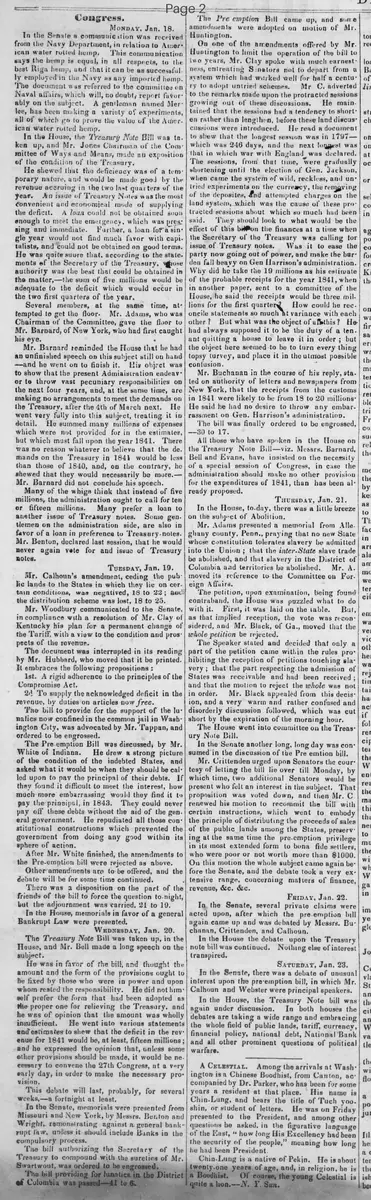
MONDAY, Jan. 18,
In the Senate a communication was received from the Navy Department, in relation to American water rotted hemp. This communication says the hemp is equal, in all respects, to the best Riga hemp, and that it can be as successfully employed in the Navy as any imported hemp.
The document was referred to the committee on Naval affairs, which will, no doubt, report favorably on the subject. A gentleman named Merlee, has been making a variety of experiments, all of which go to prove the value of the American water rotted hemp.
In the House, the Treasury Note Bill was taken up, and Mr. Jones Chairman of the Committee of Ways and Means, made an exposition of the condition of the Treasury.
He shewed that the deficiency was of a temporary nature, and would be made good by the revenue accruing in the two last quarters of the year. An issue of Treasury Notes was the most convenient and economical mode of supplying the deficit. A loan could not be obtained soon enough to meet the emergency, which was pressing and immediate. Further, a loan for a single year would not find much favor with capitalists, and could not be obtained on good terms.
He was quite sure that, according to the statements of the Secretary of the Treasury, whose authority was the best that could be obtained in the matter.-the sum of five millions would be adequate to the deficit which would occur in the two first quarters of the year.
Several members, at the same time, attempted to get the floor. Mr. Adams, who was Chairman of the Committee, gave the floor to Mr. Barnard, of New York, who had first caught his eye.
Mr. Barnard reminded the House that he had an unfinished speech on this subject still on hand --and he went on to finish it. His object was to show that the present Administration endeavored to throw vast pecuniary responsibilities on the next four years, and, at the same time, are making no arrangements to meet the demands on the Treasury, after the 4th of March next. He went very fully into this subject, treating it in detail. He summed many millions of expenses which were not provided for in the estimates, but which must fall upon the year 1841. There was no reason whatever to believe that the demands on the Treasury in 1841 would be less than those of 1840, and, on the contrary, he shewed that they would necessarily be more.-
Mr. Barnard did not conclude his speech.
Many of the whigs think that instead of five millions, the administration ought to call for ten or fifteen millions. Many prefer a loan to another issue of Treasury notes. Some gentlemen on the administration side, are also in favor of a loan in preference to Treasury notes.
Mr. Benton, declared last session, that he would never again vote for an issue of Treasury notes.
TUESDAY, Jan. 19.
Mr. Calhoun's amendment, ceding the public lands to the States in which they lie on certain conditions, was negatived, 18 to 22; and the distribution scheme was lost, 18 to 25.
Mr. Woodbury communicated to the Senate, in compliance with a resolution of Mr. Clay of Kentucky his plan for a permanent change of the Tariff, with a view to the condition and prospects of the revenue.
The document was interrupted in its reading by Mr. Hubbard, who moved that it be printed.
It embraces the following propositions :
1st. A rigid adherence to the principles of the Compromise Act.
2d To supply the acknowledged deficit in the revenue, by duties on articles now free.
The bill to provide for the support of the lunatics now confined in the common jail in Washington City, was advocated by Mr. Tappan, and ordered to be engrossed.
The Pre-emption Bill was discussed, by Mr. White of Indiana. He drew a strong picture of the condition of the indebted States, and asked what it would be when they should be called upon to pay the principal of their debts. If they found it difficult to meet the interest, how much more embarrassing would they find it to pay the principal, in 1843. They could never pay off these debts without the aid of the general government. He repudiated all those constitutional constructions which prevented the government from doing any good within its sphere of action.
After Mr. White finished, the amendments to the Pre-emption bill were rejected as above.
Other amendments are to be offered, and the debate will be for some time continued.
There was a disposition on the part of the friends of the bill to force the question to-night but the adjournment was carried, 21 to 19.
In the House, memorials in favor of a general Bankrupt Law were presented.
WEDNESDAY, Jan. 20.
The Treasury Note Bill was taken up, in the House, and Mr. Bell made a long speech on the subject.
He was in favor of the bill, and thought the amount and the form of the provisions ought to be fixed by those who were in power and upon whom rested the responsibility. He did not himself prefer the form that had been adopted as the proper one for relieving the Treasury, and he was of opinion that the amount was wholly insufficient. He went into various statements and estimates to shew that the deficit in the revenue for 1841 would be, at least, fifteen millions; and he expressed the opinion that, unless some other provisions should be made, it would be necessary to convene the 27th Congress, at a very early day, in order to make the necessary provision.
This debate will last, probably, for several weeks,-a fortnight at least.
In the Senate, memorials were presented from Missouri and New York, by Messrs. Benton and Wright, remonstrating against a general bankrupt law, unless it should include Banks in the compulsory process.
The bill authorizing the Secretary of the Treasury to compound with the sureties of Mr. Swartwout, was ordered to be engrossed.
The bill providing for lunatics in the District Columbia was passed-41 to 8
What sub-type of article is it?
What keywords are associated?
What entities or persons were involved?
Where did it happen?
Domestic News Details
Primary Location
Washington City
Event Date
Jan. 18 20
Key Persons
Event Details
Congressional proceedings over three days included Senate receipt of Navy Department communication on American water-rotted hemp, referral to Naval Affairs Committee; House debate on Treasury Note Bill with speeches by Mr. Jones and Mr. Barnard criticizing administration fiscal policies; Senate rejection of Mr. Calhoun's land cession amendment and distribution scheme; Mr. Woodbury's tariff change plan proposing adherence to Compromise Act and new duties; passage of bill for support of lunatics in Washington City jail; discussion of Pre-emption Bill by Mr. White highlighting indebted states' needs; House presentation of memorials for general Bankrupt Law; Mr. Bell's speech supporting but critiquing Treasury Note Bill amount; Senate memorials against bankrupt law without bank inclusion; engrossment of bill for Treasury Secretary to compound with Mr. Swartwout's sureties; passage of lunatics bill in Senate.