Thank you for visiting SNEWPapers!
Sign up free
Editorial
May 23, 1871
The Daily Phoenix
Columbia, Richland County, South Carolina
What is this article about?
Editorial critiques Radical Reconstruction in the post-Civil War South, quoting the New York Tribune on disenfranchised Southern elites plundered by unqualified rulers, H.V. Redfield on an inexperienced Black Supreme Court judge in South Carolina, and a New York World correspondent on untrustworthy Governor Scott's handling of taxes and the Tax-Payers' Convention, urging universal amnesty and impartial suffrage.
Clipping
OCR Quality
95%
Excellent
Full Text
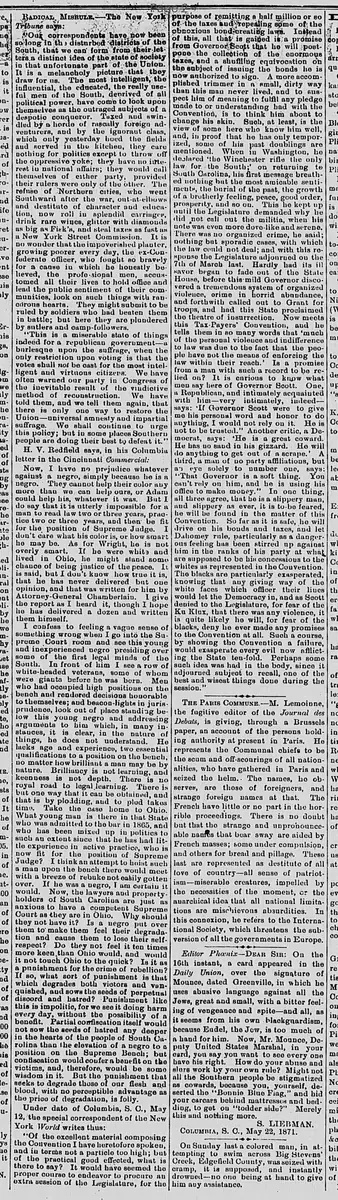
RADICAL MISRULE.
The New York Tribune says:
"Our correspondents have now been so long in the disturbed districts of the South, that we can form from their letters a distinct idea of the state of society in that unfortunate part of the Union. It is a melancholy picture that they draw for us. The most intelligent, the influential, the educated, the really useful men of the South, deprived of all political power, have come to look upon themselves as the outraged subjects of a despotic conqueror. Taxed and swindled by a horde of rascally foreign adventurers, and by the ignorant class, which only yesterday hoed the fields and served in the kitchen, they care nothing for politics except to throw off the oppressive yoke: they have no interest in national affairs; they would call themselves of either party, provided their rulers were only of the other. The refuse of Northern cities, who went Southward after the war, out-at-elbows and destitute of character and education, now roll in splendid carriages, drink rare wines, glitter with diamonds as big as Fisk's, and steal taxes as fast as a New York Street Commission.
It is no wonder that the impoverished planter, growing poorer every day, the ex-Confederate officer, who fought so bravely for a cause in which he honestly believed, the professional men, accustomed all their lives to hold office and lead the public sentiment of their communities, look on such things with rancorous hearts. They might submit to be ruled by soldiers who had beaten them in battle; but here they are plundered by sutlers and camp-followers.
This is a miserable state of things indeed for a republican government - a burlesque upon the suffrage, when the only restriction upon voting is that the votes shall not be cast for the most intelligent and virtuous citizens: We have often warned our party in Congress of the inevitable result of the vindictive method of reconstruction. We have told them, and we tell them again, that there is only one way to restore the Union - universal amnesty and impartial suffrage. We shall continue to urge this policy; but in some places Southern people are doing their best to defeat it."
H. V. Redfield says, in his Columbia letter in the Cincinnati Commercial:
Now, I have no prejudice whatever against a negro, simply because he is a negro. They cannot help their color any more than we can help ours, or Adam could help his, whatever it was. But I do say that it is utterly impossible for a man to read law two or three years, practice two or three years, and then be fit for the position of Supreme Judge. I don't care what his color is, or how smart he may be. As for Wright, he is not overly smart. If he were white and lived in Ohio, he might stand some chance of being justice of the peace. It is said, but I don't know how true it is, that he has never delivered but one opinion, and that was written for him by Attorney-General Chamberlain. I give the report as I heard it, though I hope he has delivered a dozen and written them himself.
I confess to feeling a vague sense of something wrong when I go into the Supreme Court room and see this young and inexperienced negro presiding over some of the first legal minds of the South. In front of him I see a row of white-headed veterans, some of whom were giants before he was born. Men who had occupied high positions on the bench and rendered decisions honorable to themselves; and beacon-lights in jurisprudence, look out of place standing before this young negro and addressing arguments to him which, in many instances, it is clear, in the nature of things, he does not understand. He lacks age and experience, two essential qualifications to a position on the bench, no matter how brilliant a man may be by nature. Brilliancy is not learning, and keenness is not depth. There is no royal road to legal learning. There is but one way that it can be obtained, and that is by plodding, and to plod takes time. Take the case home to Ohio. What young man is there in that State who was admitted to the bar in 1865, and who has been mixed up in politics to such an extent since that he has had little experience in active practice, who is now fit for the position of Supreme Judge? I think an attempt to hoist such a man upon the bench there would meet with a breeze of rebuke not easily gotten over. If he was a negro, I am certain it would. Now, the lawyers and property holders of South Carolina are just as anxious to have a competent Supreme Court as they are in Ohio. Why should they not have it? Is a negro put over them to make them feel their degradation and cause them to lose their self-respect? Do they not feel it ten times more keen than Ohio would, and would it not touch Ohio to the quick? Is it as a punishment for the crime of rebellion? If so, what sort of punishment is that which degrades both victors and vanquished, and sows the seeds of perpetual discord and hatred? - Punishment like this is impolitic, for we see it doing harm every day, without the possibility of a benefit. Partial confiscation itself would not sow the seeds of hatred any deeper in the hearts of the people of South Carolina than the elevation of a negro to a position on the Supreme Bench; but confiscation would confer a benefit on the victims, and, therefore, would be some wisdom in it. But the punishment that seeks to degrade those of our flesh and blood, with no perceptible advantage as the price of degradation, is folly.
Under date of Columbia, S. C., May 12, the special correspondent of the New York World writes thus:
"Of the excellent material composing the Convention I have heretofore spoken, and in terms not a particle too high; but of the practical good effected, what is there to say? It would have seemed the proper course to endeavor to procure an extra session of the Legislature, for the purpose of remitting a half million or so of the taxes and repealing some of the obnoxious bond-creating laws. Instead of this, all that is gained is a promise from Governor Scott that he will postpone the collection of the enormous taxes, and a shuffling equivocation on the subject of issuing the bonds he is now authorized to sign. A more accomplished trimmer in a small, dirty way than this man never lived, and to suspect him of meaning to fulfil any pledge made to or understanding had with the Convention, is to think him about to change his skin. Such, at least, is the view of some here who know him well, and, in proof that he has only temporized, some of his past doublings are mentioned. When in Washington, he declared the Winchester rifle the only law for the South; on returning to South Carolina, his first message breathed nothing but the most amicable sentiments, the burial of the past, the growth of a brotherly feeling, peace, good order, prosperity, and so on. This he kept up until the Legislature demanded why he did not call out the militia, when his note was even more dove-like and serene. There was no organized crime, he said; nothing but sporadic cases, with which the law could not deal; and with this response the Legislature adjourned on the 7th of March last. Hardly had its ill savor begun to fade out of the State House, before this mild Governor discovered a tremendous system of organized violence, crime in horrid abundance, and forthwith called out to Grant for troops, and had this State proclaimed the theatre of insurrection. Now meets this Tax-Payers' Convention, and he tells them in so many words that 'much of the personal violence and indifference to law was due to the fact that the people have not the means of enforcing the law within their reach.' Is a promise from a man with such a record to be relied on? It is curious to know what men say here of Governor Scott. One, a Republican, and intimately acquainted with him - very intimately, indeed - says: If Governor Scott were to give me his personal word and honor to do anything, I would not rely on it. He is not to be trusted. Another critic, a Democrat, says: He is a great coward. He has no sand in his gizzard. He will do anything to get out of a scrape. A third, a man of no party affiliations, but an eye solely to number one, says: "That Governor is a soft thing. You can't rely on him, and he is using his office to make money." In one thing all three agree, that he is a slippery man, and slippery as ever, it is to be feared, he will be found in the matter of this Convention. So far as it is safe, he will drive on his bonds and taxes, and let Dahomey rule, particularly as a dangerous feeling has been stirred up against him in the ranks of his party at what are supposed to be his concessions to the whites as represented in the Convention. The blacks are particularly exasperated, knowing that any giving way of the white faces which officer their lines would let the Democracy in, and as Scott denied to the Legislature, for fear of the Ku Klux, that there was any violence, it is quite likely he will, for fear of the blacks, deny he ever made any promises to the Convention at all. Such a course, by showing the Convention a failure, would exasperate every evil now afflicting the State ten-fold. Perhaps some such idea was had in the body, since it adjourned subject to recall, one of the best and wisest things done during the session."
The New York Tribune says:
"Our correspondents have now been so long in the disturbed districts of the South, that we can form from their letters a distinct idea of the state of society in that unfortunate part of the Union. It is a melancholy picture that they draw for us. The most intelligent, the influential, the educated, the really useful men of the South, deprived of all political power, have come to look upon themselves as the outraged subjects of a despotic conqueror. Taxed and swindled by a horde of rascally foreign adventurers, and by the ignorant class, which only yesterday hoed the fields and served in the kitchen, they care nothing for politics except to throw off the oppressive yoke: they have no interest in national affairs; they would call themselves of either party, provided their rulers were only of the other. The refuse of Northern cities, who went Southward after the war, out-at-elbows and destitute of character and education, now roll in splendid carriages, drink rare wines, glitter with diamonds as big as Fisk's, and steal taxes as fast as a New York Street Commission.
It is no wonder that the impoverished planter, growing poorer every day, the ex-Confederate officer, who fought so bravely for a cause in which he honestly believed, the professional men, accustomed all their lives to hold office and lead the public sentiment of their communities, look on such things with rancorous hearts. They might submit to be ruled by soldiers who had beaten them in battle; but here they are plundered by sutlers and camp-followers.
This is a miserable state of things indeed for a republican government - a burlesque upon the suffrage, when the only restriction upon voting is that the votes shall not be cast for the most intelligent and virtuous citizens: We have often warned our party in Congress of the inevitable result of the vindictive method of reconstruction. We have told them, and we tell them again, that there is only one way to restore the Union - universal amnesty and impartial suffrage. We shall continue to urge this policy; but in some places Southern people are doing their best to defeat it."
H. V. Redfield says, in his Columbia letter in the Cincinnati Commercial:
Now, I have no prejudice whatever against a negro, simply because he is a negro. They cannot help their color any more than we can help ours, or Adam could help his, whatever it was. But I do say that it is utterly impossible for a man to read law two or three years, practice two or three years, and then be fit for the position of Supreme Judge. I don't care what his color is, or how smart he may be. As for Wright, he is not overly smart. If he were white and lived in Ohio, he might stand some chance of being justice of the peace. It is said, but I don't know how true it is, that he has never delivered but one opinion, and that was written for him by Attorney-General Chamberlain. I give the report as I heard it, though I hope he has delivered a dozen and written them himself.
I confess to feeling a vague sense of something wrong when I go into the Supreme Court room and see this young and inexperienced negro presiding over some of the first legal minds of the South. In front of him I see a row of white-headed veterans, some of whom were giants before he was born. Men who had occupied high positions on the bench and rendered decisions honorable to themselves; and beacon-lights in jurisprudence, look out of place standing before this young negro and addressing arguments to him which, in many instances, it is clear, in the nature of things, he does not understand. He lacks age and experience, two essential qualifications to a position on the bench, no matter how brilliant a man may be by nature. Brilliancy is not learning, and keenness is not depth. There is no royal road to legal learning. There is but one way that it can be obtained, and that is by plodding, and to plod takes time. Take the case home to Ohio. What young man is there in that State who was admitted to the bar in 1865, and who has been mixed up in politics to such an extent since that he has had little experience in active practice, who is now fit for the position of Supreme Judge? I think an attempt to hoist such a man upon the bench there would meet with a breeze of rebuke not easily gotten over. If he was a negro, I am certain it would. Now, the lawyers and property holders of South Carolina are just as anxious to have a competent Supreme Court as they are in Ohio. Why should they not have it? Is a negro put over them to make them feel their degradation and cause them to lose their self-respect? Do they not feel it ten times more keen than Ohio would, and would it not touch Ohio to the quick? Is it as a punishment for the crime of rebellion? If so, what sort of punishment is that which degrades both victors and vanquished, and sows the seeds of perpetual discord and hatred? - Punishment like this is impolitic, for we see it doing harm every day, without the possibility of a benefit. Partial confiscation itself would not sow the seeds of hatred any deeper in the hearts of the people of South Carolina than the elevation of a negro to a position on the Supreme Bench; but confiscation would confer a benefit on the victims, and, therefore, would be some wisdom in it. But the punishment that seeks to degrade those of our flesh and blood, with no perceptible advantage as the price of degradation, is folly.
Under date of Columbia, S. C., May 12, the special correspondent of the New York World writes thus:
"Of the excellent material composing the Convention I have heretofore spoken, and in terms not a particle too high; but of the practical good effected, what is there to say? It would have seemed the proper course to endeavor to procure an extra session of the Legislature, for the purpose of remitting a half million or so of the taxes and repealing some of the obnoxious bond-creating laws. Instead of this, all that is gained is a promise from Governor Scott that he will postpone the collection of the enormous taxes, and a shuffling equivocation on the subject of issuing the bonds he is now authorized to sign. A more accomplished trimmer in a small, dirty way than this man never lived, and to suspect him of meaning to fulfil any pledge made to or understanding had with the Convention, is to think him about to change his skin. Such, at least, is the view of some here who know him well, and, in proof that he has only temporized, some of his past doublings are mentioned. When in Washington, he declared the Winchester rifle the only law for the South; on returning to South Carolina, his first message breathed nothing but the most amicable sentiments, the burial of the past, the growth of a brotherly feeling, peace, good order, prosperity, and so on. This he kept up until the Legislature demanded why he did not call out the militia, when his note was even more dove-like and serene. There was no organized crime, he said; nothing but sporadic cases, with which the law could not deal; and with this response the Legislature adjourned on the 7th of March last. Hardly had its ill savor begun to fade out of the State House, before this mild Governor discovered a tremendous system of organized violence, crime in horrid abundance, and forthwith called out to Grant for troops, and had this State proclaimed the theatre of insurrection. Now meets this Tax-Payers' Convention, and he tells them in so many words that 'much of the personal violence and indifference to law was due to the fact that the people have not the means of enforcing the law within their reach.' Is a promise from a man with such a record to be relied on? It is curious to know what men say here of Governor Scott. One, a Republican, and intimately acquainted with him - very intimately, indeed - says: If Governor Scott were to give me his personal word and honor to do anything, I would not rely on it. He is not to be trusted. Another critic, a Democrat, says: He is a great coward. He has no sand in his gizzard. He will do anything to get out of a scrape. A third, a man of no party affiliations, but an eye solely to number one, says: "That Governor is a soft thing. You can't rely on him, and he is using his office to make money." In one thing all three agree, that he is a slippery man, and slippery as ever, it is to be feared, he will be found in the matter of this Convention. So far as it is safe, he will drive on his bonds and taxes, and let Dahomey rule, particularly as a dangerous feeling has been stirred up against him in the ranks of his party at what are supposed to be his concessions to the whites as represented in the Convention. The blacks are particularly exasperated, knowing that any giving way of the white faces which officer their lines would let the Democracy in, and as Scott denied to the Legislature, for fear of the Ku Klux, that there was any violence, it is quite likely he will, for fear of the blacks, deny he ever made any promises to the Convention at all. Such a course, by showing the Convention a failure, would exasperate every evil now afflicting the State ten-fold. Perhaps some such idea was had in the body, since it adjourned subject to recall, one of the best and wisest things done during the session."
What sub-type of article is it?
Partisan Politics
Constitutional
Legal Reform
What keywords are associated?
Radical Reconstruction
Southern Misrule
Negro Judge
Governor Scott
Universal Amnesty
Impartial Suffrage
Tax Payers Convention
South Carolina Politics
What entities or persons were involved?
New York Tribune
H. V. Redfield
Cincinnati Commercial
Wright
Attorney General Chamberlain
Governor Scott
New York World
Tax Payers' Convention
Ku Klux
Editorial Details
Primary Topic
Criticism Of Radical Reconstruction In The South
Stance / Tone
Strongly Critical Of Radical Rule, Advocating Universal Amnesty And Impartial Suffrage
Key Figures
New York Tribune
H. V. Redfield
Cincinnati Commercial
Wright
Attorney General Chamberlain
Governor Scott
New York World
Tax Payers' Convention
Ku Klux
Key Arguments
Southern Educated Classes Disenfranchised And Plundered By Unqualified Northern Adventurers And Former Slaves
Inexperienced Black Judge Unfit For South Carolina Supreme Court, Causing Degradation And Hatred
Governor Scott Untrustworthy, Temporizing On Taxes And Bonds, Unreliable In Promises
Vindictive Reconstruction Sows Discord; Only Universal Amnesty And Impartial Suffrage Can Restore Union
Elevation Of Unqualified Individuals As Punishment Is Impolitic And Harmful