Thank you for visiting SNEWPapers!
Sign up free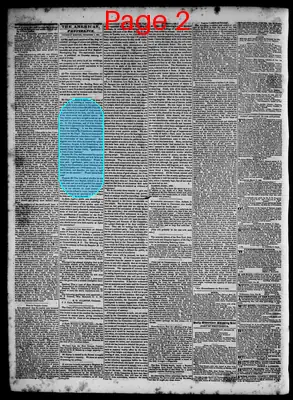
Editorial
December 1, 1831
Rhode Island American And Gazette
Providence, Providence County, Rhode Island
What is this article about?
Critique of Henry Clay's refusal to disclose his opinions on Masonry, questioning his frankness and independence as a presidential candidate, contrasting with hypothetical responses on other topics like colonization or religion, and arguing public figures should address vital issues openly.
Clipping
OCR Quality
95%
Excellent
Full Text
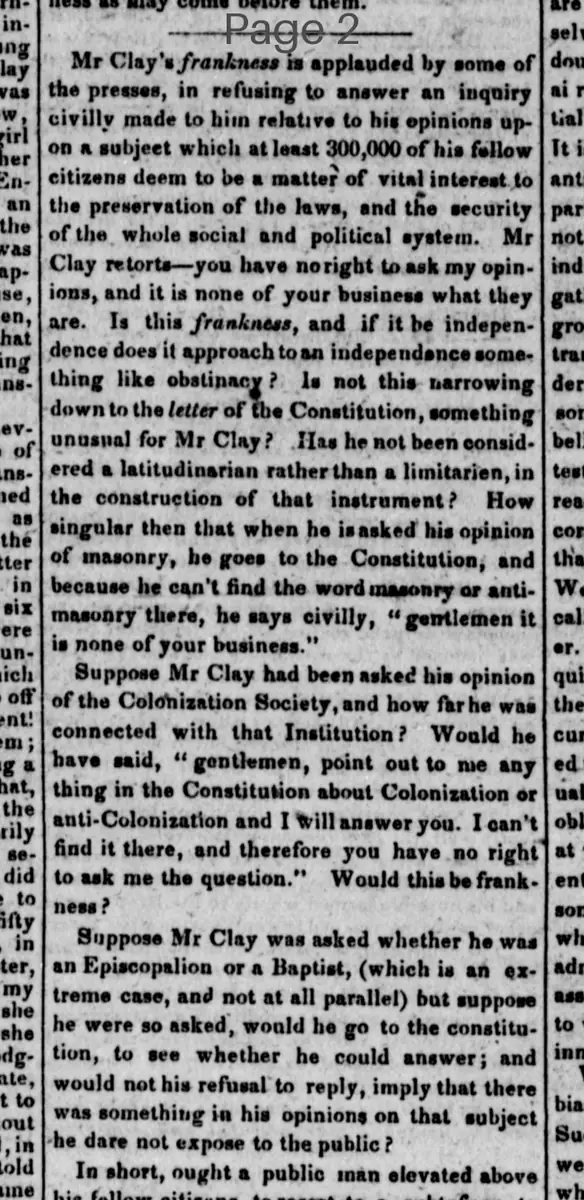
Mr Clay's frankness is applauded by some of the presses, in refusing to answer an inquiry civilly made to him relative to his opinions upon a subject which at least 300,000 of his fellow citizens deem to be a matter of vital interest to the preservation of the laws, and the security of the whole social and political system. Mr Clay retorts—you have no right to ask my opinions, and it is none of your business what they are. Is this frankness, and if it be independence does it approach to an independence something like obstinacy? is not this narrowing down to the letter of the Constitution, something unusual for Mr Clay? Has he not been considered a latitudinarian rather than a limitarian, in the construction of that instrument? How singular then that when he is asked his opinion of masonry, he goes to the Constitution; and because he can't find the word masonry or anti-masonry there, he says civilly, "gentlemen it is none of your business."
Suppose Mr Clay had been asked his opinion of the Colonization Society, and how far he was connected with that Institution? Would he have said, "gentlemen, point out to me any thing in the Constitution about Colonization or anti-Colonization and I will answer you. I can't find it there, and therefore you have no right to ask me the question." Would this be frankness?
Suppose Mr Clay was asked whether he was an Episcopalian or a Baptist, (which is an extreme case, and not at all parallel) but suppose he were so asked, would he go to the constitution, to see whether he could answer; and would not his refusal to reply, imply that there was something in his opinions on that subject he dare not expose to the public?
In short, ought a public man elevated above his fellow citizens, to resort to a subterfuge to avoid an expression of his opinion upon any topic which a vast portion of his fellow citizens desire to have openly discussed, and which they deem of vital and paramount importance in the qualifications of a candidate for the Presidency? Besides if Mr Clay could be so frank and so independent after Mr Wirt's nomination, why should he not have been equally so before the nomination?
Suppose Mr Clay had been asked his opinion of the Colonization Society, and how far he was connected with that Institution? Would he have said, "gentlemen, point out to me any thing in the Constitution about Colonization or anti-Colonization and I will answer you. I can't find it there, and therefore you have no right to ask me the question." Would this be frankness?
Suppose Mr Clay was asked whether he was an Episcopalian or a Baptist, (which is an extreme case, and not at all parallel) but suppose he were so asked, would he go to the constitution, to see whether he could answer; and would not his refusal to reply, imply that there was something in his opinions on that subject he dare not expose to the public?
In short, ought a public man elevated above his fellow citizens, to resort to a subterfuge to avoid an expression of his opinion upon any topic which a vast portion of his fellow citizens desire to have openly discussed, and which they deem of vital and paramount importance in the qualifications of a candidate for the Presidency? Besides if Mr Clay could be so frank and so independent after Mr Wirt's nomination, why should he not have been equally so before the nomination?
What sub-type of article is it?
Partisan Politics
Moral Or Religious
What keywords are associated?
Henry Clay
Masonry
Anti Masonry
Presidential Candidate
Constitutional Interpretation
Colonization Society
Frankness
Independence
What entities or persons were involved?
Mr Clay
Mr Wirt
Editorial Details
Primary Topic
Critique Of Henry Clay's Refusal To Discuss Masonry
Stance / Tone
Critical Of Clay's Evasion And Independence
Key Figures
Mr Clay
Mr Wirt
Key Arguments
Clay's Refusal To Answer On Masonry Is Not True Frankness But Obstinacy
Unusual For Clay To Strictly Interpret The Constitution On This Issue
Hypothetical Refusal On Colonization Society Would Not Be Seen As Frank
Refusal On Religious Affiliation Would Imply Hidden Opinions
Public Figures Should Express Views On Vital Topics For Presidential Candidacy
Inconsistency In Clay's Frankness Before And After Wirt's Nomination