Thank you for visiting SNEWPapers!
Sign up free
Vilas County News
Eagle River, Vilas County, Wisconsin
What is this article about?
Descriptive tour of the Waterloo battlefield near Brussels, highlighting key monuments like the Lion Mound, La Haie Sainte, Belle-Alliance, and Hougomont, commemorating the June 18, 1815 battle involving Wellington, Blucher, and Napoleon.
Clipping
OCR Quality
Full Text
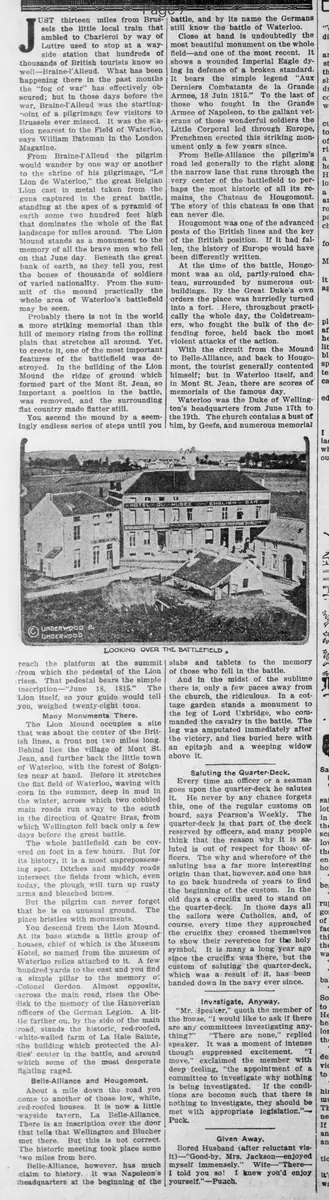
From Braine-l'Alleud the pilgrim would wander by one way or another to the shrine of his pilgrimage, "Le Lion de Waterloo," the great Belgian Lion cast in metal taken from the guns captured in the great battle, standing at the apex of a pyramid of earth some two hundred feet high that dominates the whole of the flat landscape for miles around. The Lion Mound stands as a monument to the memory of all the brave men who fell on that June day. Beneath the great bank of earth, as they tell you, rest the bones of thousands of soldiers of varied nationality. From the summit of the mound practically the whole area of Waterloo's battlefield may be seen.
Probably there is not in the world a more striking memorial than this hill of memory rising from the rolling plain that stretches all around. Yet, to create it, one of the most important features of the battlefield was destroyed. In the building of the Lion Mound the ridge of ground which formed part of the Mont St. Jean, so important a position in the battle, was removed, and the surrounding flat country made flatter still.
You ascend the mound by a seemingly endless series of steps until you reach the platform at the summit from which the pedestal of the Lion rises. That pedestal bears the simple inscription—"June 18, 1815." The Lion itself, so your guide would tell you, weighed twenty-eight tons.
Many Monuments There.
The Lion Mound occupies a site that was about the center of the British lines, a front not two miles long. Behind lies the village of Mont St. Jean, and further back the little town of Waterloo, with the forest of Soignies near at hand. Before it stretches the flat field of Waterloo, waving with corn in the summer, deep in mud in the winter, across which two cobbled main roads run away to the south in the direction of Quatre Bras, from which Wellington fell back only a few days before the great battle.
The whole battlefield can be covered on foot in a few hours. But for its history, it is a most unprepossessing spot. Ditches and muddy roads intersect the fields from which, even today, the plough will turn up rusty arms and bleached bones.
But the pilgrim can never forget that he is on unusual ground. The place bristles with monuments.
You descend from the Lion Mound. At its base stands a little group of houses, chief of which is the Museum Hotel, so named from the museum of Waterloo relics attached to it. A few hundred yards to the east and you find a simple pillar to the memory of Colonel Gordon. Almost opposite, across the main road, rises the Obelisk to the memory of the Hanoverian officers of the German Legion. A little farther on, by the side of the main road, stands the historic, red-roofed, white-walled farm of La Haie Sainte, the building which protected the Allies' center in the battle, and around which some of the most desperate fighting raged.
Belle-Alliance and Hougomont.
About a mile down the road you come to another of those low, white, red-roofed houses. It is now a little wayside tavern, La Belle-Alliance. There is an inscription over the door that tells that Wellington and Blucher met there. But this is not correct. The historic meeting took place some two miles from here.
Belle-Alliance, however, has much claim to history. It was Napoleon's headquarters at the beginning of the battle, and by its name the Germans still know the battle of Waterloo.
Close at hand is undoubtedly the most beautiful monument on the whole field—and one of the most recent. It shows a wounded Imperial Eagle dying in defense of a broken standard. It bears the simple legend "Aux Derniers Combatants de la Grande Armee. 18 Juin 1815." To the last of those who fought in the Grande Armee of Napoleon, to the gallant veterans of those wonderful soldiers the Little Corporal led through Europe, Frenchmen erected this striking monument only a few years since.
From Belle-Alliance the pilgrim's road led generally to the right along the narrow lane that runs through the very center of the battlefield to perhaps the most historic of all its remains, the Chateau de Hougomont.
The story of this chateau is one that can never die.
Hougomont was one of the advanced posts of the British lines and the key of the British position. If it had fallen, the history of Europe would have been differently written.
At the time of the battle, Hougomont was an old, partly-ruined chateau, surrounded by numerous outbuildings. By the Great Duke's own orders the place was hurriedly turned into a fort. Here, throughout practically the whole day, the Coldstreamers, who fought the bulk of the defending force, held back the most violent attacks of the action.
With the circuit from the Mound to Belle-Alliance, and back to Hougomont, the tourist generally contented himself; but in Waterloo itself, and in Mont St. Jean, there are scores of memorials of the famous day.
Waterloo was the Duke of Wellington's headquarters from June 17th to the 19th. The church contains a bust of him, by Geefs, and numerous memorials in the shape of slabs and tablets to the memory of those who fell in the battle.
And in the midst of the sublime there is, only a few paces away from the church, the ridiculous. In a cottage garden stands a monument to the leg of Lord Uxbridge, who commanded the cavalry in the battle. The leg was amputated immediately after the victory, and lies buried here with an epitaph and a weeping widow above it.
What sub-type of article is it?
What keywords are associated?
What entities or persons were involved?
Where did it happen?
Foreign News Details
Primary Location
Waterloo, Belgium
Event Date
June 18, 1815
Key Persons
Outcome
monument to thousands of soldiers buried beneath lion mound; allies held key positions like hougomont, leading to napoleon's defeat.
Event Details
Tour of Waterloo battlefield sites including Lion Mound monument, La Haie Sainte farm, Belle-Alliance (Napoleon's HQ), Hougomont chateau (key British position defended by Coldstream Guards), and various memorials to fallen soldiers and officers.