Thank you for visiting SNEWPapers!
Sign up free
Spirit Of The Times
Portsmouth, Ironton, Scioto County, Lawrence County, Ohio
What is this article about?
Diplomatic crisis between Austria and Turkey: Austria demands territorial cessions, coal mines in Bosnia, protection for Catholics, and recognition of Montenegro's independence. Turkey refuses all. Russia sends Prince Menchikoff as envoy; England seeks to avert war. Potential European conflict involving Hungary and Kossuth.
Clipping
OCR Quality
Full Text
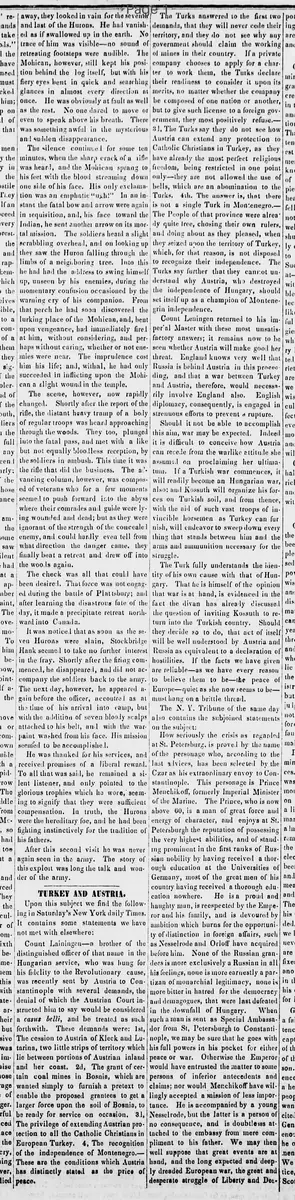
Upon this subject we find the following in Saturday's New York daily Times. It contains some statements we have not met with elsewhere:
Count Leiningen—a brother of the distinguished officer of that name in the Hungarian service, who was hung for his fidelity to the Revolutionary cause, was recently sent by Austria to Constantinople with several demands, the denial of which the Austrian Court instructed him to say would be considered a casus belli, and be treated as such forthwith. These demands were: 1st, The cession to Austria of Kleck and Lutarian, two little strips of territory which lie between portions of Austrian inland and her coast. 2d, The grant of certain coal mines in Bosnia, which are wanted simply to furnish a pretext to enable the proposed grantees to get a larger force upon the soil of Bosnia, to be ready for service on occasion. 3d, The privilege of extending Austrian protection to all the Catholic Christians in European Turkey. 4, The recognition of the independence of Montenegro.—These are the conditions which Austria has distinctly stated as the price of peace.
The Turks answered to the first two demands, that they will never cede their territory, and they do not see why any government should claim the working of mines in their country. If a private company chooses to apply for a charter to work them, the Turks declare their readiness to consider it upon its merits, no matter whether the company be composed of one nation or another but to give such license to a foreign government, they most positively refuse.
—3d, The Turks say they do not see how Austria can extend any protection to Catholic Christians in Turkey, as they have already the most perfect religious freedom, being restricted in one point only—they are not allowed the use of bells, which are an abomination to the Turks. 4th. The answer is, that there is not a single Turk in Montenegro.—The People of that province were already quite free, choosing their own rulers, and doing about as they pleased, when they seized upon the territory of Turkey, which, for that reason, is not disposed to recognize their independence. The Turks say further that they cannot understand why Austria, who destroyed the independence of Hungary, should set itself up as a champion of Montenegrin independence.
Count Leiningen returned to his Imperial Master with these most unsatisfactory answers; it remains now to be seen whether Austria will make good her threat. England knows very well that Russia is behind Austria in this proceeding, and that a war between Turkey and Austria, therefore, would necessarily involve England also. English diplomacy, consequently, is engaged in strenuous efforts to prevent a rupture. Should it not be able to accomplish this aim, war may be expected. Indeed it is difficult to conceive how Austria can recede from the warlike attitude she assumed on proclaiming her ultimatum. If a Turkish war commences, it will readily become an Hungarian war, also: and Kossuth will organize his forces on Turkish soil, and from thence, with the aid of such vast troops of invincible horsemen as Turkey can furnish, will endeavor to sweep down everything that stands between him and the arms and ammunition necessary for the struggle.
The Turk fully understands the identity of his own cause with that of Hungary. That he is himself of the opinion that war is at hand, is evidenced in the fact the divan has already discussed the question of inviting Kossuth to return into the Turkish country. Should they decide so to do, that act of itself will be well understood by Austria and Russia as equivalent to a declaration of hostilities. If the facts we have given are reliable—as we have every reason to believe them to be—the peace of Europe—quiet as she now seems to be—must hang on a brittle thread
The N. Y. Tribune of the same day also contains the subjoined statements on the subject:
How seriously the crisis as regarded at St. Petersburg, is proved by the name of the personage who, according to the last advices, has been selected by the Czar as his extraordinary envoy to Constantinople. This personage is Prince Menchikoff, formerly Imperial Minister of the Marine. The Prince, who is now above 60, is a man of great force and energy of character, and enjoys at St. Petersburgh the reputation of possessing the very highest abilities, and of standing prominent in the first ranks of Russian nobility by having received a thorough education at the Universities of Germany, most of the great men of his country having received a thorough education nowhere. He is a proud and haughty man, is respected by the Emperor and his family, and is devoured by ambition which burns for the opportunity of distinction in foreign affairs, such as Nesselrode and Orloff have acquired before him. None of the Russian grandees is more exclusively a Russian in all his feelings, none is more earnestly a partisan of monarchical legitimacy, none is more bitter in hatred of the democracy and demagogues, that were last defeated in the downfall of Hungary. When such a man is sent as Special Ambassador from St. Petersburgh to Constantinople, we may be sure that he goes with his full powers in his pocket for either peace or war. Otherwise the Emperor would have entrusted the matter to some persons of inferior antecedents and claims: nor would Menchikoff have willingly accepted a mission of less importance. He is accompanied by a young Nesselrode, but the latter is a person of no consequence, and is doubtless attached to the embassy from mere compliment to his father. We may then well suppose that great events are at hand, and the long expected and deeply dreaded European war, the great and desperate struggle of Liberty and Despotism may be on the very eve of breaking out. If the confederate Emperors are ready, let them ring up the curtain and begin the play.
What sub-type of article is it?
What keywords are associated?
What entities or persons were involved?
Where did it happen?
Foreign News Details
Primary Location
Constantinople
Key Persons
Outcome
turkey refuses austrian demands; potential war involving england, russia, and hungary; russia sends envoy with full powers.
Event Details
Austria sent Count Leiningen to Constantinople with demands for territorial cessions (Kleck and Lutarian), coal mines in Bosnia, protection for Catholic Christians in European Turkey, and recognition of Montenegro's independence, threatening war if denied. Turkey rejected all demands, citing sovereignty and existing freedoms. Leiningen returned with refusals. Russia backs Austria and dispatches Prince Menchikoff as special envoy to Constantinople. England works to prevent rupture. Turkey considers inviting Kossuth, aligning with Hungary's cause.