Thank you for visiting SNEWPapers!
Sign up free
Story
November 6, 1881
New York Tribune
New York, New York County, New York
What is this article about?
Professor S. C. Chandler Jr. of Harvard announces that Denning's comet, discovered October 4, 1881, is periodic with an 8-year orbit, providing computed elliptic elements from observations at Harvard and Marseilles Observatories.
Clipping
OCR Quality
98%
Excellent
Full Text
DENNING'S COMET
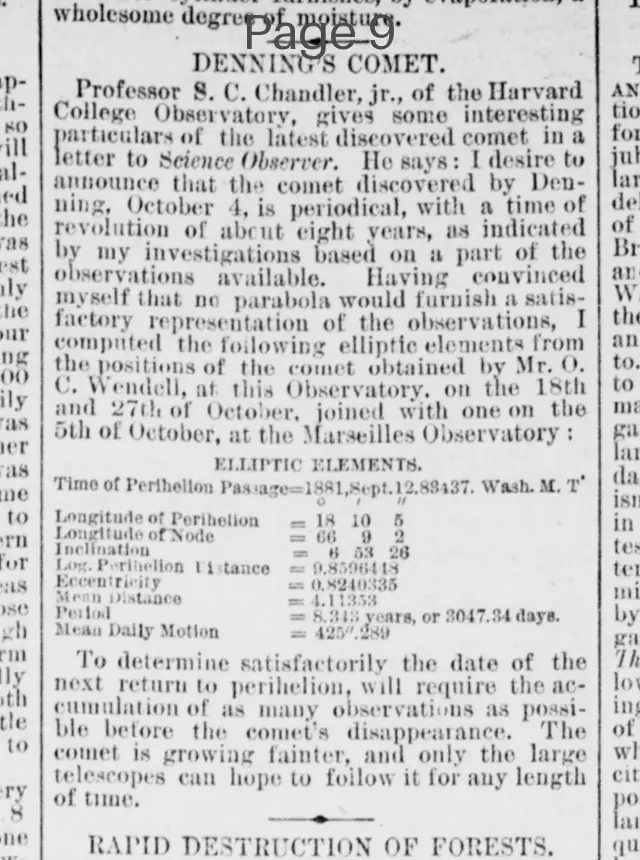
Professor S. C. Chandler Jr. of the Harvard College Observatory gives some interesting particulars of the latest discovered comet in a letter to Science Observer. He says: I desire to announce that the comet discovered by Denning, October 4, is periodical, with a time of revolution of about eight years, as indicated by my investigations based on a part of the observations available. Having convinced myself that no parabola would furnish a satisfactory representation of the observations, I computed the following elliptic elements from the positions of the comet obtained by Mr. O. C. Wendell at this Observatory, on the 18th and 27th of October, joined with one on the 5th of October, at the Marseilles Observatory:
ELLIPTIC ELEMENTS.
Time of Perihelion Passage=1881.Sept.12.88437. Wash. M. T
Longitude of Perihelion 18 10
Longitude of Node 66 9
Inclination 6 53 26
Log. Perihelion Distance 9.8596413
Eccentricity 0.8240335
Mean Distance 4.11353
Period 8.31 years, or 3047.34 days
Mean Daily Motion 425.289
To determine satisfactorily the date of the next return to perihelion, will require the accumulation of as many observations as possible before the comet's disappearance. The comet is growing fainter, and only the large telescopes can hope to follow it for any length of time.
Professor S. C. Chandler Jr. of the Harvard College Observatory gives some interesting particulars of the latest discovered comet in a letter to Science Observer. He says: I desire to announce that the comet discovered by Denning, October 4, is periodical, with a time of revolution of about eight years, as indicated by my investigations based on a part of the observations available. Having convinced myself that no parabola would furnish a satisfactory representation of the observations, I computed the following elliptic elements from the positions of the comet obtained by Mr. O. C. Wendell at this Observatory, on the 18th and 27th of October, joined with one on the 5th of October, at the Marseilles Observatory:
ELLIPTIC ELEMENTS.
Time of Perihelion Passage=1881.Sept.12.88437. Wash. M. T
Longitude of Perihelion 18 10
Longitude of Node 66 9
Inclination 6 53 26
Log. Perihelion Distance 9.8596413
Eccentricity 0.8240335
Mean Distance 4.11353
Period 8.31 years, or 3047.34 days
Mean Daily Motion 425.289
To determine satisfactorily the date of the next return to perihelion, will require the accumulation of as many observations as possible before the comet's disappearance. The comet is growing fainter, and only the large telescopes can hope to follow it for any length of time.
What sub-type of article is it?
Curiosity
Extraordinary Event
Historical Event
What themes does it cover?
Exploration
What keywords are associated?
Denning's Comet
Periodic Comet
Elliptic Elements
Harvard Observatory
Comet Discovery
Astronomical Observations
What entities or persons were involved?
Professor S. C. Chandler Jr.
Denning
Mr. O. C. Wendell
Where did it happen?
Harvard College Observatory, Marseilles Observatory
Story Details
Key Persons
Professor S. C. Chandler Jr.
Denning
Mr. O. C. Wendell
Location
Harvard College Observatory, Marseilles Observatory
Event Date
1881
Story Details
Professor Chandler announces Denning's comet, discovered October 4, is periodic with an 8-year revolution, providing elliptic elements based on observations.