Thank you for visiting SNEWPapers!
Sign up free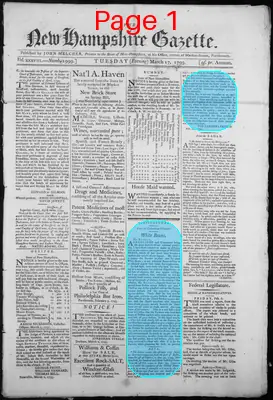
Editorial
March 17, 1795
The New Hampshire Gazette
Portsmouth, Rockingham County, New Hampshire
What is this article about?
Letter from 'The Farmer's Friend' in the Columbian Centinel urges farmers to plant only clear white beans for export, arguing that colored beans reduce value by 20% compared to Dutch white beans, leading to annual losses of thousands of dollars for American producers.
Clipping
OCR Quality
95%
Excellent
Full Text
AGRICULTURAL.
From the Columbian Centinel.
White Beans.
Mr. RUSSELL,
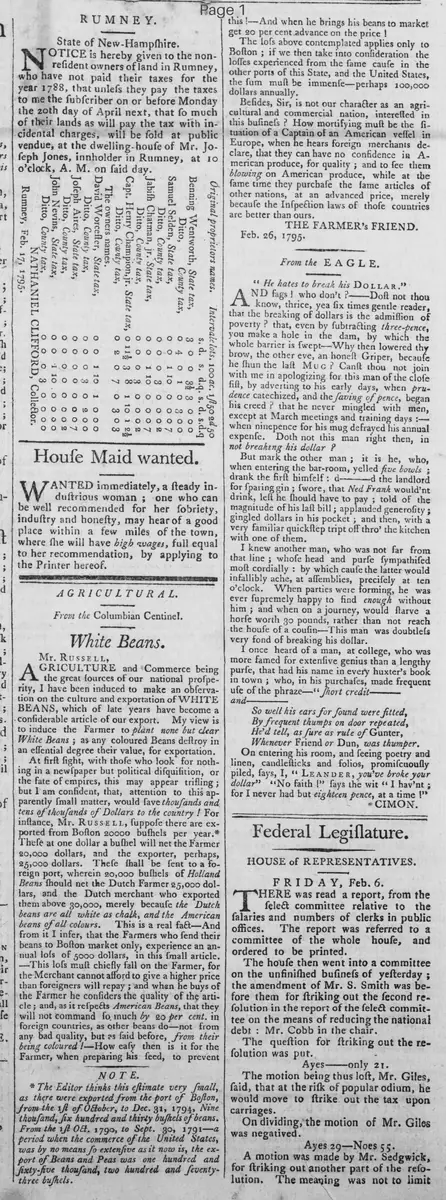
AGRICULTURE and Commerce being the great sources of our national prosperity, I have been induced to make an observation on the culture and exportation of WHITE BEANS, which of late years have become a considerable article of our export. My view is to induce the Farmer to plant none but clear White Beans; as any coloured Beans destroy in an essential degree their value, for exportation. At first sight, with those who look for nothing in a newspaper but political disquisition, or the fate of empires, this may appear trifling; but I am confident, that, attention to this apparently small matter, would save thousands and tens of thousands of Dollars to the country! For instance. Mr. RUSSELL, suppose there are exported from Boston 20,000 bushels per year.* These at one dollar a bushel will net the Farmer 20,000 dollars, and the exporter, perhaps, 25,000 dollars. These shall be sent to a foreign port, wherein 20,000 bushels of Holland Beans should net the Dutch Farmer 25,000 dollars, and the Dutch merchant who exported them above 30,000, merely because the Dutch beans are all white as chalk, and the American beans of all colours. This is a real fact--And from it I infer, that the Farmers who send their beans to Boston market only, experience an annual loss of 5,000 dollars, in this small article. This loss must chiefly fall on the Farmer, for the Merchant cannot afford to give a higher price than foreigners will repay; and when he buys of the Farmer he considers the quality of the article: and, as it respects American Beans, that they will not command so much by 20 per cent. in foreign countries, as other beans do--not from any bad quality, but as said before, from their being coloured!--How easy then is it for the Farmer, when preparing his seed, to prevent this!--And when he brings his beans to market get 20 per cent. advance on the price! The loss above contemplated applies only to Boston: if we then take into consideration the losses experienced from the same cause in the other ports of this State, and the United States, the sum must be immense--perhaps 100,000 dollars annually. Besides, Sir, is not our character as an agricultural and commercial nation, interested in this business? How mortifying must be the situation of a Captain of an American vessel in Europe, when he hears foreign merchants declare, that they can have no confidence in American produce, for quality; and to see them blowing on American produce, while at the same time they purchase the same articles of other nations, at an advanced price, merely because the Inspection laws of those countries are better than ours.
THE FARMER's FRIEND.
Feb. 26, 1795.
NOTE.
* The Editor thinks this estimate very small, as there were exported from the port of Boston, from the 1st of October, to Dec. 31, 1794, Nine thousand, six hundred and thirty bushels of beans. From the 1st Oct. 1790, to Sept. 30, 1791--a period when the commerce of the United States, was by no means so extensive as it now is, the export of Beans and Peas was one hundred and sixty-five thousand, two hundred and seventy-three bushels.
From the Columbian Centinel.
White Beans.
Mr. RUSSELL,
AGRICULTURE and Commerce being the great sources of our national prosperity, I have been induced to make an observation on the culture and exportation of WHITE BEANS, which of late years have become a considerable article of our export. My view is to induce the Farmer to plant none but clear White Beans; as any coloured Beans destroy in an essential degree their value, for exportation. At first sight, with those who look for nothing in a newspaper but political disquisition, or the fate of empires, this may appear trifling; but I am confident, that, attention to this apparently small matter, would save thousands and tens of thousands of Dollars to the country! For instance. Mr. RUSSELL, suppose there are exported from Boston 20,000 bushels per year.* These at one dollar a bushel will net the Farmer 20,000 dollars, and the exporter, perhaps, 25,000 dollars. These shall be sent to a foreign port, wherein 20,000 bushels of Holland Beans should net the Dutch Farmer 25,000 dollars, and the Dutch merchant who exported them above 30,000, merely because the Dutch beans are all white as chalk, and the American beans of all colours. This is a real fact--And from it I infer, that the Farmers who send their beans to Boston market only, experience an annual loss of 5,000 dollars, in this small article. This loss must chiefly fall on the Farmer, for the Merchant cannot afford to give a higher price than foreigners will repay; and when he buys of the Farmer he considers the quality of the article: and, as it respects American Beans, that they will not command so much by 20 per cent. in foreign countries, as other beans do--not from any bad quality, but as said before, from their being coloured!--How easy then is it for the Farmer, when preparing his seed, to prevent this!--And when he brings his beans to market get 20 per cent. advance on the price! The loss above contemplated applies only to Boston: if we then take into consideration the losses experienced from the same cause in the other ports of this State, and the United States, the sum must be immense--perhaps 100,000 dollars annually. Besides, Sir, is not our character as an agricultural and commercial nation, interested in this business? How mortifying must be the situation of a Captain of an American vessel in Europe, when he hears foreign merchants declare, that they can have no confidence in American produce, for quality; and to see them blowing on American produce, while at the same time they purchase the same articles of other nations, at an advanced price, merely because the Inspection laws of those countries are better than ours.
THE FARMER's FRIEND.
Feb. 26, 1795.
NOTE.
* The Editor thinks this estimate very small, as there were exported from the port of Boston, from the 1st of October, to Dec. 31, 1794, Nine thousand, six hundred and thirty bushels of beans. From the 1st Oct. 1790, to Sept. 30, 1791--a period when the commerce of the United States, was by no means so extensive as it now is, the export of Beans and Peas was one hundred and sixty-five thousand, two hundred and seventy-three bushels.
What sub-type of article is it?
Agriculture
Trade Or Commerce
Economic Policy
What keywords are associated?
White Beans
Agriculture
Export
Farmers
Commerce
Bean Quality
Dutch Beans
American Produce
What entities or persons were involved?
Mr. Russell
The Farmer's Friend
Columbian Centinel
Editorial Details
Primary Topic
Cultivation And Export Of Clear White Beans
Stance / Tone
Advisory To Farmers On Improving Bean Quality For Export Profits
Key Figures
Mr. Russell
The Farmer's Friend
Columbian Centinel
Key Arguments
Agriculture And Commerce Are Key To National Prosperity
Plant Only Clear White Beans To Avoid Loss In Export Value
Colored Beans Reduce Value By 20% In Foreign Markets Compared To Dutch White Beans
Annual Export From Boston Estimated At 20,000 Bushels, Causing $5,000 Loss
Total U.S. Losses From Poor Bean Quality May Reach $100,000 Annually
Better Quality Improves National Reputation For American Produce
Foreign Inspection Laws Affect Confidence In U.S. Exports