Thank you for visiting SNEWPapers!
Sign up free
Thomas's Massachusetts Spy, Or, Worcester Gazette
Worcester, Worcester County, Massachusetts
What is this article about?
London papers report Neapolitan victory over Austrians at Rieti on March 9, 1821, costing Gen. Pepe's life. King of Sardinia abdicates due to troop mutinies proclaiming Spanish Constitution; Prince Carignan appointed Regent. Revolutionary spirit spreads across Italy, with uprisings in Tuscany, Genoa, and threats to Pope in Rome; Neapolitans face Austrian invasion but show high morale.
Clipping
OCR Quality
Full Text
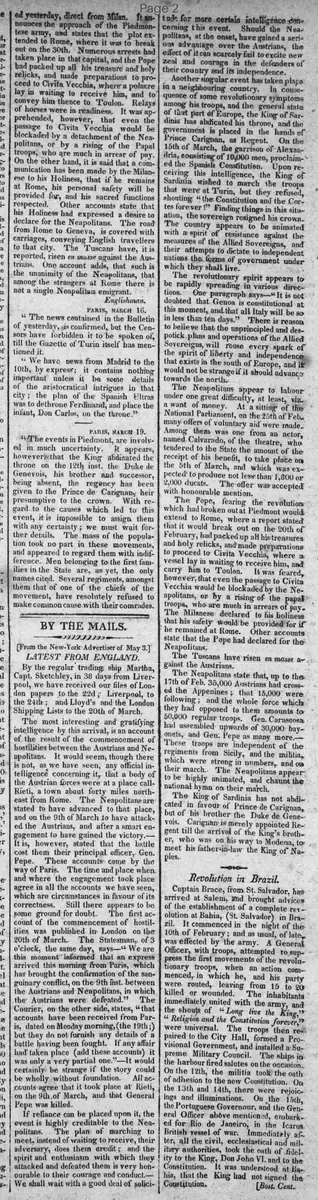
LATEST FROM ENGLAND.
By the regular trading ship Martha, Capt. Sketchley, in 38 days from Liverpool, we have received our files of London papers to the 22d; Liverpool, to the 24th; and Lloyd's and the London Shipping Lists to the 20th of March.
The most interesting and gratifying intelligence by this arrival, is an account of the result of the commencement of hostilities between the Austrians and Neapolitans. It would seem; though there is not, as we have seen, any official intelligence concerning it, that a body of the Austrian forces were at a place called Rieti, a town about forty miles north-east from Rome. The Neapolitans are stated to have advanced to that place, and on the 9th of March to have attacked the Austrians, and after a smart engagement to have gained the victory. It is, however, stated that the battle cost them their principal officer, Gen. Pepe. These accounts come by the way of Paris. The time and place when and where the engagement took place agree in all the accounts we have seen, which are circumstances in favour of its correctness. Still there appears to be some ground for doubt. The first account of the commencement of hostilities was published in London on the 20th of March. The Statesman, of 3 o'clock, the same day, says—" We are this moment informed that an express arrived this morning from Paris, which has brought the confirmation of the sanguinary conflict, on the 9th inst. between the Austrians and Neapolitans, in which the Austrians were defeated." The Courier, on the other side, states, "that accounts have been received from Paris, dated on Monday morning,(the 19th; ) but they do not furnish any details of a battle having been fought. If any affair had taken place (add these accounts) it was only a very partial one."—It would certainly be strange if the story could be wholly without foundation. All accounts agree that it took place at Rieti, on the 9th. of March, and that General Pepe was killed.
If reliance can be placed upon it, the event is highly creditable to the Neapolitans. The plan of marching to meet, instead of waiting to receive, their adversary, does them credit; and the spirit and enthusiasm with which they attacked and defeated them is very honourable to their courage and conduct. We shall wait with a good deal of solicitude for more certain intelligence concerning this event. Should the Neapolitans, at the onset, have gained a serious advantage over the Austrians, the effect of it can scarcely fail to excite new zeal and courage in the defenders of their country and its independence.
Another singular event has taken place in a neighbouring country. In consequence of some revolutionary symptoms among his troops, and the general state of that part of Europe, the King of Sardinia has abdicated his throne, and the government is placed in the hands of Prince Carignan, as Regent. On the 15th of March, the garrison of Alexandria, consisting of 10,000 men, proclaimed the Spanish Constitution. Upon receiving this intelligence, the King of Sardinia wished to march the troops that were at Turin, but they refused, shouting "the Constitution and the Cortes forever!" Finding things in this situation, the sovereign resigned his crown. The country appears to be animated with a spirit of resistance against the measures of the Allied Sovereigns, and their attempts to dictate to independent nations the forms of government under which they shall live.
The revolutionary spirit appears to be rapidly spreading in various directions. One paragraph says—"It is not doubted that Genoa is constitutional at this moment, and that all Italy will be so in less than ten days." There is reason to believe that the unprincipled and despotic plans and operations of the Allied Sovereigns, will rouse every spark of the spirit of liberty and independence that exists in the south of Europe, and it would not be strange if it should advance towards the north.
The Neapolitans appear to labour under one great difficulty, at least, viz. a want of money. At a sitting of the National Parliament, on the 25th of Feb. many offers of voluntary aid were made. Among them was one from an actor, named Calvarado, of the theatre, who tendered to the State the amount of the receipt of his benefit, to take place on the 5th of March, and which was expected to produce not less than 1,800 or 2,000 ducats. The offer was accepted with honourable mention.
The Pope, fearing the revolution which had broken out at Piedmont would extend to Rome, where a report stated that it would break out on the 20th of February, had packed up all his treasures and holy relicks, and made preparations to proceed to Civita Vecchia, where a vessel lay in waiting to receive him, and carry him to Toulon. It was feared, however, that even the passage to Civita Vecchia would be blockaded by the Neapolitans, or by a rising of the papal troops, who are much in arrears of pay. The Milanese declared to his holiness that his safety would be provided for if he remained at Rome. Other accounts state that the Pope had declared for the Neapolitans.
The Tuscans have risen en masse against the Austrians.
The Neapolitans state that, up to the 17th of Feb. 35,000 Austrians had crossed the Appenines; that 15,000 were following; and the whole force which they had opposed to them amounts to 50,000 regular troops. Gen. Carascosa had assembled upwards of 30,000 bayonets, and Gen. Pepe as many more. These troops are independent of the regiments from Sicily, and the militia, which were strong in numbers, and on their march. The Neapolitans appear to be highly animated, and chaunt the national hymn on their march.
The King of Sardinia has not abdicated in favour of Prince de Carignan but of his brother the Duke de Genevois. Carignan is merely appointed Regent till the arrival of the King's brother, who was on his way to Modena, to meet his father-in-law the King of Naples.
What sub-type of article is it?
What keywords are associated?
What entities or persons were involved?
Where did it happen?
Foreign News Details
Primary Location
Italy
Event Date
March 1821
Key Persons
Outcome
neapolitans defeated austrians at rieti on march 9, but gen. pepe killed; king of sardinia abdicated throne amid troop proclamations of spanish constitution; revolutionary spirit spreads to genoa, tuscany; pope prepares to flee but assured safety; neapolitans face 50,000 austrians with 50,000 regulars plus militia.
Event Details
Accounts from Paris via London report Neapolitans attacking and defeating Austrians at Rieti on March 9, though unconfirmed officially; Gen. Pepe killed. King of Sardinia abdicates after Alexandria garrison and Turin troops proclaim Spanish Constitution on March 15; Prince Carignan Regent until Duke de Genevois arrives. Revolution spreads, with Genoa constitutional and all Italy expected soon; Tuscans rise against Austrians. Neapolitans short on funds but receive voluntary aids like actor Calvarado's benefit. Pope packs treasures fearing spread to Rome, plans flight to Toulon, but Milanese assure safety; other reports say he supports Neapolitans. Up to Feb 17, 35,000 Austrians crossed Appenines, 15,000 following; Neapolitans muster 50,000 regulars under Gens. Carascosa and Pepe, plus Sicily regiments and militia, marching with high spirits chanting national hymn.