Thank you for visiting SNEWPapers!
Sign up free
Daily National Intelligencer
Washington, District Of Columbia
What is this article about?
Judge Luther Martin's charge to the Baltimore County Grand Jury laments moral decline causing the War of 1812 as divine punishment, urging virtue. The jury replies, defending American integrity, rejecting perpetual allegiance doctrine, and affirming justice in the war against Britain.
Merged-components note: This is a continuation of the same article across pages 2 and 3, as the text flows directly from the end of the page 2 component to the start of the page 3 component, maintaining the same topic and narrative.
Clippings
1 of 2
OCR Quality
Full Text
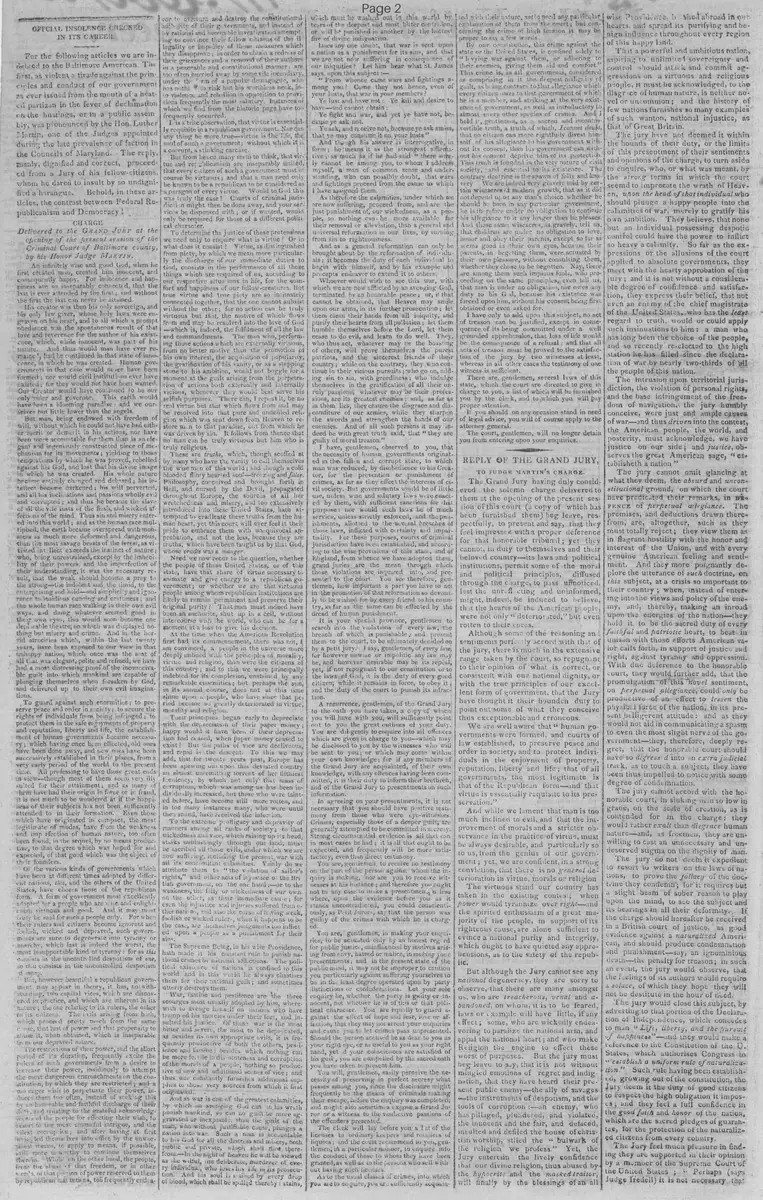
IN ITS CAREER.
For the following articles we are indebted to the Baltimore American. The first, as violent a tirade against the principles and conduct of our government as ever issued from the mouth of a heated partizan in the fever of declamation on the hustings, or in a public assembly, was pronounced by the Hon. Luther Martin, one of the Judges appointed during the late prevalence of faction in the Councils of Maryland. The reply, manly, dignified and correct, proceeded from a Jury of his fellow-citizens, whom he dared to insult by so undignified a harangue. Behold, in these articles, the contrast between Federal Republicanism and Democracy!
CHARGE
Delivered to the Grand Jury at the opening of the present session of the Criminal Court of Baltimore county, by his Honor Judge MARTIN.
An infinitely wise and good God, when he first created man, created him innocent, and consequently happy. For innocence and happiness are so inseparably connected, that the last is ever attended by the first: and without the first the last can never be attained. His creator was then his only sovereign, and his only law giver, whose holy laws were engraven on his heart, and to all which a prompt obedience was the spontaneous result of that love and reverence for the author of his existence, which, while innocent, was part of his nature. And thus would man have ever remained, had he continued in that state of innocence, in which he was created. Human governments in that case would never have been formed; nor would civil institutions ever have existed: for they would not have been wanted. Our Creator would have continued to be our only ruler and governor. This earth would have been a blooming paradise: and ourselves but little lower than the angels.
But man, being endowed with freedom of will, without which he could not have had either merit or demerit in his actions, nor have been more accountable for them than is an elegant and ingeniously constructed piece of mechanism for its movements; yielding to those temptations by which he was proved, rebelled against his God, and lost that his divine image in which he was created. His whole nature became entirely changed and debased; his intellect became darkened: his will perverted, and all his inclinations and passions wholly evil and corrupted; and thus he became the slave of all the vile lusts of the flesh, and wicked affections of the mind. Thus sin and misery entered into this world; and as the human race multiplied, the earth became overspread with monsters as much more deformed and dangerous than the most savage beasts of the forest, as vitiated intellect exceeds the instinct of nature; who, being unrestrained, except by the imbecility of their powers, and the imperfection of their understanding, it was the necessary result, that the weak should become a prey to the strong--the indolent and the timid, to the enterprising and bold--and simplicity and ignorance to insidious cunning and craftiness: and the whole human race walking in their own evil ways, and doing whatever seemed good in their own eyes, this would soon become one deplorable theatre, on which was displayed nothing but misery and crime. And in the horrid atrocities which, within the last twenty years, have been exposed to our view in that unhappy nation, which once was the seat of all that was elegant, polite and refined, we have had a most distressing proof of the inconceivable guilt into which mankind are capable of plunging themselves when forsaken by God, and delivered up to their own evil imaginations.
To guard against such enormities; to preserve peace and order in society; to secure the rights of individuals from being infringed; to protect them in the safe enjoyments of property and reputation, liberty and life, the establishment of human governments became necessary; which having once been effected, old ones have been done away, and new ones have been successively established in their places, from a very early period of the world to the present time. All professing to have those great ends in view--though most of them seem very illy suited for their attainment; and as many of them have had their origin in force or in fraud, it is not much to be wondered at if the happiness of their subjects has not been sufficiently attended to in their formation. Even those which have originated in compact, the most legitimate of modes, have from the weakness and imperfection of human nature, too often been found, in the sequel, by no means productive, to that degree which was hoped for and expected, of that good which was the object of their founders.
Of the various kinds of governments which have been at different times adopted by different nations, this, and the others of the United States, have chosen those of the republican form. A form of government most excellently adapted for a people who are wise and enlightened, virtuous and good. And it may most truly be said for such a people only. For when their rulers and citizens become ignorant and foolish, wicked and depraved, such governments are sure to degenerate into tyranny or anarchy, which last is indeed the worst, the most insupportable kind of tyranny: for as this consists in the uncontrolled despotism of one, so that consists in the uncontrolled despotism of many.
But, however beautiful a republican government may appear in theory, it has, notwithstanding, two capital vices, which are discovered in practice, and which are inherent in its nature; the one relating to its rulers, the other to its citizens. The evils arising from both, which proceed pretty much from the same cause, that lust of power and that propensity to abuse it, when obtained, which is inseparable from our depraved nature.
The restrictions of their power, and the short period of its duration, frequently excite the rulers of such governments from a desire to increase their power, insidiously to attempt the most dangerous encroachments on the constitution, by which they are restricted; and a more eager wish to perpetuate their power, induces them too often, instead of seeking this by an honorable and faithful discharge of their duty, and trusting to the grateful acknowledgments of the people for effecting their wish, to resort to the most shameful intrigue, and the vilest corruption; and after having at first wangled themselves into office by the unworthiest means, to apply to means, if possible, still more unworthy to continue themselves therein. While on the other hand, the people, from the abuse of that freedom, or in other words, of that portion of power reserved to them by republican institutions, too frequently endeavor to overturn and destroy the constitutional authority of their governments, and instead of by rational and honorable investigation attempting to convince their fellow citizens of the illegality or impolicy of those measures which they disapprove: in order to obtain a redress of their grievances and a removal of their authors in a peaceable and constitutional manner; are too often hurried away by some vile incendiary, under the form of a popular demagogue, who has nothing to risk but his worthless neck, into violence and rebellion in opposition to provisions frequently the most salutary. Instances of which we find from the historic page have too frequently occurred.
It is a trite observation, that virtue is essentially requisite in a republican government. Nor can any thing be more true--virtue is the life, the soul of such a government; without which it is a corrupt, a stinking carcase.
But from hence many seem to think, that virtue and republicanism are inseparably united, that every citizen of such a government must of course be virtuous: and that a man need only be known to be a republican to be considered as a paragon of every virtue. Would to God this was truly the case! Courts of criminal jurisdiction might then be done away, and your services be dispensed with; or if wanted, would only be required for those of a different political character.
To determine the justice of these pretensions we need only to enquire what is virtue? Or in what does it consist? Virtue, as distinguished from piety, by which we mean more particularly the discharge of our immediate duties to God, consists in the performance of all those things which are required of us, according to our respective situations in life, for the comfort and happiness of our fellow-creatures. But true virtue and true piety are so intimately connected together, that the one cannot subsist without the other; for no action can be truly virtuous but that, the motive of which flows from and may be resolved into the love of God--which is, indeed, the fulfilment of all the law and commandments. The man who, performing those actions which are externally virtuous, from no better motive than the promotion of his own interest, the acquisition of popularity, the gratification of his vanity, or as a stepping stone to his ambition, would not boggle for a moment at the guilt arising from the perpetration of actions both externally and internally vicious, whenever they would best serve his selfish purposes. There can, I repeat it, be no real virtue but that which flows from and may be resolved into that pure and undefiled religion which was sent down from Heaven to restore man to that paradise, out from which he was driven by sin. It follows from thence that no man can be truly virtuous but him who is truly religious.
These are truths, which, though scoffed at by many who have the vanity to call themselves the wise men of this world; and though a cold blooded flinty hearted soul-freezing and false Philosophy, conceived and brought forth in Hell, and nursed by the Devil, propagated throughout Europe, the sources of all her wretchedness and misery, and too extensively introduced into these United States, hath attempted to eradicate these truths from the human heart, yet this court will ever feel it their pride to embrace them with unequivocal approbation, and not the less, because they are truths, which have been taught us by that God, whose cradle was a manger.
Need we now recur to the question, whether the people of these United States, or of this state, have that share of virtue necessary to animate and give energy to a republican government; or whether we are that virtuous people among whom republican institutions are likely to remain permanent and preserve their original purity? That man must indeed have been an anchorite, shut up in a cell, without intercourse with the world, who can be for a moment at a loss to give this decision.
At the time when the American Revolution first had its commencement, there was not, I am convinced, a people in the universe more deeply imbued with the principles of morality virtue and religion, than were the citizens of this country; and to this we were principally indebted for its completion, unstained by any remarkable enormities; but perhaps the sun, in its annual course, does not at this time shine upon a people, who have since that period become so greatly deteriorated in virtue morality and religion.
Their principles began early to depreciate with the depreciation of their paper money; happy would it have been if their depreciation had ceased, when paper money ceased to exist! But the paths of vice are declivious, and rapid is the descent. To this we may add, that for twenty years past, Europe has been spewing out upon this devoted country an almost unremitting torrent of her filthiest feculency, by which not only that mass of corruption, which was among us has been individually increased, but those who were tainted before, have become still more rotten, and in too many instances many, who were until then sound, have received the infection.
To the extreme profligacy and depravity of manners among all ranks of society; to that wickedness and vice, which raising up its head stalks unblushingly through our land, must be ascribed all those evils, under which we are now suffering, including the present war with all its concomitant calamities. Vainly do we attribute them to "the violation of sailor's rights," and other acts of injustice of the British government, on the one hand; or to the weakness, the folly or wickedness of our own, on the other, as their immediate cause; for even the injustice and injuries suffered from other nations, and also the curse of having weak, foolish or wicked rulers, when it happens to be the case, are themselves judgments too inflicted upon a people as a punishment for their sins.
The Supreme Being, in his wise Providence, hath made it his constant rule to punish national crimes by national afflictions. The political existence of nations is confined to this world, and in this world he always chastises them for their national guilt; and sometimes utterly destroys them.
War, famine and pestilence are the three scourges most usually adopted by him, wherewith to avenge himself on nations who have trampled his mercies under their feet, and insulted his justice. Of these war is the most bitter and severe, the most to be deprecated, as besides its own appropriate evils, it is frequently productive of both the others, pestilence and famine; besides which nothing can be more fertile in dissoluteness and corruption of the morals of a people, nothing so productive of new and additional scenes of vice; and thus war constantly furnishes additional supplies to those very sources from which it first originated.
And as war is one of the greatest calamities, by which an avenging God can in his wrath punish mankind, so can no guilt be more aggravated or inexpiable, than the guilt of the man, who without justifiable cause, plunges a nation into war. Such a man is accountable to his God for all the distress and misery, both public and private, which shall flow therefrom.--In the sight of heaven he will be viewed as the wilful, the deliberate, murderer of every individual, who loses his life in its prosecution. And his soul is stained by every drop of blood, which shall be spilled thereby: stains, which must be washed out in this world by tears of the deepest and most bitter contrition, or will be punished in another by the hottest fire of divine indignation.
Does any one doubt, that war is sent upon a nation as a punishment for its sins, and that we are not now suffering in consequence of our iniquities? Let him hear what St. James says upon this subject:--
"From whence came wars and fightings among you? Come they not hence, even of your lusts, that war in your members?
Ye lust and have not: Ye kill and desire to have--and cannot obtain:
Ye fight and war, and yet ye have not, because ye ask not.
Ye ask, and receive not, because ye ask amiss, that ye may consume it on your lusts."
And though his answer is interrogative, in form: he means it as the strongest affirmative; as much as if he had said "there surely cannot be among you, to whom I address myself, a man of common sense and understanding, who can possibly doubt, that wars and fightings proceed from the cause to which I have assigned them."
As therefore the calamities, under which we are now suffering, proceed from, and are the just punishment of, our wickedness, as a people, so nothing can be more available for their removal or alleviation, than a general and universal reformation in our lives, by turning from sin to righteousness.
And as a general reformation can only be brought about by the reformation of individuals; it becomes the duty of each individual to begin with himself, and by his example and precepts endeavor to extend it to others.
Whoever would wish to see this war, with which we are now afflicted by an avenging God, terminated by an honorable peace: or, if that cannot be obtained, that Heaven may smile upon our arms, in its further prosecution; let them cleanse their hands from all iniquity, and purify their hearts from all pollution; let them humble themselves before the Lord, let them cease to do evil, and learn to do well. They, who thus act, whatever may be the boasting of others, will prove themselves the purest patriots, and the sincerest friends of their country; while on the contrary, they who continue in their vicious pursuits; who go on, adding sin to sin, with greediness; who indulge themselves in the gratification of all their unruly passions, whatever may be their professions, are its greatest enemies; and, as far as in them lies, they ensure the disgrace and discomfiture of our armies, while they sharpen the swords and strengthen the hands of our enemies. And of all such persons it may indeed be with great truth said, that "they are guilty of moral treason."
I have, gentlemen, observed to you, that the necessity of human governments originated in the fallen and corrupt state, to which man was reduced, by disobedience to his Creator, for the prevention or punishment of crimes, as far as they affect the interests of civil society. But governments would be of little use, unless wise and salutary laws were enacted by them, with sufficient sanctions for that purpose: nor would such laws be of much service, unless strictly enforced, and the punishments, allotted to the several breaches of those laws, inflicted with certainty and impartiality. For these purposes, courts of criminal jurisdiction have been established, and according to the wise provisions of this state, and of England, from whence we have adopted them, grand juries are the mean through which those violations are inquired into, and presented to the court. You see therefore, gentlemen, how important a part you have to act in the promotion of that reformation so devoutly to be wished for by every friend to his country, as far as the same can be effected by the dread of human punishment.
It is your special province, gentlemen to search into the violations of every law, the breach of which is punishable; and present them to the court, to be ultimately decided on by a petit jury. I say, gentlemen, of every law, for however unwise or impolitic any law may be, and however desirable may be its repeal, yet, if not repugnant to our constitution or to the laws of God, it is the duty of every good citizen; while it remains in force, to obey it; and the duty of the court to punish its infraction.
A recurrence, gentlemen, of the Grand Jury to the oath you have taken, a copy of which you will have with you, will sufficiently point out to you the great outlines of your duty. You are diligently to enquire into all offences which are given in charge to you--which may be disclosed to you by the witnesses who will be sent to you; or which may come within your own knowledge; for if any members of the Grand Jury are acquainted, of their own knowledge, with any offences having been committed, it is their duty to inform their brethren, and of the Grand Jury to presentments on such information.
In agreeing on your presentments, it is not necessary that you should have positive testimony from those who were eye-witnesses. Crimes, especially those of a deeper guilt, are generally attempted to be committed in secresy. Strong circumstantial evidence is all that can in most cases be had; it is all that ought to be expected, and frequently will be more satisfactory, even than direct testimony.
You are, gentlemen, to receive no testimony on the part of the person against whom the inquiry is making, nor are you to receive witnesses at his instance; and therefore you ought not in any case to make a presentment, unless where, upon the evidence before you as it stands uncontradicted, you could conscientiously, as Petit Jurors, say that the person was guilty of the crimes with which he is charged.
You are, gentlemen, in making your enquiries, to be actuated only by an honest regard for public justice, uninfluenced by motives arising from envy, hatred or malice, in making your presentments; and in the present state of the public mind, it may not be improper to caution you particularly against suffering yourselves to be in the least degree operated upon by party distinctions or confederations. Let your sole enquiry be, whether the party is guilty or innocent, not whether he is of this or that political character. You are equally to guard against the effect of hope and fear, love or affection, that they may not arrest your enquiries and cause you to let crimes pass unpresented. Should the person accused be as dear to you as your right eye, or as useful to you as your right hand, yet if your consciences are satisfied of his guilt, you are compelled by the sacred oath you have taken to present him.
You will, gentlemen, easily perceive the necessity of preserving in perfect secresy what passes among you, since the disclosure might frequently be the means of criminals making their escape, before the enquiry was completed; and might also sometimes expose a Grand Juror or a witness to the vindictive passions of the offenders presented.
The clerk will lay before you a list of the licenses to ordinary keepers and retailers of liquors; and the court recommend to you, gentlemen, in a particular manner, to enquire into the conduct of those to whom they have been granted, as well as to the persons who sell without having such licenses.
As to the usual classes of crimes, into which you are to enquire, you are sufficiently acquainted with their nature, not to need any particular explanation of them from the court; but concerning the crime of high treason it may be proper to say a few words.
By our constitution, this crime against the state or the United States, is confined solely to "levying war against them, or adhering to their enemies, giving them aid and comfort."
This crime is, in all governments, considered as comprising in it the deepest malignity of guilt, as being contrary to that allegiance which every citizen owes to that government of which he is a member, and striking at the very existence of government, as well as introductory to almost every other species of crimes. And I hold it, gentlemen, as a sacred and incontrovertible truth, a truth of which I cannot doubt, that no citizen can more rightfully divest himself of his allegiance to his government without its consent, than his government can without his consent deprive him of its protection.
This truth is founded in the very nature of civil society, and essential to its existence. The contrary doctrine is the spawn of folly and knavery. We are indeed very gravely told by certain wiseacres of modern growth, that as it did not depend upon any man's choice whether he should be born in any particular government, he is therefore under no obligation to continue his allegiance to it any longer than he pleases. And these same wiseacres, as gravely, tell us, that children are under no obligation to love, honor and obey their parents, except so far as seems good in their own eyes, because their parents, in begetting them, were actuated by their own pleasure, without consulting them, whether they chose to be begotten. Nay, there are among them such impious fools, who proceeding on the same principles, even tell us, that man is under no obligation, nor owes any duty to his God, because his existence was forced upon him, without his consent being first obtained or even asked for.
I have only to add upon this subject, no act of treason can be justified, except in consequence of its being committed under a well grounded apprehension, that loss of life would be the consequence of a refusal: and that all acts of treason must be proved to the satisfaction of the jury by two witnesses at least, whereas in all other cases the testimony of one witness is sufficient.
There are, gentlemen, several laws of this state, which the court are directed to give in charge to you, a list of which will be furnished you by the clerk, and to which you will pay proper attention.
If you should on any occasion stand in need of legal advice, you will of course apply to the attorney general.
The court, gentlemen, will no longer detain you from entering upon your enquiries.
REPLY OF THE GRAND JURY,
TO JUDGE MARTIN'S CHARGE.
The Grand Jury having duly considered the solemn charge delivered to them at the opening of the present session of this court (a copy of which has been furnished them) beg leave, respectfully, to present and say, that they feel impressed with a proper deference for that honorable tribunal; yet they cannot, in duty to themselves and their beloved country--its laws and political institutions, permit some of the moral and political principles, diffused through the charge, to pass unnoticed, lest the unreflecting and uninformed, might, indeed, be induced to believe, that the hearts of the American people were not only "deteriorated," but even rotten to their cores.
Although some of the reasoning and sentiments perfectly accord with that of the jury, there is much in the extensive range taken by the court, so repugnant to their opinion of what is correct, or consistent with our national dignity, or with the true principles of our excellent form of government, that the Jury have thought it their bounden duty to point out some of what they conceive thus exceptionable and erroneous.
We are well aware that "human governments were formed, and courts of law established, to preserve peace and order in society, and to protect individuals in the enjoyment of property, reputation, liberty and life; that of all governments, the most legitimate is that of the Republican form--and that virtue is essentially requisite to its preservation."
And while we lament that man is too much inclined to evil, and that the improvement of morals and a stricter observance in the practice of virtue, must be always desirable, and particularly so to us, from the genius of our government; yet, we are confident, in a strong conviction, that there is no general deterioration in virtue, morals or religion.
The virtuous stand our country has taken in the existing contest; when power would tyrannize over right--and the spirited enthusiasm of a great majority of the people, in support of its righteous cause, are alone sufficient to evince a national purity and integrity, which ought to have quieted any apprehensions, as to the safety of the republic.
But although the Jury cannot see any national degeneracy, they are sorry to observe, that there are many amongst us, who are treacherous, venal and abandoned, on whom, it is to be feared, laws or example will have little, if any effect: some, who are wickedly endeavoring to paralyze the national arm, and appal the national heart; and who make Religion the engine to effect these worst of purposes. But the jury must beg leave to say, that it is not without mingled emotions of regret and indignation, that they have heard their present public enemy--the ally of savages--the instruments of despotism, and the tools of corruption:--an enemy, who has pillaged, plundered, and violated, the innocent and the fair, and defaced, insulted and defiled the house of Christian worship, styled the "bulwark of the religion we profess." Yet, the Jury entertain the lively confidence that our divine religion, thus abused by the hypocrite and the masked traitor, will finally by the blessings of an all wise Providence, be shed abroad in our hearts, and spread its purifying and benign influence throughout every region of this happy land.
That a powerful and ambitious nation, aspiring to unlimited sovereignty and control should attack and commit aggressions on a virtuous and religious people, it must be acknowledged, to the disgrace of human nature, is neither novel or uncommon: and the history of few nations furnishes so many examples of such wanton, national injustice, as that of Great Britain.
The jury have not deemed it within the bounds of their duty, or the limits of this presentment of their sentiments and opinions of the charge, to turn aside to enquire, who, or what was meant, by the strong terms in which the court seemed to imprecate the wrath of Heaven, upon the head of that individual who should plunge a happy people into the calamities of war, merely to gratify his own ambition. They believe, that none but an individual possessing despotic control could have the power to inflict so heavy a calamity. So far as the expressions or the allusions of the court applied to absolute governments, they meet with the hearty approbation of the jury; and it is not without a considerable degree of confidence and satisfaction, they express their belief, that not even an enemy of the chief magistrate of the United States, who has the least regard to truth, would or could apply such insinuations to him: a man who has long been the choice of the people, and so recently re-elected to the high station he has filled since the declaration of war by nearly two-thirds of all the people of this nation.
The intrusion upon territorial jurisdiction, the violation of personal rights, and the base infringement of the freedom of navigation, the jury humbly conceive, were just and ample causes of war--and thus driven into the contest, the American people, the world, and posterity, must acknowledge, we have justice on our side; and justice, observes the great American sage, "establisheth a nation"
The jury cannot omit glancing at what they deem, the absurd and unconstitutional ground, on which the court have predicated their remarks, in defence of perpetual allegiance. The premises, and deductions drawn therefrom, are, altogether, such as they must totally reject; they view them as in flagrant hostility with the honor and interest of the Union, and with every genuine American feeling and sentiment. And they more poignantly deplore the utterance of such doctrine, on this subject, at a crisis so important to their country; when, instead of entering into the views and policy of the enemy, and, thereby, making an inroad upon the energies of the nation--they hold it to be the sacred duty of every faithful and patriotic heart, to beat in unison with those efforts American valor calls forth, in support of justice and right, against tyranny and oppression.
With due deference to the honorable court, they would further add, that the promulgation of this novel sentiment, on perpetual allegiance, could only be productive of an effect to lessen the physical force of the nation, in its present belligerent attitude: and as they would not aid in communicating a spasm to even the most slight nerve of the government--they, therefore, deeply regret, that the honorable court should have so digressed into an extra judicial track, as to touch a subject, they have been thus impelled to notice with some degree of condemnation.
The jury cannot accord with the honorable court, in sinking man so low in grade, on the scale of creation, as is contended for in the charge: they would rather exalt than disgrace human nature--and, as freemen, they are unwilling to cast an unnecessary and undeserved stigma, on the dignity of man.
The jury do not deem it expedient to resort to writers on the laws of nations, to prove the fallacy of the doctrine they condemn; for it requires but a slight beam of sober reason to play upon the mind, to see the subject and its bearings in all their deformity. If the charge should hereafter be received in a British court of justice, as good evidence against a naturalized American, and should produce condemnation and punishment--say, an ignominious death--the penalty for treason; in such an event, the jury would observe, that the feelings of its authors would require a solace, of which they hope they will not be destitute in the hour of need.
The jury would close this subject, by adverting to that portion of the Declaration of Independence, which concedes to man "Life, liberty, and the pursuit of happiness"--and they would make a reference to the Constitution of the U. States, which authorises Congress to "establish a uniform rule of naturalization." Such rule having been established, growing out of the constitution, the Jury deem it the duty of good citizens to respect the high obligation it imposes; and they feel a full confidence in the good faith and honor of the nation, which are the sacred pledges of guarantee, for the protection of the naturalized citizens from every country.
The Jury feel much pleasure in finding they are supported in their opinion by a member of the Supreme Court of the United States; "Perhaps (says Judge Iredell) it is not necessary that"
I (the right of expatriation) should be expressly decided on this occasion: but I will freely express my sentiments on that subject; that a man ought not to be a slave; that he should not be confined, against his will, to a particular spot, because he happened to draw his first breath upon it: that he should not be compelled to continue in a society to which he is accidentally attached, when he can better his situation elsewhere, much less when he must starve in one country, and may live comfortably in another, are positions which I hold as strongly as any man, and they are such as most nations in the world appear clearly to recognise."
For these and other reasons not herein particularly expressed, the jury beg leave respectfully to present and say, that the charge delivered to them, at the opening of the present session of the Court of Oyer and Terminer, by the Chief Judge thereof, contained sentiments and expressions of which they totally disapproved.
Richardson Stuart, Foreman
Baltimore Assessors
John Ralston,
Luke Tiernan,
Thomas C. Jenkins,
James Martin,
Wm. Pechin.
Wm. M'Quin,
David Fulton,
Michael Kiddlemosher
John Haves,
David Burke,
Wm Woods.
A. Welsh,
Wm. Raborg,
Samuel R. Smith,
Wm. J Alcock,
Wm. Hawkins,
J.b. Smith,
Peter Forney,
Samuel Briscoe.
What sub-type of article is it?
What themes does it cover?
What keywords are associated?
What entities or persons were involved?
Where did it happen?
Story Details
Key Persons
Location
Baltimore County
Event Date
Present Session Of The Criminal Court Of Baltimore County
Story Details
Judge Luther Martin delivers a charge to the Grand Jury decrying moral decay in America as cause of the War of 1812, seen as divine punishment, and instructs on duties. The Grand Jury replies, defending national virtue, justifying the war against Britain, and rejecting Martin's views on perpetual allegiance and human depravity.