Thank you for visiting SNEWPapers!
Sign up free
Literary
March 6, 1870
The Morning Star And Catholic Messenger
New Orleans, Orleans County, Louisiana
What is this article about?
Philosophical essay arguing for the existence of free will, evidenced by history, human progress, and contrast with animal instinct. Critiques rationalists for ignoring social manifestations and links free will to law, liberty, morality, and religion, warning denial leads to atheism.
Clipping
OCR Quality
98%
Excellent
Full Text
Rationalism—No. 5.
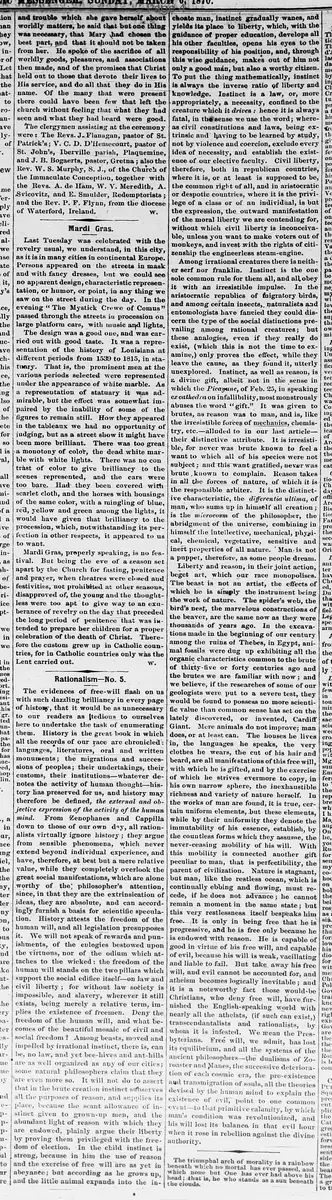
The evidences of free-will flash on us with such dazzling brilliancy in every page of history, that it would be as unnecessary to our readers as tedious to ourselves here to undertake the task of enumerating them. History is the great book in which all the records of our race are chronicled: languages, literatures, oral and written monuments; the migrations and successions of peoples; their undertakings, their customs, their institutions—whatever denotes the activity of human thought—history has preserved for us, and history may therefore be defined, the external and objective expression of the activity of the human mind.
From Xenophanes and Capella down to those of our own day, all rationalists virtually ignore history; they argue from sensible phenomena, which never extend beyond individual experience, and have, therefore, at best but a mere relative value, while they completely overlook the great social manifestations, which are alone worthy of the philosopher's attention, since, in that they are the extrinsication of ideas, they are absolute, and can accordingly furnish a basis for scientific speculation. History attests the freedom of the human will, and all legislation presupposes it. We will not speak of rewards and punishments, of the eulogies bestowed upon the virtuous, nor of the odium which attaches to the wicked: the freedom of the human will stands on the two pillars which support the social edifice itself—on law and civil liberty; for without law society is impossible, and slavery, wherever it still exists, being merely a relative term, implies the existence of freemen. Deny the freedom of the human will, and what becomes of the beautiful mosaic of civil and social freedom? Among beasts, moved and impelled by irrational instinct, there is, can be, no law, and yet bee-hives and ant-hills are as well organized as any of our cities; some natural philosophers claim that they are even more so. It will not do to assert that in the brute creation instinct subServes all the purposes of reason, and supplies its place, because the scant allowance of instinct given to grown-up men, and the abundant light of reason with which they are endowed, plainly argue their liberty by proving them privileged with the freedom of election. In the child instinct is strong, because in him the use of reason and the exercise of free will are as yet in abeyance; but according as he grows up, and the little animal expands into the inchoate man, instinct gradually wanes, and yields its place to liberty, which, with the guidance of proper education, develops all his other faculties, opens his eyes to the responsibility of his position, and, through this wise guidance, makes out of him not only a good man, but also a worthy citizen.
To put the thing mathematically, instinct is always the inverse ratio of liberty and knowledge. Instinct is a law, or, more appropriately, a necessity, confined to the creature which it drives: hence it is always fatal, in the sense we use the word; whereas civil constitutions and laws, being extrinsic and having to be learned by study, not by violence and coercion, exclude every idea of necessity, and establish the existence of our elective faculty. Civil liberty, therefore, both in republican countries, where it is, or at least is supposed to be, the common right of all, and in aristocratic or despotic countries, where it is the privilege of a class or of an individual, is but the expression, the outward manifestation of the moral liberty we are contending for, without which civil liberty is inconceivable, unless you want to make voters out of monkeys, and invest with the rights of citizenship the engineerless steam-engine.
Among irrational creatures there is neither serf nor franklin. Instinct is the one sole common rule for them all, and all obey it with an irresistible impulse. In the aristocratic republics of migratory birds, and among certain insects, naturalists and entomologists have fancied they could discern the type of the social distinctions prevailing among rational creatures; but these analogies, even if they really do exist, (which this is not the time to examine,) only proves the effect, while they leave the cause, as they found it, utterly unexplored. Instinct, as well as reason, is a divine gift, albeit not in the sense in which the Picayune, of Feb. 25, in speaking ex cathedra on infallibility, most monstrously abuses the word "gift." It was given to brutes, as reason was to man, and is, like the irresistible forces of mechanics, chemistry, etc.—alluded to in our last article—their distinctive attribute. It is irresistible, for never was brute known to feel a want to which all of his species were not subject; and this want gratified, never was brute known to complain. Reason takes in all the forces of nature, of which it is the responsible arbiter. It is the distinctive characteristic, the differentia ultima, of man, who sums up in himself all creation; is the microcosm of the philosopher, the abridgment of the universe, combining in himself the intellective, mechanical, physical, chemical, vegetative, sensitive and inert properties of all nature. Man is not a puppet, therefore, as some people dream. Liberty and reason, in their joint action, beget art, which our race monopolises. The beast is not an artist, the effects of which he is simply the instrument being the work of nature. The spider's web, the bird's nest, the marvelous constructions of the beaver, are the same now as they were thousands of years ago. In the excavations made in the beginning of our century among the ruins of Thebes, in Egypt, animal fossils were dug up exhibiting all the organic characteristics common to the brute of thirty-five or forty centuries ago and the brutes we are familiar with now; and we believe, if the researches of some of our geologists were put to a severe test, they would be found to possess no more scientific value than common sense has set on the lately discovered, or invented, Cardiff Giant. Mere animals do not improve; man does, or at least can. The houses he lives in, the languages he speaks, the very clothes he wears, the cut of his hair and beard, are all manifestations of this free will, with which he is gifted, and by the exercise of which he strives evermore to copy, in his own narrow sphere, the inexhaustible richness and variety of nature herself. In the works of man are found, it is true, certain uniform elements, but these elements, while by their uniformity they denote the immutability of his essence, establish, by the countless forms which they assume, the never-ceasing mobility of his will. With this mobility is connected another gift peculiar to man, that is perfectibility, the parent of civilization. Nature is stagnant, but man, like the restless ocean, which is continually ebbing and flowing, must recede, if he does not advance; he cannot remain a moment in the same state; but this very restlessness itself bespeaks him free. It is only in being free that he is progressive, and he is free only because he is endowed with reason. He is capable of good in virtue of his free will, and capable of evil, because his will is weak, vacillating and liable to fail. But take away his free will, and evil cannot be accounted for, and atheism becomes logically inevitable; and it is a noteworthy fact those would-be Christians, who deny free will, have furnished the English-speaking world with nearly all the atheists, (if such can exist,) transcendentalists and rationalists, by whom it is infested. We mean the Presbyterians. Free will, we admit, has lost its equilibrium, and all the systems of the ancient philosophers—the dualisms of Zoroaster and Manes, the successive deterioration of each cosmic era, the pre-existence and transmigration of souls, all the theories devised by the human mind to explain the existence of evil, point to one common event—to that primitive calamity, by which man's condition was revolutionized, and his will lost its balance in that evil hour when it rose in rebellion against the divine authority.
The triumphal arch of morality is a rainbow beneath which no mortal has ever passed, and which none but One has ever had above his head: that is, he who stands as a sun beneath the clouds.
The evidences of free-will flash on us with such dazzling brilliancy in every page of history, that it would be as unnecessary to our readers as tedious to ourselves here to undertake the task of enumerating them. History is the great book in which all the records of our race are chronicled: languages, literatures, oral and written monuments; the migrations and successions of peoples; their undertakings, their customs, their institutions—whatever denotes the activity of human thought—history has preserved for us, and history may therefore be defined, the external and objective expression of the activity of the human mind.
From Xenophanes and Capella down to those of our own day, all rationalists virtually ignore history; they argue from sensible phenomena, which never extend beyond individual experience, and have, therefore, at best but a mere relative value, while they completely overlook the great social manifestations, which are alone worthy of the philosopher's attention, since, in that they are the extrinsication of ideas, they are absolute, and can accordingly furnish a basis for scientific speculation. History attests the freedom of the human will, and all legislation presupposes it. We will not speak of rewards and punishments, of the eulogies bestowed upon the virtuous, nor of the odium which attaches to the wicked: the freedom of the human will stands on the two pillars which support the social edifice itself—on law and civil liberty; for without law society is impossible, and slavery, wherever it still exists, being merely a relative term, implies the existence of freemen. Deny the freedom of the human will, and what becomes of the beautiful mosaic of civil and social freedom? Among beasts, moved and impelled by irrational instinct, there is, can be, no law, and yet bee-hives and ant-hills are as well organized as any of our cities; some natural philosophers claim that they are even more so. It will not do to assert that in the brute creation instinct subServes all the purposes of reason, and supplies its place, because the scant allowance of instinct given to grown-up men, and the abundant light of reason with which they are endowed, plainly argue their liberty by proving them privileged with the freedom of election. In the child instinct is strong, because in him the use of reason and the exercise of free will are as yet in abeyance; but according as he grows up, and the little animal expands into the inchoate man, instinct gradually wanes, and yields its place to liberty, which, with the guidance of proper education, develops all his other faculties, opens his eyes to the responsibility of his position, and, through this wise guidance, makes out of him not only a good man, but also a worthy citizen.
To put the thing mathematically, instinct is always the inverse ratio of liberty and knowledge. Instinct is a law, or, more appropriately, a necessity, confined to the creature which it drives: hence it is always fatal, in the sense we use the word; whereas civil constitutions and laws, being extrinsic and having to be learned by study, not by violence and coercion, exclude every idea of necessity, and establish the existence of our elective faculty. Civil liberty, therefore, both in republican countries, where it is, or at least is supposed to be, the common right of all, and in aristocratic or despotic countries, where it is the privilege of a class or of an individual, is but the expression, the outward manifestation of the moral liberty we are contending for, without which civil liberty is inconceivable, unless you want to make voters out of monkeys, and invest with the rights of citizenship the engineerless steam-engine.
Among irrational creatures there is neither serf nor franklin. Instinct is the one sole common rule for them all, and all obey it with an irresistible impulse. In the aristocratic republics of migratory birds, and among certain insects, naturalists and entomologists have fancied they could discern the type of the social distinctions prevailing among rational creatures; but these analogies, even if they really do exist, (which this is not the time to examine,) only proves the effect, while they leave the cause, as they found it, utterly unexplored. Instinct, as well as reason, is a divine gift, albeit not in the sense in which the Picayune, of Feb. 25, in speaking ex cathedra on infallibility, most monstrously abuses the word "gift." It was given to brutes, as reason was to man, and is, like the irresistible forces of mechanics, chemistry, etc.—alluded to in our last article—their distinctive attribute. It is irresistible, for never was brute known to feel a want to which all of his species were not subject; and this want gratified, never was brute known to complain. Reason takes in all the forces of nature, of which it is the responsible arbiter. It is the distinctive characteristic, the differentia ultima, of man, who sums up in himself all creation; is the microcosm of the philosopher, the abridgment of the universe, combining in himself the intellective, mechanical, physical, chemical, vegetative, sensitive and inert properties of all nature. Man is not a puppet, therefore, as some people dream. Liberty and reason, in their joint action, beget art, which our race monopolises. The beast is not an artist, the effects of which he is simply the instrument being the work of nature. The spider's web, the bird's nest, the marvelous constructions of the beaver, are the same now as they were thousands of years ago. In the excavations made in the beginning of our century among the ruins of Thebes, in Egypt, animal fossils were dug up exhibiting all the organic characteristics common to the brute of thirty-five or forty centuries ago and the brutes we are familiar with now; and we believe, if the researches of some of our geologists were put to a severe test, they would be found to possess no more scientific value than common sense has set on the lately discovered, or invented, Cardiff Giant. Mere animals do not improve; man does, or at least can. The houses he lives in, the languages he speaks, the very clothes he wears, the cut of his hair and beard, are all manifestations of this free will, with which he is gifted, and by the exercise of which he strives evermore to copy, in his own narrow sphere, the inexhaustible richness and variety of nature herself. In the works of man are found, it is true, certain uniform elements, but these elements, while by their uniformity they denote the immutability of his essence, establish, by the countless forms which they assume, the never-ceasing mobility of his will. With this mobility is connected another gift peculiar to man, that is perfectibility, the parent of civilization. Nature is stagnant, but man, like the restless ocean, which is continually ebbing and flowing, must recede, if he does not advance; he cannot remain a moment in the same state; but this very restlessness itself bespeaks him free. It is only in being free that he is progressive, and he is free only because he is endowed with reason. He is capable of good in virtue of his free will, and capable of evil, because his will is weak, vacillating and liable to fail. But take away his free will, and evil cannot be accounted for, and atheism becomes logically inevitable; and it is a noteworthy fact those would-be Christians, who deny free will, have furnished the English-speaking world with nearly all the atheists, (if such can exist,) transcendentalists and rationalists, by whom it is infested. We mean the Presbyterians. Free will, we admit, has lost its equilibrium, and all the systems of the ancient philosophers—the dualisms of Zoroaster and Manes, the successive deterioration of each cosmic era, the pre-existence and transmigration of souls, all the theories devised by the human mind to explain the existence of evil, point to one common event—to that primitive calamity, by which man's condition was revolutionized, and his will lost its balance in that evil hour when it rose in rebellion against the divine authority.
The triumphal arch of morality is a rainbow beneath which no mortal has ever passed, and which none but One has ever had above his head: that is, he who stands as a sun beneath the clouds.
What sub-type of article is it?
Essay
What themes does it cover?
Liberty Freedom
Moral Virtue
Religious
What keywords are associated?
Free Will
Rationalism
History
Instinct
Reason
Civil Liberty
Morality
Atheism
Literary Details
Title
Rationalism—No. 5.
Subject
Evidences Of Free Will
Key Lines
History Attests The Freedom Of The Human Will, And All Legislation Presupposes It.
Deny The Freedom Of The Human Will, And What Becomes Of The Beautiful Mosaic Of Civil And Social Freedom?
Man Is Not A Puppet, Therefore, As Some People Dream.
It Is Only In Being Free That He Is Progressive, And He Is Free Only Because He Is Endowed With Reason.
The Triumphal Arch Of Morality Is A Rainbow Beneath Which No Mortal Has Ever Passed, And Which None But One Has Ever Had Above His Head: That Is, He Who Stands As A Sun Beneath The Clouds.