Thank you for visiting SNEWPapers!
Sign up free
The Enquirer
Richmond, Henrico County, Virginia
What is this article about?
On January 15, 1810, in the U.S. House of Representatives, Mr. Poindexter defends the bill admitting the Territory of Orleans as a state. He refutes objections on undefined western boundaries, French loyalties among inhabitants, and constitutional limits on acquiring and incorporating foreign territory, countering arguments by Mr. Quincy of Massachusetts and Mr. Pitkin of Connecticut.
Merged-components note: This is a continuation of Mr. Poindexter's speech in Congress on the Louisiana territory bill, spanning pages; merged and labeled as 'story' for the narrative debate account, changing from 'domestic_news' for the second part.
Clippings
1 of 2
OCR Quality
Full Text
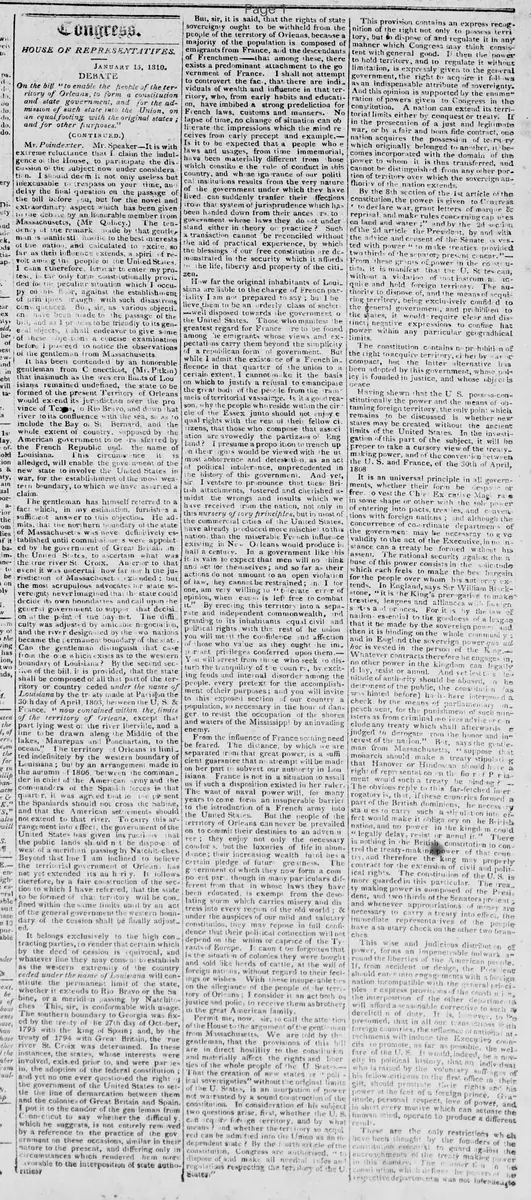
HOUSE OF REPRESENTATIVES.
JANUARY 15, 1810.
DEBATE
On the bill "to enable the people of the territory of Orleans, to form a constitution and state government, and for the admission of such state into the Union, on an equal footing with the original states; and for other purposes."
(CONTINUED.)
Mr. Poindexter. Mr. Speaker—It is with extreme reluctance that I claim the indulgence of the House, to participate the discussion of the subject now under consideration. I should deem it not only useless but inexcusable to trespass on your time, and delay the final question on the passage of the bill before you, but for the novel and extraordinary aspect which has been given to the debate by an honorable member from Massachusetts, (Mr. Quincy.) The tendency of the remarks made by that gentleman is manifestly hostile to the best interests of the nation, and calculated to excite, so far as their influence extends, a spirit of revolt among the people of the United States. I cannot therefore, forbear to enter my protest, in the only form constitutionally provided for the peculiar situation which I occupy on this floor, against the establishment of principles fraught with such disastrous consequences. But, sir, as various objections have been made to the passage of the bill, and as I profess to be friendly to its general objects, I shall endeavor to give some of these objections a concise examination before I proceed to notice the observations of the gentleman from Massachusetts.
It has been contended by an honorable gentleman from Connecticut, (Mr. Pitkin) that inasmuch as the western limits of Louisiana remain undefined, the state to be formed of the present Territory of Orleans would extend its jurisdiction over the province of Texas, to Rio Bravo, and down that river to its confluence with the sea, so as to include the Bay of St. Bernard, and the whole extent of country, supposed by the American government to be transferred by the French Republic under the name of Louisiana. This circumstance it is alleged, will enable the government of the new state to involve the United States in war, for the establishment of the most western boundary, to which we have asserted a claim.
The gentleman has himself referred to a fact which, in my estimation, furnishes a sufficient answer to this objection. He admits, that the northern boundary of the state of Massachusetts was never definitively established until commissioners were appointed by the government of Great Britain and the United States, to ascertain what was the true river St. Croix. An error to that event it was uncertain how far north the jurisdiction of Massachusetts extended; but the most scrupulous advocates for state sovereignty never imagined that the state could decide its own boundaries and call upon the general government to support that decision at the point of the bayonet. The difficulty was adjusted by amicable negotiation, and the river designated by the two nations became the permanent boundary of the state.
Can the gentleman distinguish that case from the one which exists as to the western boundary of Louisiana? By the second section of the bill, it is provided, that the state shall be composed of all that part of the territory or country ceded under the name of Louisiana by the treaty made at Paris on the 30th day of April, 1803, between the U. S. & France. "now contained within the limits of the territory of Orleans, except that part lying west of the river Iberville, and a line to be drawn along the Middle of the lakes, Maurepas and Pontchartrain, to the ocean."
The territory of Orleans is limited indefinitely by the western boundary of Louisiana; but by an arrangement made in the autumn of 1806, between the commander in chief of the American army and the commanders of the Spanish forces in that quarter, it was agreed that to the present the Spaniards should not cross the Sabine, and that the American settlements should not extend to that river. To carry this arrangement into effect, the government of the United States has given instructions that the public lands should not be disposed of west of a meridian passing by Natchitoches. Beyond that line I am inclined to believe the territorial government of Orleans, has not yet extended its authority. It follows therefore, by a fair construction of the section to which I have referred, that the state to be formed of that territory will be confined within the same limits until by an act of the general government the western boundary of the cession shall be finally adjusted.
It belongs exclusively to the high contracting parties, to render that certain which by the deed of cession is equivocal, and whatever line they may consent to establish as the western extremity of the country ceded under the name of Louisiana will constitute the permanent limit of the state, whether it extends to Rio Bravo or the Sabine, or a meridian passing by Natchitoches. This, sir, is conformable with usage. The southern boundary to Georgia was fixed by the treaty of the 27th day of October, 1795 with the king of Spain; and, by the treaty of 1794 with Great Britain, the true river St. Croix was determined. In these instances, the states, whose interests were involved, existed prior to, and were parties in, the adoption of the federal constitution; and yet no one ever questioned the right of the government of the United States to settle the line of demarcation between them and the colonies of Great Britain and Spain.
I put it to the candor of the gentleman from Connecticut to say whether the difficulty, which he suggests, is not entirely removed by a reference to the practice of the government on these occasions, similar in their nature to the present, and differing only in circumstances which rendered them more favorable to the interposition of state authorities.
But, sir, it is said, that the rights of state sovereignty ought to be withheld from the people of the territory of Orleans, because a majority of the population is composed of emigrants from France, and the descendants of Frenchmen—that among these, there exists a predominant attachment to the government of France. I shall not attempt to controvert the fact, that there are individuals of wealth and influence in that territory, who, from early habits and education, have imbibed a strong predilection for French laws, customs and manners. No lapse of time, no change of situation can obliterate the impressions which the mind receives from early precept and example.
Is it to be expected that a people who have been governed by laws and usages, from time immemorial, have been materially different from those which constitute the rule of conduct in this country, and whose ignorance of our political institutions results from the very nature of the government under which they have lived, can suddenly transfer their affections from that system of jurisprudence which has been handed down from their ancestors, to a government whose laws they do not understand either in theory or practice? Such a transition cannot be reconciled without the aid of practical experience, by which the blessings of our free constitution are demonstrated in the security which it affords the life, liberty and property of the citizen.
How far the original inhabitants of Louisiana are liable to the charge of French partiality I am not prepared to say; but I believe them to be an orderly class of society—well disposed towards the government of the United States. Those who manifest the greatest regard for France are to be found among the emigrants whose views and expectations carry them beyond the simplicity of a republican form of government. But while I admit the existence of a French influence in that quarter of the union to a certain extent, I cannot make it the basis on which to justify a refusal to emancipate the great body of the people from the trammels of territorial vassalage. Is it a good reason, why the people who reside within the circle of the Essex junto should not enjoy equal rights with the rest of their fellow citizens, that those who compose that association are avowedly the partizans of England? I presume a proposition to trench on their rights would be viewed with the utmost abhorrence and detestation, as an act of political intolerance, unprecedented in the history of this government. And yet, sir I venture to pronounce that these British attachments, fostered and cherished amidst the wrongs and insults which we have received from the nation, not only in this nursery of tory principles, but in most of the commercial cities of the United States, have already produced more mischief to this nation than the miserable French influence existing in New Orleans would produce in half a century. In a government like this it is vain to expect that men will not think and act for themselves; and so far as their actions do not amount to an open violation of law, they cannot be restrained; in toleration, am very willing to tolerate error of opinion, when reason is left free to combat it. By erecting this territory into a separate and independent commonwealth, and granting to its inhabitants equal civil and political rights with the rest of the union you will merit the confidence and affection of those who value as they ought the inestimable privileges conferred upon them.
You will arrest from those who seek to disturb the tranquility of the country, by exciting feuds and internal disorder among the people, every pretext for the accomplishment of their purposes; and you will invite to this exposed section of our country a population, so necessary in the hour of danger to resist the occupation of the shores and waters of the Mississippi by an invading enemy.
From the influence of France nothing need be feared. The distance, by which we are separated from that great power, is a sufficient guarantee that no attempt will be made on her part to subvert our authority in Louisiana. France is not in a situation to assail us if such a disposition existed in her rulers. The want of naval power will, for many years to come form an insuperable barrier to the introduction of a French army into the United States. But the people of the territory of Orleans can never be prevailed on to commit their destinies to an adventurer; they enjoy not only the necessary comforts, but the luxuries of life in abundance; their increasing wealth furnishes a certain pledge of future greatness. The government of which they now form a component part, though in many particulars different from that in whose laws they have been educated, is exempt from the desolating storm which carries misery and distress into every region of the old world; & under the auspices of our mild and salutary constitution, they may repose in full confidence that their political connection will not depend on the whim or caprice of the Tyrants of Europe. It cannot be forgotten that in the situation of colonies they were bought and sold like herds of cattle, at the will of foreign nations, without regard to their feelings or wishes. With these insuperable ties on the allegiance of the people of the territory of Orleans: I consider it an act both of justice and policy, to receive them as brethren in the great American family.
Permit me, now, sir, to call the attention of the House to the argument of the gentleman from Massachusetts. We are told by the gentleman, that the provisions of this bill are in direct hostility to the constitution and materially affect the rights and liberties of the whole people of the U States. That the creation of new states or "political sovereignties" without the original limits of the U. States, is an usurpation of power not warranted by a sound Construction of the constitution. In consideration of this subject two questions arise. first, whether the U. S. can acquire foreign territory, and by what means? and whether the territory so acquired can be admitted into the Union as an independent state? By the fourth article of the constitution, Congress are authorised, "to dispose of and make all needful rules and regulations respecting the territory of the U. States."
This provision contains an express recognition of the right not only to possess territory, but do dispose of and regulate it in any manner which Congress may think consistent with general good. If then the power to hold territory, and to regulate it without limitation, is expressly given to the general government, the right to acquire it follows as an indispensable attribute of sovereignty. And this opinion is supported by the enumeration of powers given to Congress in the constitution. A nation can extend its territorial limits either by conquest or treaty. If in the prosecution of a just and legitimate war, or by a fair and bona fide contract, one nation acquires the possession of territory which originally belonged to another, it becomes incorporated with the domain of the power to whom it is thus transferred, and cannot be distinguished from any other portion of territory over which the sovereign authority of the nation extends.
By the 8th section of the 1st article of the constitution, the power is given to Congress 'to declare war, grant letters of marque & reprisal, and make rules concerning captures on land and water;' and by the 2d section of the 2d article the President, by and with the advice and consent of the Senate, is vested with power 'to make treaties, provided two thirds of the senators present concur.'— From these grounds of power in the constitution, it is manifest that the U. States can, without a violation of that instrument acquire and hold foreign territory: The authority to dispose of, and the means of acquiring territory, being exclusively confided to the general government, and prohibited to the states, it would require clear and distinct negative expressions to confine that power within any particular geographical limits.
The constitution contains no prohibition of the right to acquire territory, either by war or compact, but the latter alternative has been adopted by this government, whose policy is founded in justice, and whose object is peace.
Having shewn that the U S. possess constitutionally the power and the means of obtaining foreign territory, the only point which remains to be discussed is whether new states may be created without the ancient limits of the United States. In the investigation of this part of the subject, it will be proper to take a cursory view of the treaty-making power, and of the convention between the U. S. and France, of the 30th of April, 1803.
It is an universal principle in all governments, whether their form be despotic or free, to vest the Chief Executive Magistrate in some shape or other with the sole power of entering into pacts, treaties, and conventions with foreign nations; and although the concurrence of co-ordinate departments of the government may be necessary to give validity to the act of the Executive, in no instance can a treaty be formed without his assent. The rational security against the abuse of this power consists in the solicitude which each feels to make the best bargain for the people over whom his authority extends. In England, says Sir William Blackstone, "it is the King's prerogative to make treaties, leagues and alliances with foreign sovereigns and states. For it is by the law of nations essential to the goodness of a league that it be made by the sovereign power and. then it is binding on the whole community: and in England the sovereign power qua ad hoc is vested in the person of the King. Whatever contracts therefore he engages in, no other power in the kingdom can legally delay, resist or annul. And yet lest this prerogative should be abused to the detriment of the public, the constitution (as was hinted before) has here interposed a check by the means of parliamentary impeachment, for the punishment of such ministers as from criminal motives advise or conclude any treaty which shall afterwards be judged to derogate from the honor and interest of the nation."
But, says the gentleman from Massachusetts, "suppose that monarch should make a treaty stipulating that Hanover or Hindostan should have a right of representation on the floor of Parliament would such a treaty be binding?"— The obvious reply to this far-fetched interrogatory is, that, if these countries formed a part of the British dominions, the necessary statutes to carry such a stipulation into effect would make it obligatory on the British nation, and no power in the kingdom could "legally delay, resist or annul it." There is nothing in the British Constitution to control the treaty-making power of that country, and therefore the king may properly contract for the extension of civil and political rights. The constitution of the U.S. is more guarded in this particular. The treaty making power is composed of the President, and two-thirds of the Senators present; and whenever appropriations of money are necessary to carry a treaty into effect, the immediate representatives of the people have a salutary check on the other two branches.
This wise and judicious distribution of power, forms an impenetrable bulwark around the liberties of the American people. If, from accident or design, the President should enter into engagements with a foreign nation incompatible with the general principles or express provisions of the constitution, the interposition of the other departments will afford a seasonable corrective to such a dereliction of duty. It is, however, to be presumed, that in all our transactions with foreign countries, the influence of national attachments will induce the Executive councils to promote, as far as possible, the welfare of the U. S. It would, indeed, be a novelty in political history, that an individual who is raised by the voluntary suffrages of his fellow-citizens to the first office in their gift, should prostrate their rights and his power at the feet of a foreign prince. Gratitude, personal respect, love of power, and in short every motive which can actuate the human mind, operate to produce a different result.
These are the only restrictions which have been thought by the founders of the constitution essential to guard against the encroachments of the treaty making power in this Country. The enumeration in the Constitution, which defines the powers the respective departments, was not intended to
With respect to treaties and conventions entered into with foreign nations, it would have been unreasonable to have attempted a specification of all the cases in which external regulations would from time to time become expedient and necessary. No human being could foresee all the contingencies that might occur in the practical operation of the government, which require the interposition of the treaty-making power. I therefore contend, that a treaty, once ratified by each co-ordinate department of the government, becomes the supreme law of the land, and is as binding on this House, as an article in the Constitution itself. To illustrate this position beyond the reach of contradiction, and to give to reason the aid of an express provision in the constitution, I beg leave to quote from article 6th the following words: "This constitution, and the laws of the U. S. which shall be made in pursuance thereof, and all treaties made, or which shall be made, under the authority of the United States, shall be the supreme law of the land; and the judges in every state shall be bound thereby, any thing in the constitution or laws of any state to the contrary notwithstanding." The distinction here taken between laws and treaties cannot be misunderstood; laws are to be made in pursuance of the constitution, treaties under the authority of the United States. I admit, sir, that an article in a treaty which would go to contravene an express provision of the constitution, would not be binding, but who is to be arbiter between the treaty-making power and the constitution? Will you confide this gigantic power to the Supreme Court of the U. S. and give to that tribunal the exposition of all controversies growing out of treaties or conventions with foreign nations? I presume no gentleman will advance a doctrine so absurd and ridiculous. If then the other three branches of the general government determine a treaty constitutional, by passing the necessary laws to carry it into effect, it becomes the supreme law of the land, and, so far as its stipulations secure personal privileges, and the rights of property, they must be fulfilled. Let us now enquire what are the obligations which we have contracted, in relation to the inhabitants of Louisiana, by the treaty of cession with the French republic. The 3d article of that treaty stipulates, that "the inhabitants of the ceded territory shall be incorporated into the Union of the U. S. and admitted as soon as possible, according to the principles of the Federal Constitution, to the enjoyment of all the rights and immunities of citizens of the United States; and in the meantime, they shall be maintained and protected in the free enjoyment of their liberty, property and the religion which they profess." And are we sitting here to deliberate whether we will perform these solemn engagements which have been entered into by the constituted authorities, and which are presented to us in the imposing attitude of the supreme law of the land? Are all the principles of the constitution in unison with these engagements? Article the 4th. Sec. 3d, "new states may be admitted by the Congress into this Union, but no new state shall be formed or erected within the jurisdiction of any other state, nor any state be formed by the junction of two or more states, or parts of states, without the consent of the states concerned as well as of the Congress." Here then is a general power to admit new states, and I challenge any gentleman to shew that it is confined to the original territory belonging to the U. S. There is no clause of the constitution which contains such a limitation, even by the remotest implication. Such a construction would not only be contrary to the letter, but to the spirit of the article to which I have referred. For if other territory than that which belonged to the U. S. at the time of the adoption of the federal constitution was not intended to be incorporated into the union, why has it been the constant practice of the government to annex Indian territory to the old states, and to form new states of lands purchased from the different tribes of Indians in the United States? They are foreign powers, acknowledged and treated with as such, from the commencement of the government; and the objection urged on this occasion would apply with equal force against the extinguishment of Indian title. I trust sir, that enough has been said, to satisfy every candid individual of this body, that the territory which it is the object of this bill to create into a separate commonwealth, was fairly and constitutionally acquired; that we are bound by the sacred obligations of treaty to extend its inhabitants all the rights, advantages and immunities of citizens of the U. States, and that there exists no constitutional barrier to a fulfilment of that undertaking on the part of the U. States. The most approved writers on public law, declares that, "he who has made a promise to any one, has conferred upon him a true right to require the thing promised, and that consequently not to keep a perfect promise, is to violate the right of another; and is as manifest an injustice as that of depriving a person of his property. And further, as the engagements of a treaty impose on the one hand a perfect obligation, they produce on the other a perfect right. To violate a treaty, then, is to violate the perfect right of him with whom we have contracted, and this is to do him an injury." I conceive the character of the nation to be deeply involved in the question now before the house. If we refuse to perform the legal, moral and political obligation, which is imposed on us by the treaty of cession, to incorporate the inhabitants of the ceded territory into the Union of the U. S. and to admit them to the enjoyment of all the rights and privileges of citizens, we shall deserve to be branded with the odious epithet of a faithless nation. We shall merit the censure of the civilized world, and the just resentment of the people, to whom these rights and privileges ought to be extended. Mr. Speaker, I enter with lively sensibility on that portion of the remarks made by the honorable gentleman from Massachusetts, which menace insurrection and a dissolution of the Union. Had these sentiments fallen from the gentleman in the ardor of debate, while the imagination was inflamed with an unconquerable zeal to prove the impolicy of the measure and to consider at random, or had they been offered in the shape of possible results, I should have regarded them only with pity and contempt; but the gentleman declares it to be his "deliberate opinion, that if this bill passes the bonds of the Union are virtually dissolved-that the states which compose it are free from their moral obligations, and that as it will be the right of all, so it will be the duty of some to prepare definitely to a separation; amicably if they can, violently if they must." Influenced by a desire to stamp on these expressions their merited disgrace, and to preserve dignity and decorum in our deliberations, I felt it my duty to call the gentleman to order. Perhaps in doing so I was actuated more by a sudden impulse of feeling than by an accurate knowledge of Parliamentary proceedings. I am still, however, impressed with a conviction, that these sacred walls-the sanctuary of the liberties of the American people, ought not to be polluted by direct invitations to rebellion against the government of which we are a constituent part; but the liberality and the courtesy of the House have overruled that opinion, and the gentleman was permitted to proceed. Are we then about to commit an act which is to burst asunder the bonds of our political Union, and prostrate the glorious fabric which has been reared by the valor of our ancestors? Sir, when I look at the events which led to the acquisition of Louisiana, and the efforts made at that time by those who opposed the measures of the administration, to call forth the national energies for the purpose of securing that important point by conquest, lest it should fall into the hands of a powerful neighbor, and compare them with the declarations now made by the gentleman from Massachusetts, I am filled with astonishment. I cannot believe, that the party, with whom that gentleman is in the habit of acting, will support the visionary theories and frantic anticipations which he has advanced on the present occasion. For the honor of every real American who is ranked with the federal party, I hope that these idle dreams of political insanity will be suffered to vanish without a struggle, before the effulgent sunshine of patriotism. (Mr. P's speech to be Continued.)
What sub-type of article is it?
What themes does it cover?
What keywords are associated?
What entities or persons were involved?
Where did it happen?
Story Details
Key Persons
Location
House Of Representatives
Event Date
January 15, 1810
Story Details
Mr. Poindexter delivers a speech defending the bill to admit the Territory of Orleans as a state, addressing objections concerning undefined western boundaries of Louisiana, potential French loyalties among inhabitants, and the constitutional authority of Congress to acquire foreign territory and form new states from it, while refuting claims by Mr. Quincy that passage would dissolve the Union.