Thank you for visiting SNEWPapers!
Sign up free
The Daily Advertiser
New York, New York County, New York
What is this article about?
A letter to the Daily Advertiser defends Publius's reference to the beneficial Union of England and Scotland as analogous to the proposed US Constitution, refuting the Petulant Observer's claims of Scottish suffering by citing historians Robertson and Goldsmith on the Union's advantages in liberty, commerce, and prosperity.
Merged-components note: These two components form a single continuous letter to the editor, split across columns, discussing the Union between England and Scotland in response to the Petulant Observer.
Clipping
OCR Quality
Full Text
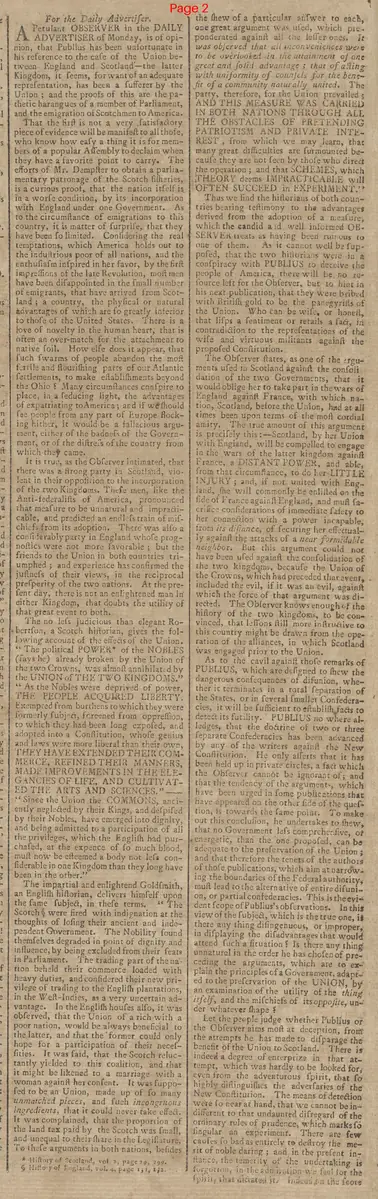
Petulant OBSERVER in the DAILY ADVERTISER of Monday, is of opinion, that Publius has been unfortunate in his reference to the case of the Union between England and Scotland-the latter Kingdom, it seems, for want of an adequate representation, has been a sufferer by the Union ; and the proofs of this are the pathetic harangues of a member of Parliament, and the emigration of Scotchmen to America. That the first is not a very satisfactory piece of evidence will be manifest to all those who know how easy a thing it is for members of a popular Assembly to declaim when they have a favorite point to carry. The efforts of Mr. Dempster to obtain a parliamentary patronage of the Scotch fisheries, is a curious proof, that the nation itself is in a worse condition, by its incorporation with England under one Government. As to the circumstance of emigrations to this country, it is matter of surprise, that they have been so limited. Considering the real temptations, which America holds out to the industrious poor of all nations, and the enthusiasm inspired in her favor, by the first impressions of the late Revolution, most men have been disappointed in the small number of emigrants, that have arrived from Scotland; a country, the physical or natural advantages of which are so greatly inferior to those of the United States. There is a love of novelty in the human heart, that is often an over-match for. the attachment to native soil. How else does it appear, that such swarms of people abandon the most fertile and flourishing parts of our Atlantic settlements, to make establishments beyond the Ohio : Many circumstances conspire to place, in a seducing light, the advantages of expatriating to America; and if we should see people from any part of Europe flocking hither, it would be a fallacious argu- ment, either of the badness of the Govern- ment, or of the distress of the country from which they came. It is true, as the Observer intimated, that there was a strong party in Scotland, vio- lent in their opposition to the incorporation of the two Kingdoms. These men, like the Anti-federalists of America, pronounced that measure to be unnatural and impracti- cable, and predicted an endless train of mi- chiefs from its adoption. There was also a considerably party in England whose prog- nostics were not more favorable; but the friends to the Union in both countries tri- umphed ; and experience has confirmed the justice of their views, in the reciprocal prosperity of the two nations. At the pre- sent day, there is not an enlightened man in either Kingdom, that doubts the utility of that great event to both. The no less judicious than elegant Ro- bertson, a Scotch historian, gives the fol- lowing account of the effects of the Union. " The political POWER* of the NOBLES (says he) already broken by the Union of the two Crowns, was almost annihilated by the UNION of THE TWO KINGDOMS." " As the Nobles were deprived of power, THE PEOPLE ACQUIRED LIBERTY. Exempted from burthens to which they were formerly subject, screened from oppression, to which they had been long exposed, and adopted into a Constitution, whose genius and laws were more liberal than their own, THEY HAVE EXTENDED THEIR COM- MERCE, REFINED THEIR MANNERS, MADE IMPROVEMENTS IN THE ELE- GANCIES OF LIFE, AND CULTIVAT- ED THE ARTS AND SCIENCES." " Since the Union the COMMONS. anci- ently neglected by their Kings, and despised by their Nobles, have emerged into dignity, and being admitted to a participation of all the privileges, which the English had pur- chased, at the expense of so much blood, must now be esteemed a body not less con- siderable in one Kingdom than they long have been in the other." The impartial and enlightened Goldsmith, an English historian, delivers himself upon the same subject, in these terms. " The Scotch§ were fired with indignation at the thoughts of losing their ancient and inde- pendent Government. The Nobility found themselves degraded in point of dignity and influence, by being excluded from their seats in Parliament. The trading part of the na- tion beheld their commerce loaded with heavy duties, and considered their new pri- vilege of trading to the English plantations, in the West-Indies, as a very uncertain ad- vantage. In the English houses also, it was observed, that the Union of a rich with a poor nation, would be always beneficial to the latter, and that the 'former could only hope for a participation of their nece- sities. It was said, that the Scotch reluc- tantly yielded to this coalition, and that it might be likened to a marriage with a woman against her consent. It was supposed to be an Union, made up of so many unmatched pieces, and such incongruous ingredients, that it could never take effect. It was complained, that the proportion of the land tax paid by the Scotch was small, and unequal to their share in the Legislature, To these arguments in both nations, beides * History of Scotland, vol. 2, page 29, 299. S History of England, vol, 4, page
the news of a particular answer to each, one great argument was used, which preponderated against all che lesser ones. It was observed that all inconveniences were to be overlooked in the attainment of one great and solid advantage ; that of acting with uniformity of counsels for the bene- fit of a community naturally united. The party, therefore, for the Union prevailed s AND THIS MEASURE WAS CARRIEL IN BOTH NATIONS THROUGH ALL THE OBSTACLES OF PRETENDING PATRIOTISM AND PRIVATE INTE- REST, from which we may learn, that many great difficulties are surmounted be- cause they are not seen by those who direct the operation; and that SCHEMES, which THEORY deems IMPRACTICABLE will OFTEN SUCCEED in EXPERIMENT. Thus we find the historians of both coun- tries bearing testimony to the advantages derived from the adoption of a measure. which the candid a id well informed OB- SERVER treats as having been ruinous to one of them. As it cannot well be sup- posed, that the two historians were in a conspiracy with PUBLIUS to deceive the people of America, there will be no re- course left for the Observer, but to hint in his next publication, that they were bribed with British gold to be the panegyrists of the Union. Who can be wise, or honest. that lips a sentiment or retails a fact. in contradiction to the representations of the wise and virtuous militants against the proposed Constitution. The Observer states, as one of the arguments used in Scotland against the conoli- dation of the two Governments, that it would oblige her to rake part in the wars of England against France, with which na- tion, Scotland, before the Union, had at all times been upon terms of the most cordial amity. The true amount of this argument is precisely this : Scotland, by her Union with England, will be compelled to engage in the wars of the latter kingdom against France, a DISTANT POWER, and able, from that circumstance, to do her LITTLE INJURY; and, if not united with Eng- land, he will commonly be enlisted on the side of F rance against England, and must a- crifice considerations of immediate safety to her connection with a power incapable, from its distance, of securing her effectual- ly against the attacks of a near formidable neighbor. But this argument could nor have been used against the consolidation of the two kingdoms, because the Union of the Crowns, which had preceded that event, included the evil, if it was an evil, against which the force of that argument was di- rected. The Observer knows enough of the history of the two kingdoms, to be con- vinced, that lessons still more instructive to this country might be drawn from the ope- ration of the alliances, in which Scotland was engaged prior to the Union. As to the cavil against those remarks of PUBLIUS. which are designed to shew the dangerous consequences of disunion, whe- ther it terminates in a total separation of the States, or in several smaller Confedera- cies, it will be sufficient to establish facts to detect its futility. PUBLIUS no where al- ledges, that the doctrine of two or three separate Confederacies has been advanced by any of the writers against the New Constitution. He only asserts that it has been held up in private circles, a fact which the Observer cannot be ignorant o; and that the tendency of the arguments, which have been urged in some publications that have appeared on the other side of the que- stion, is towards the same point. To make out this conclusion, he undertakes to shew. that no Government less comprehensive, o energetic, than the one proposed, can be adequate to the preservation of the Union ; and that therefore the tenets of the authors of those publications, which aim at narrow- ing the boundaries of the Federal authority, must lead to the alternative of entire diuni- on, or partial confederacies. This is the evident scope of Publius's observations. In this view of the subject, which is the true one, is there any thing disingenuous, or improper, in displaying the disadvantages that would attend such a situation & Is there any thing unnatural in the order he has chosen of pre- ceding the arguments, which are to ex- plain the principles of a Government, adapt- ed to the preservation of the UNION, by an examination of the utility of the thing itself, and the mischiefs of its opposite, un- der whatever shape : Let the people judge whether Publius or the Observer aims most ai deception, from the attempts he has made to disparage the benefit of the Union to Scotland. There is indeed a degree of enterprize in that at- tempt, which was hardly to be looked for. even from the adventurous spirit, that o highly distinguishes the adversaries of the New Constitution. The means of detection were o near at hand, that we cannot be in- different to that undaunted disregard of the ordinary rules of prudence, which marks o ingular an experiment. There are few causes o bad as entirely to destroy the me- rit of noble daring ; and in the present in- stance, the temerity of the undertaking is forgotten, in the admiration w'e feel for the spirit, that dictated jt. Indces an the sore
What sub-type of article is it?
What themes does it cover?
What keywords are associated?
What entities or persons were involved?
Letter to Editor Details
Recipient
Daily Advertiser
Main Argument
the union between england and scotland has proven beneficial to both nations, enhancing liberty, commerce, and prosperity, as evidenced by historians robertson and goldsmith; this counters the petulant observer's criticisms and supports publius's advocacy for the us constitution against disunion.
Notable Details