Thank you for visiting SNEWPapers!
Sign up free
Editorial
December 5, 1808
Portland Gazette, And Maine Advertiser
Portland, Cumberland County, Maine
What is this article about?
A Federalist critique of President Jefferson's message to Congress, decrying its obscure language, lack of information, defense of the Embargo as coercive, misleading claims on foreign relations with Britain, France, and Spain, and suggestions of unconstitutional spending. Signed 'ROLAND.'
Clipping
OCR Quality
95%
Excellent
Full Text
Communications.
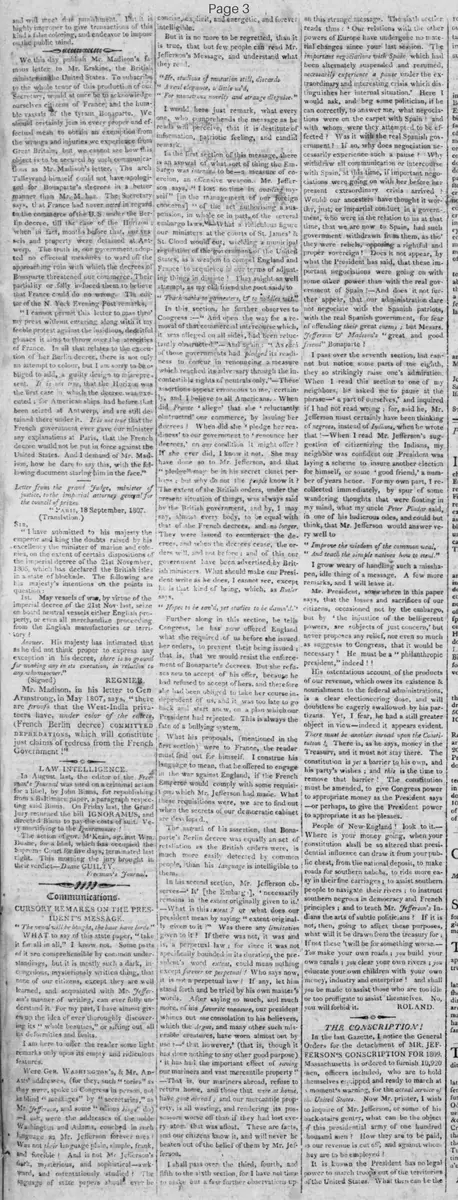
CURSORY REMARKS ON THE PRESIDENT'S MESSAGE.
"The venal will be bought, the base have lords."
What to say of this state paper, "take it for all in all," I know not. Some parts of it are comprehensible by common understandings, but it is mostly such a dark, incongruous, mysteriously written thing, that none of our citizens, except they are well learned, and acquainted with Mr. Jefferson's manner of writing, can ever fully understand it. For my part, I have almost given up the idea of ever thoroughly discovering its "whole beauties," or sifting out all its deformities and faults.
I am here to offer the reader some light remarks only upon its empty and ridiculous features.
Were Gen. Washington's, & Mr. Adams' addresses, (for they, such "tories" as they were, spoke to Congress in person, not in blind "messages" by "secretaries," as Mr. Jefferson, and some "odious kings" do) — ask, were the addresses of the noble Washington and Adams, couched in such language as Mr. Jefferson forever uses? Was not their language plain, simple, frank, and forcible? And is not Mr. Jefferson's dark, mysterious, and sophistical—awkward, and ostentatiously studied! The language of state papers should ever be concise, explicit, and energetic, and forever intelligible.
But it is no more to be regretted, than it is true, that but few people can read Mr. Jefferson's Message, and understand what they read.
"He, studious of mutation still, discards
"A real elegance, a little us'd,
"For monstrous novelty and strange disguise."
I would here just remark, what every one, who comprehends the message as he reads will perceive, that it is destitute of information, patriotic feeling, and candid remark.
In the first section of this message, there is an avowal of what sort of thing the Embargo was intended to be—a measure of coercion, an offensive weapon. Mr. Jefferson, says, "I lost no time in availing myself" [in the management of our foreign concerns] "of the act authorising a suspension, in whole or in part, of the several embargo laws." What a ridiculous figure our ministers at the courts of St. James' & St. Cloud would cut, wielding a municipal regulation of the government of the United States, as a weapon to compel England and France to acquiesce in our terms of adjusting things in dispute! They might as well attempt, as my old friend the poet said, to "Teach oaths to gamesters, & to noddles wit."
In this section, he further observes to Congress: —"And open the way for a removal of that commercial intercourse which, it was alleged on all sides, had been reluctantly obstructed."—And again: "As each of those governments had pledged its readiness to concur in renouncing a measure which reached its adversary through the incontestible rights of neutrals only,"—These assertions appear erroneous to me, certainly, and I believe to all Americans. When did France 'allege' that she 'reluctantly obstructed' our commerce, by issuing her decrees? When did she 'pledge her readiness' to our government to 'renounce her decrees,' on any condition it might offer? If she ever did, I know it not. She may have done so to Mr. Jefferson, and that "pledge" may be in his secret closet per se; but why do not the people know it?
The extent of the British orders, under the present situation of things, was always said by the British government, and by, I may say, almost every body, to be equal with that of the French decrees, and no longer. They were issued to counteract the decrees, and when the decrees cease, the orders will, and not before; and of this our government have been advertised by British ministers. What should make our President write as he does, I cannot see, except it is that kind of being, which, as Butler says,
"Hopes to be sav'd, yet studies to be damn'd."
Further along in this section, he tells Congress, he has now offered England what she required of us before she issued her orders, to prevent their being issued; that is, that we would resist the enforcement of Bonaparte's decrees. But she refuses now to accept of his offer, because he had refused to accept of hers. and therefore she had been obliged to take her course independent of us, and it was too late to go back and start anew, on a plan which our President had rejected. This is always the fate of a bullying system.
What his proposals, (mentioned in the first section) were to France, the reader must find out for himself. I construe his language to mean, that he offered to engage in the war against England, if the French Emperor would comply with some requisition; which Mr. Jefferson had made. What these requisitions were, we are to find out when the secrets of our democratic cabinet are developed.
The untruth of his assertion, that Bonaparte's Berlin decree was equally an act of retaliation as the British orders were, is much more easily detected by common people, than his language is intelligible to them.
In his second section, Mr. Jefferson observes 'It' [the Embargo], 'necessarily remains in the extent originally given to it.' —What is this extent? or what does our president mean by saying "extent originally given to it?" Was there any limitation given to it? If there was not, it was and is, a perpetual law; for since it was not specifically bounded in its duration, the president's word extent, could mean nothing except forever or perpetual! Who says now. it is not a perpetual law? If any, let him stand forth and be tried by his own master's words. After saying so much, and much more, of his favorite measure, our president whines out one consolation to his believers, which the Argus, and many other such miserable creatures, have worn almost out by use :—' that however.' (that is, though it has done nothing to any other good purpose) it has had the important effect of saving our mariners and vast mercantile property!' —That is, our mariners abroad, refuse to return home, and those that were at home, have gone abroad; and our mercantile property, is all wasting, and rendering its possessors worse off than if they had lost every atom that was afloat. These are facts, and our citizens know it, and will never be beaten out of the belief of them by Mr. Jefferson.
I shall pass over the third, fourth, and fifth to the sixth section, for I have not time to make but a few further observations upon this strange message. The sixth section reads thus: 'Our relations with the other powers of Europe have undergone no material changes since your last session. The important negotiations with Spain which had been alternately suspended and resumed, necessarily experience a pause under the extraordinary and interesting crisis which distinguishes her internal situation.' Here I would ask, and beg some politician, if he can correctly, to answer me, what negotiations were on the carpet with Spain? and with whom were they attempted to be effected? Was it with the real Spanish government! If so, why does negociation necessarily experience such a pause? Why withdraw all communication or intercourse with Spain, at this time, if important negotiations were going on with her before her present extraordinary crisis arrived? Would our ancestors have thought it worthy, just, or impartial conduct in a government, who were in the relation to us at that time, that we are now to Spain, had such government withdrawn from them, as tho' they were rebels, opposing a rightful and proper sovereign! Does it not appear, by what the President has said, that these important negociations were going on with some other power than with the real government of Spain? —And does it not further appear, that our administration dare not negociate with the Spanish patriots, with the real Spanish government, for fear of offending their great enemy; but Messrs. Jefferson & Madison's "great and good friend" Bonaparte?
I pass over the seventh section, but cannot but notice some parts of the eighth, they so strikingly raise one's admiration. When I read this section to one of my neighbors. he asked me to pause at the phrase—' a part of ourselves," and inquired if I had not read wrong; for, said he, Mr. Jefferson must certainly have been thinking of negroes, instead of Indians, when he wrote that! —When I read Mr. Jefferson's suggestion of citizenizing the Indians, my neighbor was confident our President was laying a scheme to insure another election for himself, or some 'good friend,' a number of years hence. For my own part, I recollected immediately, by spur of some wandering thoughts that were floating in my mind, what my uncle Peter Pindar said, in one of his ludicrous odes, and could but think, that Mr. Jefferson would answer very well to
"Improve the wisdom of the common weal,
"And teach the simple natives how to steal."
I grow weary of handling such a misshapen, idle thing of a message. A few more remarks, and I will leave it.
Mr. President, somewhere in this paper says, that the losses and sacrifices of our citizens, occasioned not by the embargo, but by the injustice of the belligerent powers, are subjects of just concern,' but never proposes any relief, nor even so much as suggests to Congress, that it would be necessary! He must be a "philanthropic president," indeed!!
His ostentatious account of the products of our revenue, which owes its existence & nourishment to the federal administrations, is a clear electioneering dose, and will doubtless be eagerly swallowed by his partisans. Yet, I fear, he had a still greater object in view—indeed it appears evident. There must be another inroad upon the Constitution! There is, as he says, money in the Treasury, and it must not stay there. The constitution is yet a barrier to his own, and his party's wishes; and this is the time to remove that barrier! The constitution must be amended, to give Congress power to appropriate money as the President says—or perhaps, to give the President power to appropriate it as he pleases.
People of New-England! look to it.—Where is your money going, when your constitution shall be so altered that presidential influence can draw it from your public chest, from the national deposit, to make roads for southern nabobs, to ride more easy in their fine carriages; to assist southern people to navigate their rivers: to instruct southern negroes in democracy and French principles; and to teach Mr. Jefferson's Indians the arts of subtle politicians? If it is not, then, going to affect these purposes, what will it be drawn from the treasury for; If not these 'twill be for something worse.—You make your own roads; you build your own canals; you clear your own rivers; you educate your own children with your own money, industry and enterprize! and shall you be made to assist those who are too idle or too profligate to assist themselves. No, you will forbid it.
ROLAND.
CURSORY REMARKS ON THE PRESIDENT'S MESSAGE.
"The venal will be bought, the base have lords."
What to say of this state paper, "take it for all in all," I know not. Some parts of it are comprehensible by common understandings, but it is mostly such a dark, incongruous, mysteriously written thing, that none of our citizens, except they are well learned, and acquainted with Mr. Jefferson's manner of writing, can ever fully understand it. For my part, I have almost given up the idea of ever thoroughly discovering its "whole beauties," or sifting out all its deformities and faults.
I am here to offer the reader some light remarks only upon its empty and ridiculous features.
Were Gen. Washington's, & Mr. Adams' addresses, (for they, such "tories" as they were, spoke to Congress in person, not in blind "messages" by "secretaries," as Mr. Jefferson, and some "odious kings" do) — ask, were the addresses of the noble Washington and Adams, couched in such language as Mr. Jefferson forever uses? Was not their language plain, simple, frank, and forcible? And is not Mr. Jefferson's dark, mysterious, and sophistical—awkward, and ostentatiously studied! The language of state papers should ever be concise, explicit, and energetic, and forever intelligible.
But it is no more to be regretted, than it is true, that but few people can read Mr. Jefferson's Message, and understand what they read.
"He, studious of mutation still, discards
"A real elegance, a little us'd,
"For monstrous novelty and strange disguise."
I would here just remark, what every one, who comprehends the message as he reads will perceive, that it is destitute of information, patriotic feeling, and candid remark.
In the first section of this message, there is an avowal of what sort of thing the Embargo was intended to be—a measure of coercion, an offensive weapon. Mr. Jefferson, says, "I lost no time in availing myself" [in the management of our foreign concerns] "of the act authorising a suspension, in whole or in part, of the several embargo laws." What a ridiculous figure our ministers at the courts of St. James' & St. Cloud would cut, wielding a municipal regulation of the government of the United States, as a weapon to compel England and France to acquiesce in our terms of adjusting things in dispute! They might as well attempt, as my old friend the poet said, to "Teach oaths to gamesters, & to noddles wit."
In this section, he further observes to Congress: —"And open the way for a removal of that commercial intercourse which, it was alleged on all sides, had been reluctantly obstructed."—And again: "As each of those governments had pledged its readiness to concur in renouncing a measure which reached its adversary through the incontestible rights of neutrals only,"—These assertions appear erroneous to me, certainly, and I believe to all Americans. When did France 'allege' that she 'reluctantly obstructed' our commerce, by issuing her decrees? When did she 'pledge her readiness' to our government to 'renounce her decrees,' on any condition it might offer? If she ever did, I know it not. She may have done so to Mr. Jefferson, and that "pledge" may be in his secret closet per se; but why do not the people know it?
The extent of the British orders, under the present situation of things, was always said by the British government, and by, I may say, almost every body, to be equal with that of the French decrees, and no longer. They were issued to counteract the decrees, and when the decrees cease, the orders will, and not before; and of this our government have been advertised by British ministers. What should make our President write as he does, I cannot see, except it is that kind of being, which, as Butler says,
"Hopes to be sav'd, yet studies to be damn'd."
Further along in this section, he tells Congress, he has now offered England what she required of us before she issued her orders, to prevent their being issued; that is, that we would resist the enforcement of Bonaparte's decrees. But she refuses now to accept of his offer, because he had refused to accept of hers. and therefore she had been obliged to take her course independent of us, and it was too late to go back and start anew, on a plan which our President had rejected. This is always the fate of a bullying system.
What his proposals, (mentioned in the first section) were to France, the reader must find out for himself. I construe his language to mean, that he offered to engage in the war against England, if the French Emperor would comply with some requisition; which Mr. Jefferson had made. What these requisitions were, we are to find out when the secrets of our democratic cabinet are developed.
The untruth of his assertion, that Bonaparte's Berlin decree was equally an act of retaliation as the British orders were, is much more easily detected by common people, than his language is intelligible to them.
In his second section, Mr. Jefferson observes 'It' [the Embargo], 'necessarily remains in the extent originally given to it.' —What is this extent? or what does our president mean by saying "extent originally given to it?" Was there any limitation given to it? If there was not, it was and is, a perpetual law; for since it was not specifically bounded in its duration, the president's word extent, could mean nothing except forever or perpetual! Who says now. it is not a perpetual law? If any, let him stand forth and be tried by his own master's words. After saying so much, and much more, of his favorite measure, our president whines out one consolation to his believers, which the Argus, and many other such miserable creatures, have worn almost out by use :—' that however.' (that is, though it has done nothing to any other good purpose) it has had the important effect of saving our mariners and vast mercantile property!' —That is, our mariners abroad, refuse to return home, and those that were at home, have gone abroad; and our mercantile property, is all wasting, and rendering its possessors worse off than if they had lost every atom that was afloat. These are facts, and our citizens know it, and will never be beaten out of the belief of them by Mr. Jefferson.
I shall pass over the third, fourth, and fifth to the sixth section, for I have not time to make but a few further observations upon this strange message. The sixth section reads thus: 'Our relations with the other powers of Europe have undergone no material changes since your last session. The important negotiations with Spain which had been alternately suspended and resumed, necessarily experience a pause under the extraordinary and interesting crisis which distinguishes her internal situation.' Here I would ask, and beg some politician, if he can correctly, to answer me, what negotiations were on the carpet with Spain? and with whom were they attempted to be effected? Was it with the real Spanish government! If so, why does negociation necessarily experience such a pause? Why withdraw all communication or intercourse with Spain, at this time, if important negotiations were going on with her before her present extraordinary crisis arrived? Would our ancestors have thought it worthy, just, or impartial conduct in a government, who were in the relation to us at that time, that we are now to Spain, had such government withdrawn from them, as tho' they were rebels, opposing a rightful and proper sovereign! Does it not appear, by what the President has said, that these important negociations were going on with some other power than with the real government of Spain? —And does it not further appear, that our administration dare not negociate with the Spanish patriots, with the real Spanish government, for fear of offending their great enemy; but Messrs. Jefferson & Madison's "great and good friend" Bonaparte?
I pass over the seventh section, but cannot but notice some parts of the eighth, they so strikingly raise one's admiration. When I read this section to one of my neighbors. he asked me to pause at the phrase—' a part of ourselves," and inquired if I had not read wrong; for, said he, Mr. Jefferson must certainly have been thinking of negroes, instead of Indians, when he wrote that! —When I read Mr. Jefferson's suggestion of citizenizing the Indians, my neighbor was confident our President was laying a scheme to insure another election for himself, or some 'good friend,' a number of years hence. For my own part, I recollected immediately, by spur of some wandering thoughts that were floating in my mind, what my uncle Peter Pindar said, in one of his ludicrous odes, and could but think, that Mr. Jefferson would answer very well to
"Improve the wisdom of the common weal,
"And teach the simple natives how to steal."
I grow weary of handling such a misshapen, idle thing of a message. A few more remarks, and I will leave it.
Mr. President, somewhere in this paper says, that the losses and sacrifices of our citizens, occasioned not by the embargo, but by the injustice of the belligerent powers, are subjects of just concern,' but never proposes any relief, nor even so much as suggests to Congress, that it would be necessary! He must be a "philanthropic president," indeed!!
His ostentatious account of the products of our revenue, which owes its existence & nourishment to the federal administrations, is a clear electioneering dose, and will doubtless be eagerly swallowed by his partisans. Yet, I fear, he had a still greater object in view—indeed it appears evident. There must be another inroad upon the Constitution! There is, as he says, money in the Treasury, and it must not stay there. The constitution is yet a barrier to his own, and his party's wishes; and this is the time to remove that barrier! The constitution must be amended, to give Congress power to appropriate money as the President says—or perhaps, to give the President power to appropriate it as he pleases.
People of New-England! look to it.—Where is your money going, when your constitution shall be so altered that presidential influence can draw it from your public chest, from the national deposit, to make roads for southern nabobs, to ride more easy in their fine carriages; to assist southern people to navigate their rivers: to instruct southern negroes in democracy and French principles; and to teach Mr. Jefferson's Indians the arts of subtle politicians? If it is not, then, going to affect these purposes, what will it be drawn from the treasury for; If not these 'twill be for something worse.—You make your own roads; you build your own canals; you clear your own rivers; you educate your own children with your own money, industry and enterprize! and shall you be made to assist those who are too idle or too profligate to assist themselves. No, you will forbid it.
ROLAND.
What sub-type of article is it?
Partisan Politics
Foreign Affairs
Economic Policy
What keywords are associated?
Jefferson Message
Embargo Critique
Foreign Relations
British Orders
French Decrees
Spanish Negotiations
Constitutional Amendment
Electioneering
What entities or persons were involved?
Mr. Jefferson
Gen. Washington
Mr. Adams
Bonaparte
England
France
Spain
Congress
Madison
Editorial Details
Primary Topic
Critique Of Jefferson's Presidential Message
Stance / Tone
Strongly Critical And Anti Jefferson
Key Figures
Mr. Jefferson
Gen. Washington
Mr. Adams
Bonaparte
England
France
Spain
Congress
Madison
Key Arguments
Jefferson's Message Is Obscure And Hard To Understand
Contrasts Jefferson's Style Unfavorably With Washington And Adams
Embargo Intended As Coercive Weapon Against Britain And France
Misleading Claims About French Pledges On Decrees
British Orders Retaliatory To French Decrees
Embargo Is Perpetual Without Specified End
Embargo Fails To Protect Mariners And Property
Negotiations With Spain Paused Suspiciously, Favoring Bonaparte
Suggestion To Citizenize Indians Seen As Electioneering
Message Pushes For Unconstitutional Spending And Amendments