Thank you for visiting SNEWPapers!
Sign up free
Letter to Editor
July 31, 1826
The Virginian
Lynchburg, Virginia
What is this article about?
Editorial commentary on Jonathan Roberts' letter refuting corruption charges against Adams and Clay by Jackson supporters in Philadelphia. Argues that premature 1828 presidential campaigning is inflammatory and unfounded, praising Roberts' candid response for its potential influence in Pennsylvania.
Clipping
OCR Quality
95%
Excellent
Full Text
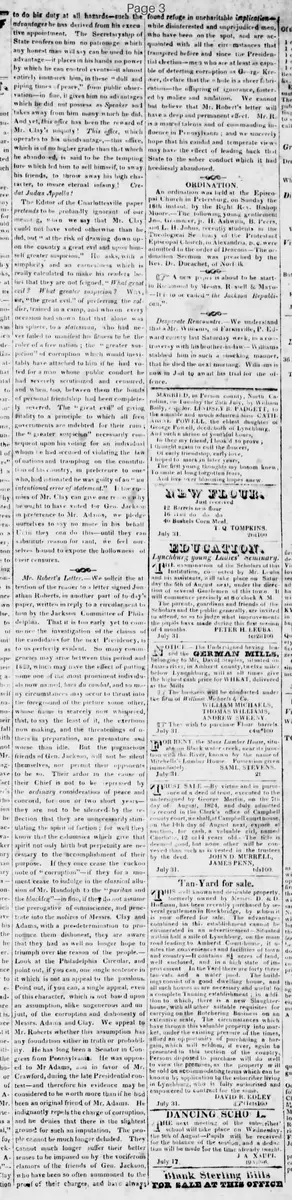
Mr. Roberts' Letter,—We solicit the attention of the reader to a letter signed Jonathan Roberts, in another part of to-day's paper, written in reply to a circular sent to him by the Jackson Committee of Philadelphia. That it is too early yet to commence the investigation of the claims of the candidates for the next Presidency, is to us perfectly evident. So many contingencies may arise between this period and 1829, which may have the effect of putting some one of the most prominent individuals now named, hors du combat, and so many circumstances may occur to thrust into the foreground of the picture some other, whose name is scarcely now whispered, that, to say the least of it, the exertions now making, and the threatenings of others in preparation, are premature and worse than idle. But the pugnacious friends of Gen. Jackson, will not be silent themselves, nor permit their opponents to be so. Their ardor in the cause of their Chief is not to be suppressed by the ordinary consideration of peace and concord, for one or two short years—they are not to be silenced—by the reflection that they are unnecessarily stimulating the spirit of faction; for well they know that the calumnies which give that spirit not only birth but perpetuity are necessary to the accomplishment of their purpose. If they once cease the cuckoo note of 'corruption'—if they for a moment cease to indulge in the classical allusion of Mr. Randolph to the 'puritan and the blackleg'—in fine, if they do not assume the prerogative of omniscience, and penetrate into the motives of Messrs. Clay and Adams, with a predetermination to pronounce them dishonest, they are aware that they had as well no longer hope to triumph over the reason of the people.—Look at the Philadelphia Circular, and point out, if you can, one single sentence in it which is not an appeal to the passions. Point out, if you can, a single appeal, even of this character, which is not based upon an assumption, alike ungenerous and unjust, of the corruption and dishonesty of Messrs. Adams and Clay. We appeal to Mr. Roberts whether this assumption has any foundation either in truth or probability. He has long been a Senator in Congress from Pennsylvania. He was opposed to Mr Adams, and in favor of Mr. Crawford, during the late Presidential contest—and therefore his evidence may be considered to be worth more than if he had been an original friend of Mr. Adams. He indignantly repels the charge of corruption, and he denies that there is the slightest ground for such an imputation. The people cannot be much longer deluded. They cannot much longer suffer their better senses to be imposed on by the vociferous clamors of the friends of Gen. Jackson, who have been so often summoned to the proof of their charges, and have always found refuge in uncharitable implication while disinterested and unprejudiced men, who have been on the spot, and are acquainted with all the circumstances that transpired before and since the Presidential election—men who are at least as capable of detecting corruption as George Kremer, declare that the whole is a sheer fabrication—the offspring of ignorance, fostered by malice and ambition. We cannot but believe that Mr. Robert's letter will have a deep and permanent effect. Mr. R. is a man of talents and of commanding influence in Pennsylvania; and we sincerely hope that his candid and temperate views may have the effect of leading back that State to the sober conduct which it had heedlessly abandoned.
What sub-type of article is it?
Persuasive
Political
Provocative
What themes does it cover?
Politics
What keywords are associated?
Presidential Election 1828
Jackson Committee
Corruption Charges
Adams Clay
Jonathan Roberts
Philadelphia Circular
Letter to Editor Details
Main Argument
premature investigations into 1828 presidential candidates are idle; jackson supporters' corruption charges against adams and clay are unfounded appeals to passion, refuted by jonathan roberts' credible testimony.
Notable Details
Philadelphia Circular Appeals To Passions
Mr. Randolph's Allusion To 'Puritan And The Blackleg'
George Kremer Mentioned As Less Capable Of Detecting Corruption
Roberts As Pennsylvania Senator, Former Crawford Supporter