Thank you for visiting SNEWPapers!
Sign up free
Editorial
March 2, 1958
Atlanta Daily World
Atlanta, Fulton County, Georgia
What is this article about?
Editorial critiques the soil bank program for displacing Negro tenant farmers, benefiting landowners while tenants lose homes and livelihoods. Urges social, religious, and governmental aid to retain rural populations and prevent broader social problems amid rural depopulation and wasted school improvements.
Clipping
OCR Quality
98%
Excellent
Full Text
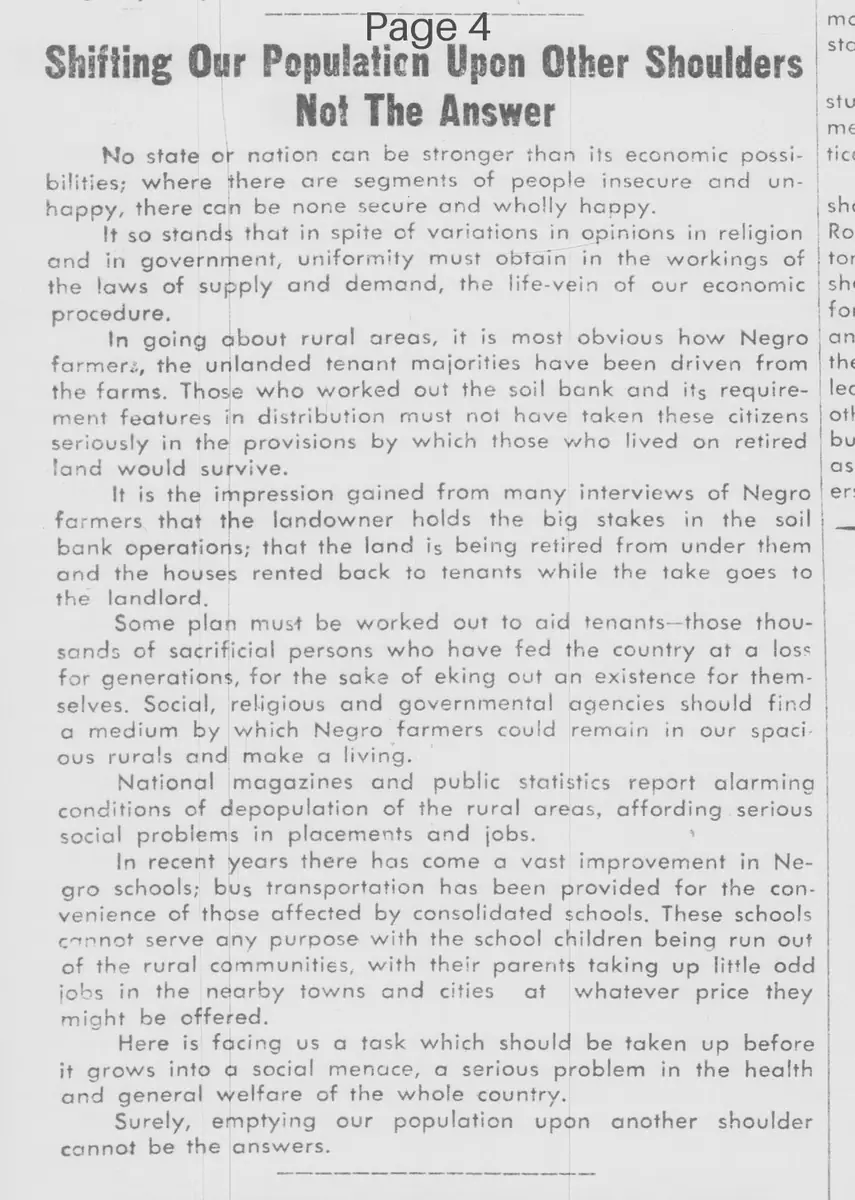
Shifting Our Population Upon Other Shoulders
Not The Answer
No state or nation can be stronger than its economic possibilities; where there are segments of people insecure and unhappy, there can be none secure and wholly happy.
It so stands that in spite of variations in opinions in religion and in government, uniformity must obtain in the workings of the laws of supply and demand, the life-vein of our economic procedure.
In going about rural areas, it is most obvious how Negro farmers, the unlanded tenant majorities have been driven from the farms. Those who worked out the soil bank and its requirement features in distribution must not have taken these citizens seriously in the provisions by which those who lived on retired land would survive.
It is the impression gained from many interviews of Negro farmers that the landowner holds the big stakes in the soil bank operations; that the land is being retired from under them and the houses rented back to tenants while the take goes to the landlord.
Some plan must be worked out to aid tenants-those thousands of sacrificial persons who have fed the country at a loss for generations, for the sake of eking out an existence for themselves. Social, religious and governmental agencies should find a medium by which Negro farmers could remain in our spacious rurals and make a living.
National magazines and public statistics report alarming conditions of depopulation of the rural areas, affording serious social problems in placements and jobs.
In recent years there has come a vast improvement in Negro schools; bus transportation has been provided for the convenience of those affected by consolidated schools. These schools cannot serve any purpose with the school children being run out of the rural communities, with their parents taking up little odd jobs in the nearby towns and cities at whatever price they might be offered.
Here is facing us a task which should be taken up before it grows into a social menace, a serious problem in the health and general welfare of the whole country.
Surely, emptying our population upon another shoulder cannot be the answers.
Not The Answer
No state or nation can be stronger than its economic possibilities; where there are segments of people insecure and unhappy, there can be none secure and wholly happy.
It so stands that in spite of variations in opinions in religion and in government, uniformity must obtain in the workings of the laws of supply and demand, the life-vein of our economic procedure.
In going about rural areas, it is most obvious how Negro farmers, the unlanded tenant majorities have been driven from the farms. Those who worked out the soil bank and its requirement features in distribution must not have taken these citizens seriously in the provisions by which those who lived on retired land would survive.
It is the impression gained from many interviews of Negro farmers that the landowner holds the big stakes in the soil bank operations; that the land is being retired from under them and the houses rented back to tenants while the take goes to the landlord.
Some plan must be worked out to aid tenants-those thousands of sacrificial persons who have fed the country at a loss for generations, for the sake of eking out an existence for themselves. Social, religious and governmental agencies should find a medium by which Negro farmers could remain in our spacious rurals and make a living.
National magazines and public statistics report alarming conditions of depopulation of the rural areas, affording serious social problems in placements and jobs.
In recent years there has come a vast improvement in Negro schools; bus transportation has been provided for the convenience of those affected by consolidated schools. These schools cannot serve any purpose with the school children being run out of the rural communities, with their parents taking up little odd jobs in the nearby towns and cities at whatever price they might be offered.
Here is facing us a task which should be taken up before it grows into a social menace, a serious problem in the health and general welfare of the whole country.
Surely, emptying our population upon another shoulder cannot be the answers.
What sub-type of article is it?
Agriculture
Economic Policy
Social Reform
What keywords are associated?
Negro Farmers
Tenant Displacement
Soil Bank
Rural Depopulation
Economic Insecurity
Social Reform
Negro Schools
What entities or persons were involved?
Negro Farmers
Landowners
Soil Bank
Social Agencies
Religious Agencies
Governmental Agencies
Negro Schools
Editorial Details
Primary Topic
Displacement Of Negro Tenant Farmers By Soil Bank Program
Stance / Tone
Critical Of Soil Bank Impacts On Tenants, Advocating For Aid To Rural Negro Farmers
Key Figures
Negro Farmers
Landowners
Soil Bank
Social Agencies
Religious Agencies
Governmental Agencies
Negro Schools
Key Arguments
No State Or Nation Stronger Than Economic Possibilities; Insecure Segments Affect All
Uniformity In Supply And Demand Laws Essential To Economy
Negro Tenant Farmers Driven From Farms By Soil Bank
Landowners Benefit From Soil Bank While Tenants Lose Land And Homes
Need Plan To Aid Tenants Who Have Fed Country At Loss
Social, Religious, Governmental Agencies Should Help Negro Farmers Stay Rural
Rural Depopulation Causes Serious Social Problems In Jobs And Placements
Improvements In Negro Schools Wasted As Families Flee Rural Areas
Task To Address Before Becoming Social Menace To National Welfare
Shifting Population To Cities Not The Answer