Thank you for visiting SNEWPapers!
Sign up free
Editorial
May 11, 1953
The Augusta Courier
Augusta, Richmond County, Georgia
What is this article about?
Editorial criticizes U.S. military and civilian leaders for incompetence in handling the ammunition shortage during the Korean War, as revealed by Senate investigations. It highlights failures in communication, control, and policy under Truman administration, comparing it to historical weaknesses.
Clipping
OCR Quality
98%
Excellent
Full Text
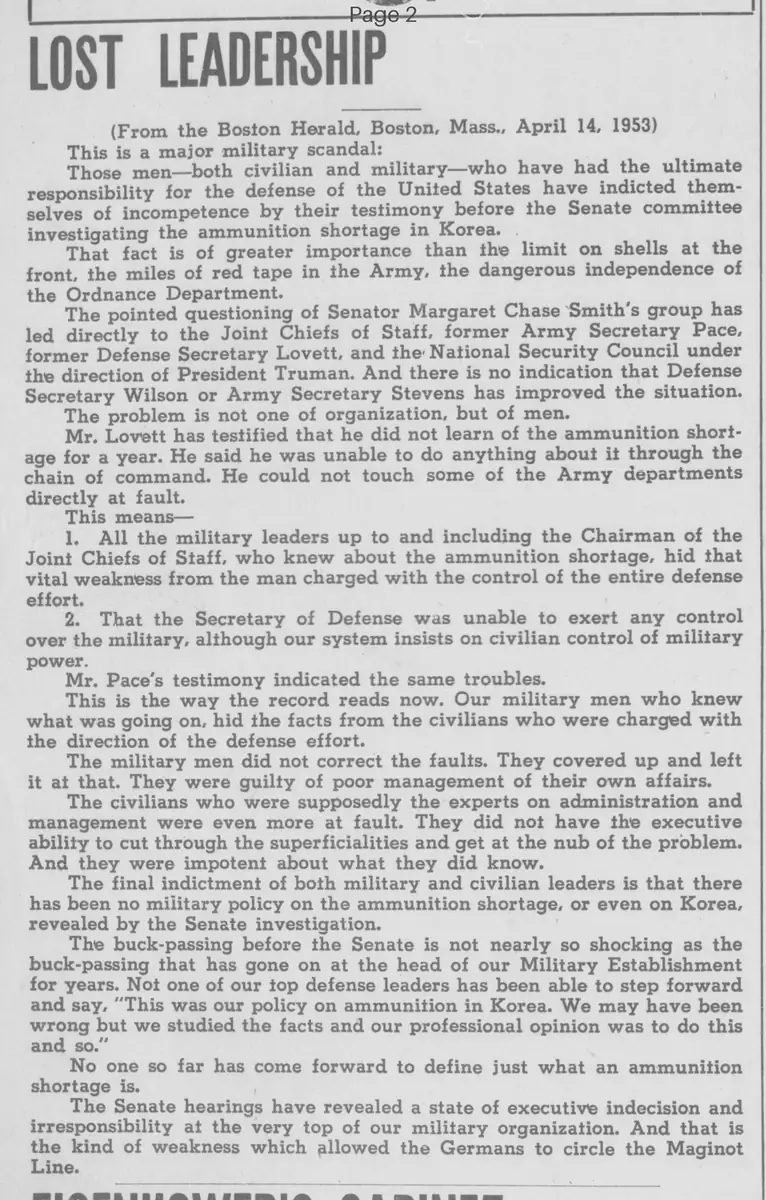
LOST LEADERSHIP
(From the Boston Herald, Boston, Mass., April 14, 1953)
This is a major military scandal:
Those men—both civilian and military—who have had the ultimate responsibility for the defense of the United States have indicted themselves of incompetence by their testimony before the Senate committee investigating the ammunition shortage in Korea.
That fact is of greater importance than the limit on shells at the front, the miles of red tape in the Army, the dangerous independence of the Ordnance Department.
The pointed questioning of Senator Margaret Chase Smith's group has led directly to the Joint Chiefs of Staff, former Army Secretary Pace, former Defense Secretary Lovett, and the National Security Council under the direction of President Truman. And there is no indication that Defense Secretary Wilson or Army Secretary Stevens has improved the situation.
The problem is not one of organization, but of men.
Mr. Lovett has testified that he did not learn of the ammunition shortage for a year. He said he was unable to do anything about it through the chain of command. He could not touch some of the Army departments directly at fault.
This means—
1. All the military leaders up to and including the Chairman of the Joint Chiefs of Staff, who knew about the ammunition shortage, hid that vital weakness from the man charged with the control of the entire defense effort.
2. That the Secretary of Defense was unable to exert any control over the military, although our system insists on civilian control of military power.
Mr. Pace's testimony indicated the same troubles.
This is the way the record reads now. Our military men who knew what was going on, hid the facts from the civilians who were charged with the direction of the defense effort.
The military men did not correct the faults. They covered up and left it at that. They were guilty of poor management of their own affairs.
The civilians who were supposedly the experts on administration and management were even more at fault. They did not have the executive ability to cut through the superficialities and get at the nub of the problem.
And they were impotent about what they did know.
The final indictment of both military and civilian leaders is that there has been no military policy on the ammunition shortage, or even on Korea, revealed by the Senate investigation.
The buck-passing before the Senate is not nearly so shocking as the buck-passing that has gone on at the head of our Military Establishment for years. Not one of our top defense leaders has been able to step forward and say, "This was our policy on ammunition in Korea. We may have been wrong but we studied the facts and our professional opinion was to do this and so."
No one so far has come forward to define just what an ammunition shortage is.
The Senate hearings have revealed a state of executive indecision and irresponsibility at the very top of our military organization. And that is the kind of weakness which allowed the Germans to circle the Maginot Line.
(From the Boston Herald, Boston, Mass., April 14, 1953)
This is a major military scandal:
Those men—both civilian and military—who have had the ultimate responsibility for the defense of the United States have indicted themselves of incompetence by their testimony before the Senate committee investigating the ammunition shortage in Korea.
That fact is of greater importance than the limit on shells at the front, the miles of red tape in the Army, the dangerous independence of the Ordnance Department.
The pointed questioning of Senator Margaret Chase Smith's group has led directly to the Joint Chiefs of Staff, former Army Secretary Pace, former Defense Secretary Lovett, and the National Security Council under the direction of President Truman. And there is no indication that Defense Secretary Wilson or Army Secretary Stevens has improved the situation.
The problem is not one of organization, but of men.
Mr. Lovett has testified that he did not learn of the ammunition shortage for a year. He said he was unable to do anything about it through the chain of command. He could not touch some of the Army departments directly at fault.
This means—
1. All the military leaders up to and including the Chairman of the Joint Chiefs of Staff, who knew about the ammunition shortage, hid that vital weakness from the man charged with the control of the entire defense effort.
2. That the Secretary of Defense was unable to exert any control over the military, although our system insists on civilian control of military power.
Mr. Pace's testimony indicated the same troubles.
This is the way the record reads now. Our military men who knew what was going on, hid the facts from the civilians who were charged with the direction of the defense effort.
The military men did not correct the faults. They covered up and left it at that. They were guilty of poor management of their own affairs.
The civilians who were supposedly the experts on administration and management were even more at fault. They did not have the executive ability to cut through the superficialities and get at the nub of the problem.
And they were impotent about what they did know.
The final indictment of both military and civilian leaders is that there has been no military policy on the ammunition shortage, or even on Korea, revealed by the Senate investigation.
The buck-passing before the Senate is not nearly so shocking as the buck-passing that has gone on at the head of our Military Establishment for years. Not one of our top defense leaders has been able to step forward and say, "This was our policy on ammunition in Korea. We may have been wrong but we studied the facts and our professional opinion was to do this and so."
No one so far has come forward to define just what an ammunition shortage is.
The Senate hearings have revealed a state of executive indecision and irresponsibility at the very top of our military organization. And that is the kind of weakness which allowed the Germans to circle the Maginot Line.
What sub-type of article is it?
Military Affairs
War Or Peace
What keywords are associated?
Ammunition Shortage
Korea War
Military Leadership
Civilian Control
Senate Investigation
Defense Policy
What entities or persons were involved?
Senate Committee
Margaret Chase Smith
Joint Chiefs Of Staff
Frank Pace
Robert Lovett
National Security Council
President Truman
Charles Wilson
Robert Stevens
Editorial Details
Primary Topic
Ammunition Shortage In Korea And Leadership Incompetence
Stance / Tone
Strongly Critical Of Military And Civilian Defense Leaders
Key Figures
Senate Committee
Margaret Chase Smith
Joint Chiefs Of Staff
Frank Pace
Robert Lovett
National Security Council
President Truman
Charles Wilson
Robert Stevens
Key Arguments
Military Leaders Hid Ammunition Shortage From Civilian Superiors.
Secretary Of Defense Unable To Control Military Despite Civilian Authority.
No Clear Military Policy On Korea Or Ammunition Revealed.
Buck Passing And Indecision At Top Of Military Establishment.
Both Military And Civilians Failed In Management And Execution.