Thank you for visiting SNEWPapers!
Sign up free
Editorial
November 16, 1796
Gazette Of The United States, & Philadelphia Daily Advertiser
Philadelphia, Philadelphia County, Pennsylvania
What is this article about?
Phocion No. XXIII critiques Thomas Jefferson's 1793 commercial report for errors, false reasoning, and advocating hostile trade measures against Britain amid passions, contrasting it with the successful 1794 Jay Treaty that achieved reciprocity and security on Jefferson's suggested principles, averting war.
Clipping
OCR Quality
95%
Excellent
Full Text
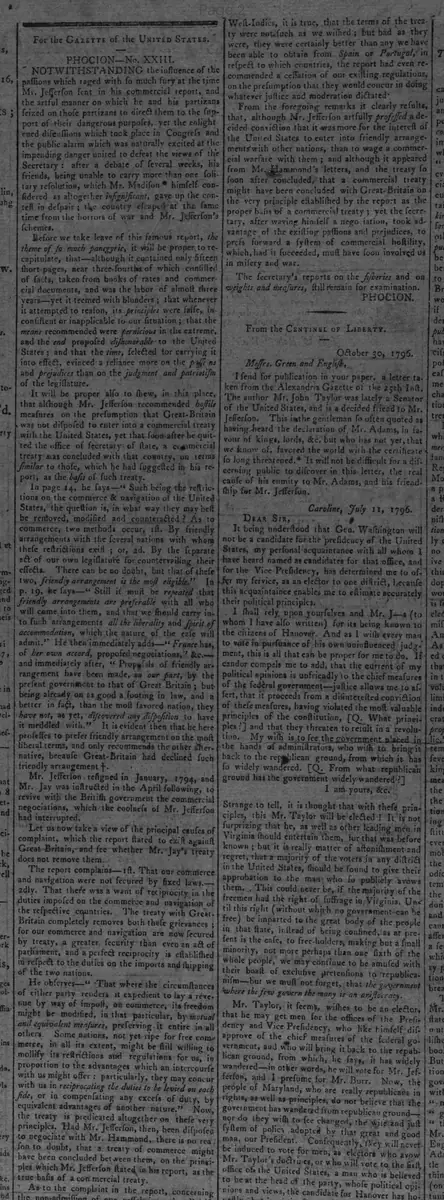
For the Gazette of the United States.
PHOCION-No. XXIII.
NOTWITHSTANDING the influence of the
passions which raged with so much fury at the time
Mr. Jefferson sent in his commercial report, and
the artful manner in which he and his partizans
seized on those passions to direct them to the sup-
port of their dangerous purposes, yet the cool, enlightened discussions which took place in Congress and
the public alarm which was naturally excited at the
impending danger united to defeat the views of the
Secretary: after a debate of several weeks, his
friends, being unable to carry more than one soli-
tary resolution, which Mr. Madison himself con-
sidered as altogether insignificant, gave up the con-
test in despair; the country escaped at the same
time from the horrors of war and Mr. Jefferson's
schemes.
Before we take leave of this famous report, the
theme of so much panegyric, it will be proper to re-
capitulate, that-although it contained only fifteen
short pages, near three fourths. of which consisted
of facts, taken from books of rates and commer-
CIAL documents, and was the labor of almost three
years- yet it teemed with blunders; that whenever
it attempted to reason, its principles were false, in-
CONSISTENT or inapplicable to our situation; that the
means recommended were pernicious in the extreme,
and the end proposed dishonorable to the United
States; and that the time, selected for carrying it
into effect, evinced a reliance more on the passions
and prejudices than on the judgment and patriotism
of the legislature.
It will be proper also to show, in this place,
that although Mr. Jefferson recommended hostile
measures on the presumption that Great-Britain
was not disposed to enter into a commercial treaty
with the United States, yet that soon after he quit-
ted the office of secretary of state, a commercial
treaty was concluded with that country, on terms
similar to those, which he had suggested in his re-
port, as the basis of such treaty.
In page 14, he says-" Such being the restrictions
on the commerce & navigation of the United
States, the question is, in what way they may be
be removed, modified and counteracted? As to
commerce, two methods occur, 1st. By friendly
arrangements with the several nations with whom
these restrictions exist ; or, 2d. By the separate
act of our own legislature for countervailing their
effects. There can be no doubt, but that of these
two, friendly arrangement is the most eligible." In
p. 19, he says-" Still it must be repeated that
friendly arrangements are preferable with all who
will come into :hem, and that we should carry in-
TO such arrangements all the liberality and spirit of
accommodation, which the nature of the case will
admit." He then immediately adds-" France has,
of her own accord, proposed negociations," &c.-
and immediately after, " Proposals of friendly ar-
rangement have been made, on our part, by the
present government to that of Great. Britain ; but
being already on as good a footing in law, and a
better in fact, than the most favored nation, they
have not, as yet, discovered any disposition to have
it meddled with." It is evident then that he here
professes to prefer friendly arrangement on the most
liberal terms, and only recommends the other alter-
native, because Great-Britain had declined such
friendly arrangement.
Mr. Jefferson resigned in January, 1794, and
Mr. Jay was instructed in the April following, to
revive with the British government the commercial
negociations, which the coolness of Mr. Jefferson
had interrupted.
Let us now take a view of the principal causes of
complaint, which the report stated to exist against
Great Britain, and see whether Mr. Jay's treaty
does not remove them.
The report complains-1st. That our commerce
and navigation were not secured by fixed laws.-
2dly. That there was a want of reciprocity in the
duties imposed on the commerce and navigation of
the respective countries. The treaty with Great.
Britain completely removes both these grievances ;
for our commerce and navigation are now secured
by treaty, a greater security than even an act of
parliament, and a perfect reciprocity is established
in respect to the duties on the imports and shipping
of the two nations.
He observes-" That where the circumstances
of either party renders it expedient to lay a reve-
nue by way of impost, on commerce, its freedom
might be modified, in that particular, by mutual
and equivalent: measures, preserving. it entire in all
others. Some nations, not yet ripe for free com-
merce, in all its extent, might be still willing to
mollify its restrictions aid regulations for us, in
proportion to the advantages which an intercourse
with us might offer : particularly, they may concur
with us in reciprocating tbe duties to be levied on each
side, or in compensating any excess of duty, by
equivalent advantages of another nature. " Now,
the treaty is predicated altogether on these very
principles. Had Mr. Jefferson, then, been disposed
to negociate with Mr. Hammond. there is no rea-
son to doubt, that a treaty of commerce might
have been concluded bet ween them, on the princi-
ples which Mr. Jefferson stated in his report, as the
true basis of a commercial treaty.
As to the complaint in the report, concerning
the, non-admission of our vessels into the British
West-Indies. it is true, that the terms of the trea-
ty were not.such as we wished; but bad as they
were, they were certainly better than any we have
been able to obtain from Spain or Portugal, in
respect to which countries, the report had even re-
commended a cessation of our existing regulations,
on the presumption that they would concur in doing
whatever justice and moderation dictated
From the foregoing remarks it clearly results,
that, although Mr. Jefferson artfully professed a de-
cided conviction that it was more for the interest of
the United States to enter into friendly arrange-
ments with other nations, than to wage a commer-
cial warfare with them ; and although it appeared
from Mr. Hammond's letters, and the treaty so
soon after concluded. that a commercial treaty
might have been concluded with Great-Britain on
the very principle established by the report as the
proper basis vf a commercial treaty ; yet the secre-
tary, after waving himself a nego iation, took ad-
vantage of the existing passions and prejudices, to
prcs forward a ystem of commercial hotility.
which, had it ucceeded, mut have oon involved us
in miery and war.
The secretary's reports on the fisheries and on
weights and meaures, still remain for examination.
PHOCION.
PHOCION-No. XXIII.
NOTWITHSTANDING the influence of the
passions which raged with so much fury at the time
Mr. Jefferson sent in his commercial report, and
the artful manner in which he and his partizans
seized on those passions to direct them to the sup-
port of their dangerous purposes, yet the cool, enlightened discussions which took place in Congress and
the public alarm which was naturally excited at the
impending danger united to defeat the views of the
Secretary: after a debate of several weeks, his
friends, being unable to carry more than one soli-
tary resolution, which Mr. Madison himself con-
sidered as altogether insignificant, gave up the con-
test in despair; the country escaped at the same
time from the horrors of war and Mr. Jefferson's
schemes.
Before we take leave of this famous report, the
theme of so much panegyric, it will be proper to re-
capitulate, that-although it contained only fifteen
short pages, near three fourths. of which consisted
of facts, taken from books of rates and commer-
CIAL documents, and was the labor of almost three
years- yet it teemed with blunders; that whenever
it attempted to reason, its principles were false, in-
CONSISTENT or inapplicable to our situation; that the
means recommended were pernicious in the extreme,
and the end proposed dishonorable to the United
States; and that the time, selected for carrying it
into effect, evinced a reliance more on the passions
and prejudices than on the judgment and patriotism
of the legislature.
It will be proper also to show, in this place,
that although Mr. Jefferson recommended hostile
measures on the presumption that Great-Britain
was not disposed to enter into a commercial treaty
with the United States, yet that soon after he quit-
ted the office of secretary of state, a commercial
treaty was concluded with that country, on terms
similar to those, which he had suggested in his re-
port, as the basis of such treaty.
In page 14, he says-" Such being the restrictions
on the commerce & navigation of the United
States, the question is, in what way they may be
be removed, modified and counteracted? As to
commerce, two methods occur, 1st. By friendly
arrangements with the several nations with whom
these restrictions exist ; or, 2d. By the separate
act of our own legislature for countervailing their
effects. There can be no doubt, but that of these
two, friendly arrangement is the most eligible." In
p. 19, he says-" Still it must be repeated that
friendly arrangements are preferable with all who
will come into :hem, and that we should carry in-
TO such arrangements all the liberality and spirit of
accommodation, which the nature of the case will
admit." He then immediately adds-" France has,
of her own accord, proposed negociations," &c.-
and immediately after, " Proposals of friendly ar-
rangement have been made, on our part, by the
present government to that of Great. Britain ; but
being already on as good a footing in law, and a
better in fact, than the most favored nation, they
have not, as yet, discovered any disposition to have
it meddled with." It is evident then that he here
professes to prefer friendly arrangement on the most
liberal terms, and only recommends the other alter-
native, because Great-Britain had declined such
friendly arrangement.
Mr. Jefferson resigned in January, 1794, and
Mr. Jay was instructed in the April following, to
revive with the British government the commercial
negociations, which the coolness of Mr. Jefferson
had interrupted.
Let us now take a view of the principal causes of
complaint, which the report stated to exist against
Great Britain, and see whether Mr. Jay's treaty
does not remove them.
The report complains-1st. That our commerce
and navigation were not secured by fixed laws.-
2dly. That there was a want of reciprocity in the
duties imposed on the commerce and navigation of
the respective countries. The treaty with Great.
Britain completely removes both these grievances ;
for our commerce and navigation are now secured
by treaty, a greater security than even an act of
parliament, and a perfect reciprocity is established
in respect to the duties on the imports and shipping
of the two nations.
He observes-" That where the circumstances
of either party renders it expedient to lay a reve-
nue by way of impost, on commerce, its freedom
might be modified, in that particular, by mutual
and equivalent: measures, preserving. it entire in all
others. Some nations, not yet ripe for free com-
merce, in all its extent, might be still willing to
mollify its restrictions aid regulations for us, in
proportion to the advantages which an intercourse
with us might offer : particularly, they may concur
with us in reciprocating tbe duties to be levied on each
side, or in compensating any excess of duty, by
equivalent advantages of another nature. " Now,
the treaty is predicated altogether on these very
principles. Had Mr. Jefferson, then, been disposed
to negociate with Mr. Hammond. there is no rea-
son to doubt, that a treaty of commerce might
have been concluded bet ween them, on the princi-
ples which Mr. Jefferson stated in his report, as the
true basis of a commercial treaty.
As to the complaint in the report, concerning
the, non-admission of our vessels into the British
West-Indies. it is true, that the terms of the trea-
ty were not.such as we wished; but bad as they
were, they were certainly better than any we have
been able to obtain from Spain or Portugal, in
respect to which countries, the report had even re-
commended a cessation of our existing regulations,
on the presumption that they would concur in doing
whatever justice and moderation dictated
From the foregoing remarks it clearly results,
that, although Mr. Jefferson artfully professed a de-
cided conviction that it was more for the interest of
the United States to enter into friendly arrange-
ments with other nations, than to wage a commer-
cial warfare with them ; and although it appeared
from Mr. Hammond's letters, and the treaty so
soon after concluded. that a commercial treaty
might have been concluded with Great-Britain on
the very principle established by the report as the
proper basis vf a commercial treaty ; yet the secre-
tary, after waving himself a nego iation, took ad-
vantage of the existing passions and prejudices, to
prcs forward a ystem of commercial hotility.
which, had it ucceeded, mut have oon involved us
in miery and war.
The secretary's reports on the fisheries and on
weights and meaures, still remain for examination.
PHOCION.
What sub-type of article is it?
Economic Policy
Foreign Affairs
Partisan Politics
What keywords are associated?
Jefferson Report
Commercial Treaty
Jay Treaty
Great Britain
Trade Restrictions
Foreign Negotiations
What entities or persons were involved?
Mr. Jefferson
Mr. Madison
Mr. Jay
Great Britain
Congress
Mr. Hammond
Editorial Details
Primary Topic
Critique Of Jefferson's Commercial Report And Defense Of Jay's Treaty
Stance / Tone
Strongly Critical Of Jefferson's Policies And Supportive Of Commercial Treaty With Britain
Key Figures
Mr. Jefferson
Mr. Madison
Mr. Jay
Great Britain
Congress
Mr. Hammond
Key Arguments
Jefferson's Commercial Report Contained Blunders And False Principles
The Report Promoted Pernicious And Dishonorable Measures Relying On Passions
A Commercial Treaty With Britain Was Concluded Soon After Jefferson's Resignation On Terms Similar To His Suggestions
Jay's Treaty Removed Complaints About Insecure Commerce And Lack Of Reciprocity
Jefferson Preferred Friendly Arrangements But Pushed Hostility Due To Prejudices
The Treaty With Britain Was Better Than Those With Spain Or Portugal