Thank you for visiting SNEWPapers!
Sign up free
The National Intelligencer And Washington Advertiser
Washington, District Of Columbia
What is this article about?
B. Henry Latrobe's engineering estimates for locks, turning dock, and naval arsenal at Washington Navy Yard total $390,181. Thomas Tingey's October 1802 report details water supply options from Stoddert's Spring and Tiber Creek, estimated at $27,295 by commissioners.
Merged-components note: Continuation of Thomas Tingey's letter to Hon. Robert Smith regarding the navy yard water supply, split across pages due to parsing.
Clippings
1 of 2
OCR Quality
Full Text
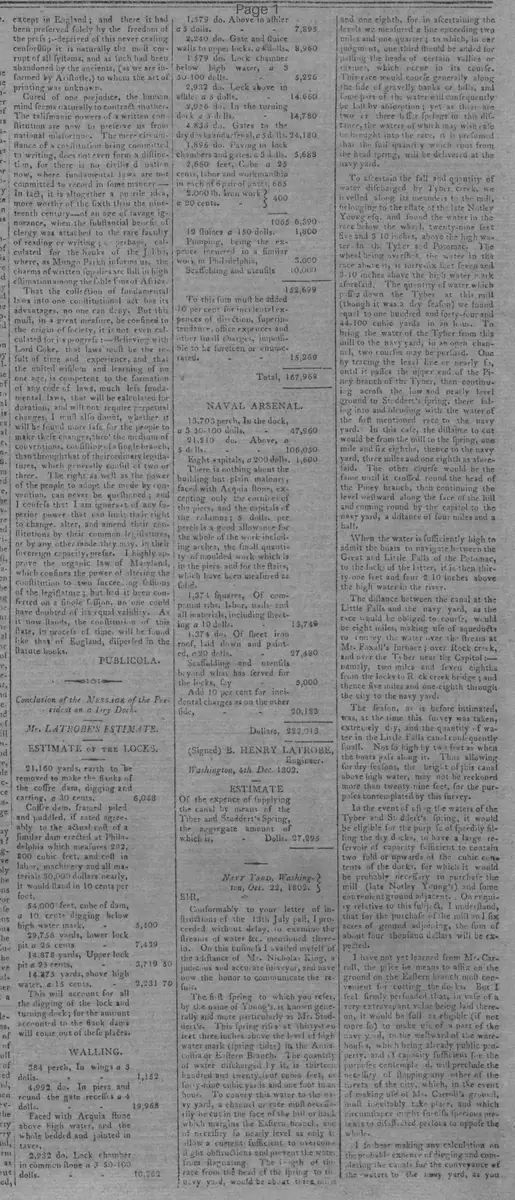
Mr. LATROBE'S ESTIMATE.
ESTIMATE OF THE LOCKS.
21,160 yards, earth to be removed to make the flanks of the coffer dam, digging and carting, @ 30 cents, 6,048
Coffer dam, framed piled and puddled, if rated agreeably to the actual cost of a similar dam erected at Philadelphia which measures 292,800 cubic feet, and cost in labor, machinery and all materials 30,000 dollars nearly, it would stand in 10 cents per foot, 54,000 feet, cube of dam, @ 10 cents digging below high water mark, 5,100
29,756 yards, lower lock pit @ 25 cents 7,439
14,878 yards, Upper lock pit @ 25 cents, 3,719 50
14,875 yards, above high water, @ 15 cents, 2,231 70
This will account for all the digging of the lock and turning dock; for the amount accounted to the flank dams will come out of these places.
WALLING.
384 perch, In wings @ 3 dolls. 1,152
4,992 do. In piers and round the gate recesses @ 4 dolls. 19,968
Faced with Aquia stone above high water, and the whole bedded and jointed in lime, 2,932 do. Lock chamber in common stone @ 3 50-100 dolls. 10,262
1,579 do. Above in ashlar @ 5 dolls. 7,895
2,240 do. Gate and sluice walls to upper locks, @4 dolls. 8,960
1,579 do. Lock chamber below high water, @ 3 50.100 dolls. 5,226
2,932 do. Lock above in ashlar @ 5 dolls. 14,660
2,956 do. In the turning dock @ 5 dolls. 14,780
4,833 do. Gates to the dry docks and arsenal, @5 dolls. 24,180
1,896 do. Paving in lock chambers and gates, @ 3 dolls. 5,688
2,650 feet, Cube @ 25 cents, labor and workmanship in each of 6 pair of gate, 665
2,000 lb. Iron work @ 20 cents. 400
1,065 6,390
12 sluices @ 150 dolls. 1,800
Pumping, being the expense incurred in a similar work in Philadelphia, 3,000
Scaffolding and utensils 10,000
152,699
To this sum must be added 10 per cent for incidental expenses of direction, superintendence, office expenses and other small charges, impossible to be foreseen or enumerated. 15,269
Total, 167,968
NAVAL ARSENAL.
13,703 perch, In the dock, @ 3 50.100 dolls. 47,960
21,210 do. Above, @ 5 dolls. 106,050
Eight capitals, @ 200 dolls. 1,600
There is nothing about the building but plain masonry, faced with Aquia stone, excepting only the cornices of the piers, and the capitals of the columns; 5 dolls. per perch is a good allowance for the whole of the work including arches, the small quantity of moulded work which is in the piers. and for the stairs, which have been measured as solid.
1,374 squares, Of compound ribs, labor. nails-and all materials, including hectoring @ 10 dolls. 13,740
1.374 do. Of sheet iron roof, laid down and painted, @20 dolls. 27,480
Scaffolding and utensils by and what has served for the locks, 5,000
Add 10 per cent for incidental charges as on the other side, 20,193
Dollars, 222,213
(Signed) B. HENRY LATROBE,
Engineer.
Washington, 4th Dec. 1802.
ESTIMATE
Of the expense of supplying the canal by means of the Tiber and Stoddert's Spring, the aggregate amount of which is,
Dolls. 27,295
Navy Yard, Washington, Oct. 22, 1802.
SIR,
Conformably to your letter of instructions of the 13th July past, I proceeded without delay, to examine the streams of water &c. mentioned therein. On this business I availed myself of the assistance of Mr. Nicholas King, a judicious and accurate surveyor, and have now the honor to communicate the result.
The first spring to which you refer, by the name of Young's, is known generally and more particularly as Mr. Stoddert's. This spring rises at thirty-two feet three inches above the level of high water mark (spring tides) in the Anacostia or Eastern Branch. The quantity of water discharged by it, is thirteen hundred and twenty-four cubic feet, or forty-nine cubic yards and one foot in an hour. To convey this water to the navy yard, a channel or race must necessarily be cut in the face of the hill or bank which margins the Eastern branch, and of necessity so nearly level as only to allow a current sufficient to overcome slight obstructions and prevent the water, from stagnating. The length of this race from the head of the spring to the navy yard, would be about three miles and one eighth, for in ascertaining the levels we measured a line exceeding two miles and one quarter; to which, in our judgment, one third should be added for passing the heads of certain vallies or ravines, which occur in its course.
This race would course generally along the side of gravelly banks or hills, and some part of the water will consequently be lost by absorption; yet as there are two or three ker springs in this distance, the waters of which may with ease be brought into the race, it is presumed that the full quantity which runs from the head spring, will be delivered at the navy yard.
To ascertain the fall and quantity of water discharged by Tyber creek, we levelled along its meanders to the mill, belonging to the estate of the late Notley Young eq. and found the water in the race below the wheel, twenty-nine feet five and 3/10 inches, above the high water in the Tyber and Potomac. The wheel being overshot the water in the race above it, is forty-six feet seven and 3/10 inches above the high water mark aforesaid, The quantity of water which passes down the Tyber at this mill (though it was a dry season) we found equal to one hundred and forty-four and 44/100 cubic yards in an hour. To bring the water of the Tyber from this mill to the navy yard, in an open channel, two routes may be pursued. One by tracing the level line or nearly so. until it passes the upper end of the Piney branch of the Tyber, then continuing across the low and nearly level ground to Stoddert's spring, there falling into and blending with the water of the first mentioned race to the navy yard. In this case, the distance to cut would be from the mill to the spring, one mile and six eighths, thence to the navy yard, three miles and one eighth as aforesaid. The other course would be the same until it crossed round the head of the Piney branch, then continuing the level westward along the face of the hill and coming round by the capitol to the navy yard, a distance of four miles and a half.
When the water is sufficiently high to admit the boats to navigate between the Great and Little Falls of the Potomac, to the locks of the latter, it is then thirty-one feet and four 2/10 inches above the high water in the river.
The distance between the canal at the Little Falls and the navy yard, as the race would be obliged to course, would be eight miles, making use of aqueducts to convey the water over the stream at Mr. Foxall's furnace; over Rock creek, and over the Tiber near the Capitol:- namely, two miles and seven eighths from the locks to Rock creek bridge ; and thence five miles and one eighth through the city to the navy yard.
The season, as is before intimated, was, at the time this survey was taken, extremely dry, and the quantity of water in the Little Falls canal consequently small. Not so high by two feet as when the boats pass along it. Thus allowing for dry seasons, the height of this canal above high water, may not be reckoned more than twenty-nine feet, or the purposes contemplated by this survey.
In the event of using the waters of the Tyber and Stoddert's spring, it would be eligible for the purpose of speedily filling the dry docks,, to have a large reservoir of capacity sufficient to contain two fold or upwards of the cubic contents of the docks. for which it would be probably necessary to purchase the mill (late Notley Young's) and some convenient ground adjacent. On enquiry relative to this subject, I understand, that for the purchase of the mill and six acres of ground adjoining, the sum of about four thousand dollars will be expected.
I have not yet learned from Mr. Carroll, the price he means to ask on the ground on the Eastern branch most convenient for cutting the docks. But I feel firmly persuaded that, in case of a very extravagant value being laid thereon, it would be full as eligible (if not more so) to make use of a part of the navy yard, to the westward of the warehouses, which being already public property, and of capacity sufficient for the purposes contemplated, will preclude the necessity of stopping any other of the streets of the city, which, in the event of making use of Mr. Carroll's ground, must inevitably take place, and which circumstance might furnish specious pretexts to disaffected persons to oppose the whole.
I forbear making any calculation on the probable expense of digging and completing the canals for the conveyance of the waters to the navy yard, as you directed that this part of the business should be referred to the Commissioners.
are in possession of superior data for the purpose than any I am capacitated to give.
I have the honor to be,
With much respect,
Sir,
Your obedient servant,
(Signed) THOMAS TINGEY.
Hon. ROBERT SMITH.
What sub-type of article is it?
What keywords are associated?
What entities or persons were involved?
Where did it happen?
Domestic News Details
Primary Location
Washington Navy Yard, Washington
Event Date
Oct. 22, 1802 And Dec. 4, 1802
Key Persons
Outcome
locks and dock estimate: $167,968; naval arsenal estimate: $222,213; water supply canal estimate: $27,295
Event Details
Engineering estimates by B. Henry Latrobe for constructing locks, turning dock, and naval arsenal at Washington Navy Yard, including detailed costs for earth removal, coffer dam, walling, iron work, and incidentals. Thomas Tingey's survey report on water supply from Stoddert's Spring and Tiber Creek to the navy yard, including measurements of water flow, proposed routes for channels, and recommendations for reservoir and land use.