Thank you for visiting SNEWPapers!
Sign up free
Story
June 14, 1911
The River Press
Fort Benton, Chouteau County, Montana
What is this article about?
James Gayley, VP of US Steel, testifies in Washington on June 9 before House committee, denying Andrew Carnegie's threats forced the corporation's formation and admitting prior price consultations with railroads to avoid monopoly. He details Carnegie Steel's history from 1885-1901.
Clipping
OCR Quality
98%
Excellent
Full Text
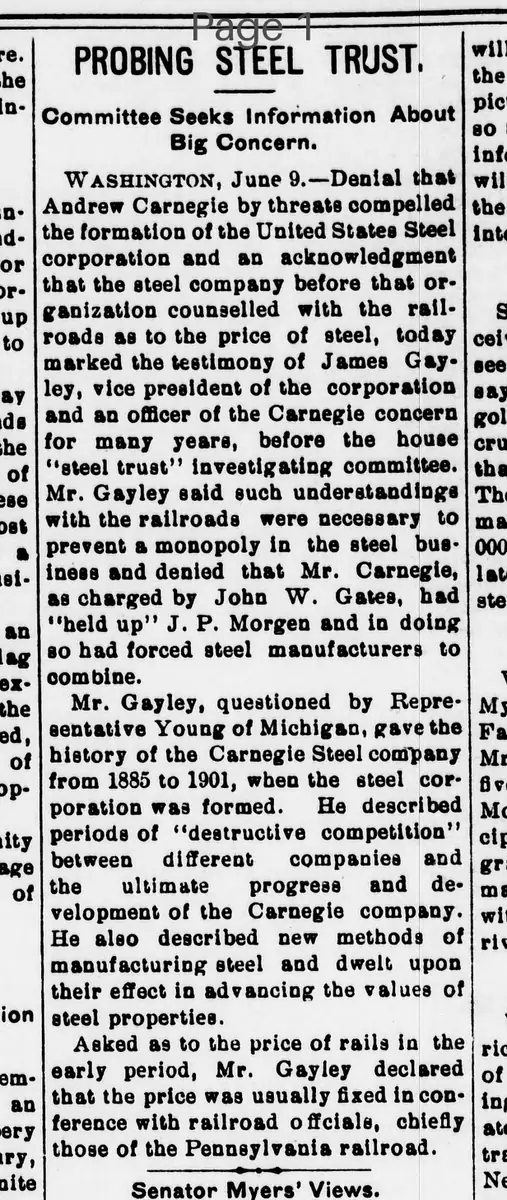
PROBING STEEL TRUST
Committee Seeks Information About Big Concern.
WASHINGTON, June 9.—Denial that Andrew Carnegie by threats compelled the formation of the United States Steel corporation and an acknowledgment that the steel company before that organization counselled with the railroads as to the price of steel, today marked the testimony of James Gayley, vice president of the corporation and an officer of the Carnegie concern for many years, before the house “steel trust” investigating committee.
Mr. Gayley said such understandings with the railroads were necessary to prevent a monopoly in the steel business and denied that Mr. Carnegie, as charged by John W. Gates, had “held up” J. P. Morgan and in doing so had forced steel manufacturers to combine.
Mr. Gayley, questioned by Representative Young of Michigan, gave the history of the Carnegie Steel company from 1885 to 1901, when the steel corporation was formed. He described periods of “destructive competition” between different companies and the ultimate progress and development of the Carnegie company.
He also described new methods of manufacturing steel and dwelt upon their effect in advancing the values of steel properties.
Asked as to the price of rails in the early period, Mr. Gayley declared that the price was usually fixed in conference with railroad officials, chiefly those of the Pennsylvania railroad.
Committee Seeks Information About Big Concern.
WASHINGTON, June 9.—Denial that Andrew Carnegie by threats compelled the formation of the United States Steel corporation and an acknowledgment that the steel company before that organization counselled with the railroads as to the price of steel, today marked the testimony of James Gayley, vice president of the corporation and an officer of the Carnegie concern for many years, before the house “steel trust” investigating committee.
Mr. Gayley said such understandings with the railroads were necessary to prevent a monopoly in the steel business and denied that Mr. Carnegie, as charged by John W. Gates, had “held up” J. P. Morgan and in doing so had forced steel manufacturers to combine.
Mr. Gayley, questioned by Representative Young of Michigan, gave the history of the Carnegie Steel company from 1885 to 1901, when the steel corporation was formed. He described periods of “destructive competition” between different companies and the ultimate progress and development of the Carnegie company.
He also described new methods of manufacturing steel and dwelt upon their effect in advancing the values of steel properties.
Asked as to the price of rails in the early period, Mr. Gayley declared that the price was usually fixed in conference with railroad officials, chiefly those of the Pennsylvania railroad.
What sub-type of article is it?
Historical Event
What themes does it cover?
Justice
Deception
What keywords are associated?
Steel Trust
Andrew Carnegie
United States Steel
Investigation
Testimony
Railroad Consultations
What entities or persons were involved?
James Gayley
Andrew Carnegie
John W. Gates
J. P. Morgan
Representative Young
Where did it happen?
Washington
Story Details
Key Persons
James Gayley
Andrew Carnegie
John W. Gates
J. P. Morgan
Representative Young
Location
Washington
Event Date
June 9
Story Details
James Gayley testifies before House committee investigating steel trust, denying Carnegie's threats forced US Steel formation, acknowledging pre-corporation consultations with railroads on steel prices, and outlining Carnegie Steel history from 1885-1901.