Thank you for visiting SNEWPapers!
Sign up free
Literary
October 31, 1789
Gazette Of The United States
New York, New York County, New York
What is this article about?
An essay arguing that true wealth accumulation requires not just industry but a ruling passion for money and frugality. It distinguishes love of gain from love of money, critiques poor education in saving, and advises teaching children economy to prevent riches from 'taking wings and flying away.'
Clipping
OCR Quality
98%
Excellent
Full Text
[No. LVIII.]
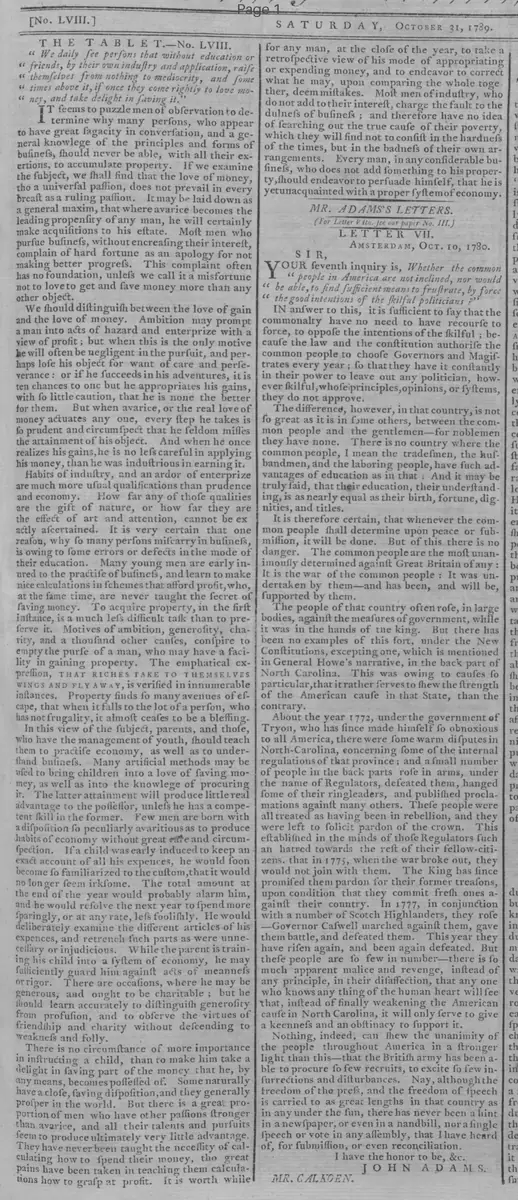
THE TABLET.-No. LVIII.
"We daily see persons that without education or friends, by their own industry and application, raise themselves from nothing to mediocrity, and sometimes above it, if once they come rightly to love money, and take delight in saving it."
It seems to puzzle men of observation to determine why many persons, who appear to have great sagacity in conversation, and a general knowledge of the principles and forms of business, should never be able, with all their exertions, to accumulate property. If we examine the subject, we shall find that the love of money, though a universal passion, does not prevail in every breast as a ruling passion. It may be laid down as a general maxim, that where avarice becomes the leading propensity of any man, he will certainly make acquisitions to his estate. Most men who pursue business, without increasing their interest, complain of hard fortune as an apology for not making better progress. This complaint often has no foundation, unless we call it a misfortune not to love to get and save money more than any other object.
We should distinguish between the love of gain and the love of money. Ambition may prompt a man into acts of hazard and enterprise with a view of profit; but when this is the only motive he will often be negligent in the pursuit, and perhaps lose his object for want of care and perseverance: or if he succeeds in his adventures, it is ten chances to one but he appropriates his gains, with so little caution, that he is none the better for them. But when avarice, or the real love of money actuates any one, every step he takes is so prudent and circumspect that he seldom misses the attainment of his object. And when he once realizes his gains, he is no less careful in applying his money, than he was industrious in earning it.
Habits of industry, and an ardor of enterprise are much more usual qualifications than prudence and economy. How far any of those qualities are the gift of nature, or how far they are the effect of art and attention, cannot be exactly ascertained. It is very certain that one reason, why so many persons miscarry in business, is owing to some errors or defects in the mode of their education. Many young men are early inured to the practice of business, and learn to make nice calculations in schemes that afford profit, who, at the same time, are never taught the secret of saving money. To acquire property, in the first instance, is a much less difficult task than to preserve it. Motives of ambition, generosity, charity, and a thousand other causes, conspire to empty the purse of a man, who may have a facility in gaining property. The emphatical expression, THAT RICHES TAKE TO THEMSELVES WINGS AND FLY AWAY, is verified in innumerable instances. Property finds so many avenues of escape, that when it falls to the lot of a person, who has not frugality, it almost ceases to be a blessing.
In this view of the subject, parents, and those, who have the management of youth, should teach them to practice economy, as well as to understand business. Many artificial methods may be used to bring children into a love of saving money, as well as into the knowledge of procuring it. The latter attainment will produce little real advantage to the possessor, unless he has a competent skill in the former. Few men are born with a disposition so peculiarly avaricious as to produce habits of economy without great care and circumspection. If a child was early induced to keep an exact account of all his expenses, he would soon become so familiarized to the custom, that it would no longer seem irksome. The total amount at the end of the year would probably alarm him, and he would resolve the next year to spend more sparingly, or at any rate, less foolishly. He would deliberately examine the different articles of his expenses, and retrench such parts as were unnecessary or injudicious. While the parent is training his child into a system of economy, he may sufficiently guard him against acts of meanness or rigor. There are occasions, where he may be generous, and ought to be charitable; but he should learn accurately to distinguish generosity from profusion, and to observe the virtues of friendship and charity without descending to weakness and folly.
There is no circumstance of more importance in instructing a child, than to make him take a delight in saving part of the money that he, by any means, becomes possessed of. Some naturally have a close, saving disposition, and they generally prosper in the world. But there is a great proportion of men who have other passions stronger than avarice, and all their talents and pursuits seem to produce ultimately very little advantage. They have never been taught the necessity of calculating how to spend their money, though great pains have been taken in teaching them calculations how to grasp at profit. It is worth while for any man, at the close of the year, to take a retrospective view of his mode of appropriating or expending money, and to endeavor to correct what he may, upon comparing the whole together, deem mistakes. Most men of industry, who do not add to their interest, charge the fault to the dulness of business; and therefore have no idea of searching out the true cause of their poverty, which they will find not to consist in the hardness of the times, but in the badness of their own arrangements. Every man, in any considerable business, who does not add something to his property, should endeavor to persuade himself, that he is yet unacquainted with a proper system of economy.
THE TABLET.-No. LVIII.
"We daily see persons that without education or friends, by their own industry and application, raise themselves from nothing to mediocrity, and sometimes above it, if once they come rightly to love money, and take delight in saving it."
It seems to puzzle men of observation to determine why many persons, who appear to have great sagacity in conversation, and a general knowledge of the principles and forms of business, should never be able, with all their exertions, to accumulate property. If we examine the subject, we shall find that the love of money, though a universal passion, does not prevail in every breast as a ruling passion. It may be laid down as a general maxim, that where avarice becomes the leading propensity of any man, he will certainly make acquisitions to his estate. Most men who pursue business, without increasing their interest, complain of hard fortune as an apology for not making better progress. This complaint often has no foundation, unless we call it a misfortune not to love to get and save money more than any other object.
We should distinguish between the love of gain and the love of money. Ambition may prompt a man into acts of hazard and enterprise with a view of profit; but when this is the only motive he will often be negligent in the pursuit, and perhaps lose his object for want of care and perseverance: or if he succeeds in his adventures, it is ten chances to one but he appropriates his gains, with so little caution, that he is none the better for them. But when avarice, or the real love of money actuates any one, every step he takes is so prudent and circumspect that he seldom misses the attainment of his object. And when he once realizes his gains, he is no less careful in applying his money, than he was industrious in earning it.
Habits of industry, and an ardor of enterprise are much more usual qualifications than prudence and economy. How far any of those qualities are the gift of nature, or how far they are the effect of art and attention, cannot be exactly ascertained. It is very certain that one reason, why so many persons miscarry in business, is owing to some errors or defects in the mode of their education. Many young men are early inured to the practice of business, and learn to make nice calculations in schemes that afford profit, who, at the same time, are never taught the secret of saving money. To acquire property, in the first instance, is a much less difficult task than to preserve it. Motives of ambition, generosity, charity, and a thousand other causes, conspire to empty the purse of a man, who may have a facility in gaining property. The emphatical expression, THAT RICHES TAKE TO THEMSELVES WINGS AND FLY AWAY, is verified in innumerable instances. Property finds so many avenues of escape, that when it falls to the lot of a person, who has not frugality, it almost ceases to be a blessing.
In this view of the subject, parents, and those, who have the management of youth, should teach them to practice economy, as well as to understand business. Many artificial methods may be used to bring children into a love of saving money, as well as into the knowledge of procuring it. The latter attainment will produce little real advantage to the possessor, unless he has a competent skill in the former. Few men are born with a disposition so peculiarly avaricious as to produce habits of economy without great care and circumspection. If a child was early induced to keep an exact account of all his expenses, he would soon become so familiarized to the custom, that it would no longer seem irksome. The total amount at the end of the year would probably alarm him, and he would resolve the next year to spend more sparingly, or at any rate, less foolishly. He would deliberately examine the different articles of his expenses, and retrench such parts as were unnecessary or injudicious. While the parent is training his child into a system of economy, he may sufficiently guard him against acts of meanness or rigor. There are occasions, where he may be generous, and ought to be charitable; but he should learn accurately to distinguish generosity from profusion, and to observe the virtues of friendship and charity without descending to weakness and folly.
There is no circumstance of more importance in instructing a child, than to make him take a delight in saving part of the money that he, by any means, becomes possessed of. Some naturally have a close, saving disposition, and they generally prosper in the world. But there is a great proportion of men who have other passions stronger than avarice, and all their talents and pursuits seem to produce ultimately very little advantage. They have never been taught the necessity of calculating how to spend their money, though great pains have been taken in teaching them calculations how to grasp at profit. It is worth while for any man, at the close of the year, to take a retrospective view of his mode of appropriating or expending money, and to endeavor to correct what he may, upon comparing the whole together, deem mistakes. Most men of industry, who do not add to their interest, charge the fault to the dulness of business; and therefore have no idea of searching out the true cause of their poverty, which they will find not to consist in the hardness of the times, but in the badness of their own arrangements. Every man, in any considerable business, who does not add something to his property, should endeavor to persuade himself, that he is yet unacquainted with a proper system of economy.
What sub-type of article is it?
Essay
What themes does it cover?
Commerce Trade
Moral Virtue
Temperance
What keywords are associated?
Frugality
Economy
Saving Money
Avarice
Business
Wealth Accumulation
Education Youth
Literary Details
Title
The Tablet. No. Lviii.
Key Lines
"We Daily See Persons That Without Education Or Friends, By Their Own Industry And Application, Raise Themselves From Nothing To Mediocrity, And Sometimes Above It, If Once They Come Rightly To Love Money, And Take Delight In Saving It."
It May Be Laid Down As A General Maxim, That Where Avarice Becomes The Leading Propensity Of Any Man, He Will Certainly Make Acquisitions To His Estate.
The Emphatical Expression, That Riches Take To Themselves Wings And Fly Away, Is Verified In Innumerable Instances.
To Acquire Property, In The First Instance, Is A Much Less Difficult Task Than To Preserve It.
Every Man, In Any Considerable Business, Who Does Not Add Something To His Property, Should Endeavor To Persuade Himself, That He Is Yet Unacquainted With A Proper System Of Economy.