Thank you for visiting SNEWPapers!
Sign up free
The Watchman And Southron
Sumter, Sumter County, South Carolina
What is this article about?
In Washington DC on Dec. 17, the arraignment of Harry T. Sinclair and Albert B. Fall on oil conspiracy charges was postponed to next Tuesday in the District of Columbia supreme court due to a crowded docket. Motions to quash the indictment by both were also deferred, with Fall's challenging special prosecutors' authority based on a Supreme Court decision.
Merged-components note: Continuation of the same story on the Sinclair and Fall arraignment, sequential reading order and coherent topic.
Clipping
OCR Quality
Full Text
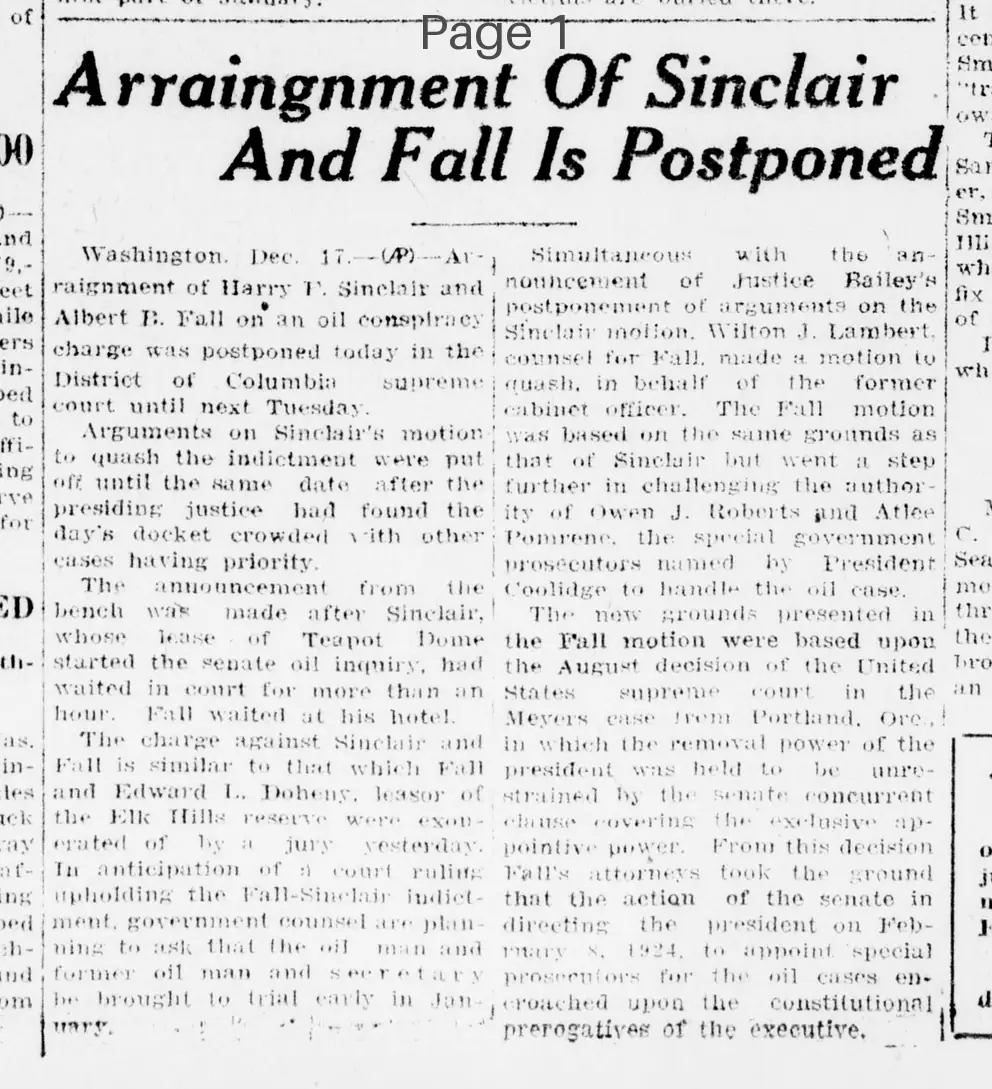
Washington, Dec. 17.--Arraignment of Harry T. Sinclair and Albert B. Fall on an oil conspiracy charge was postponed today in the District of Columbia supreme court until next Tuesday.
Arguments on Sinclair's motion to quash the indictment were put off until the same date after the presiding justice had found the day's docket crowded with other cases having priority.
The announcement from the bench was made after Sinclair, whose lease of Teapot Dome started the senate oil inquiry, had waited in court for more than an hour. Fall waited at his hotel.
The charge against Sinclair and Fall is similar to that which Fall and Edward L. Doheny, lessee of the Elk Hills reserve were exonerated of by a jury yesterday.
In anticipation of court ruling upholding the Fall-Sinclair indictment, government counsel are planning to ask that the oil man and former oil man and secretary be brought to trial early in January.
Simultaneous with the announcement of Justice Bailey's postponement of arguments on the Sinclair motion, Winton J. Lambert counsel for Fall, made a motion to quash, in behalf of the former cabinet officer. The Fall motion was based on the same grounds as that of Sinclair but went a step further in challenging the authority of Owen J. Roberts and Atlee Pomerene, the special government prosecutors named by President Coolidge to handle the oil case.
The new grounds presented in the Fall motion were based upon the August decision of the United States supreme court in the Myers case from Portland, Ore., in which the removal power of the president was held to be unrestrained by the senate concurrent clause covering the exclusive appointive power. From this decision Fall's attorneys took the ground that the action of the senate in directing the president on February 28, 1924, to appoint special prosecutors for the oil cases encroached upon the constitutional prerogatives of the executive.
What sub-type of article is it?
What keywords are associated?
What entities or persons were involved?
Where did it happen?
Domestic News Details
Primary Location
Washington
Event Date
Dec. 17
Key Persons
Outcome
arraignment and arguments on motions to quash postponed until next tuesday; government plans trial in early january; fall and doheny exonerated on similar charge yesterday.
Event Details
Arraignment of Sinclair and Fall on oil conspiracy charge postponed in District of Columbia supreme court due to crowded docket. Sinclair waited in court over an hour; Fall at hotel. Sinclair's Teapot Dome lease started senate inquiry. Fall's motion to quash challenges special prosecutors' authority based on Myers Supreme Court decision and Senate's February 28, 1924 directive.