Thank you for visiting SNEWPapers!
Sign up free
Gazette Of The United States, & Philadelphia Daily Advertiser
Philadelphia, Philadelphia County, Pennsylvania
What is this article about?
In a House of Representatives committee, members debated Mr. Nicholas's amendment to the response to the President's Speech, focusing on approbation of executive foreign measures and tone toward France. Speakers including Freeman, Griswold, Nicholas, Giles, Smith, Hartley, and Baldwin argued over relations with France, ministerial rejection, and avoiding war. The committee reported progress after further discussion.
Merged-components note: This is a continuation of the congressional debate on the response to the President's speech, split across pages due to independent page parsing; the text flows directly from one component to the next, forming a single coherent domestic political news article.
Clippings
1 of 2
OCR Quality
Full Text
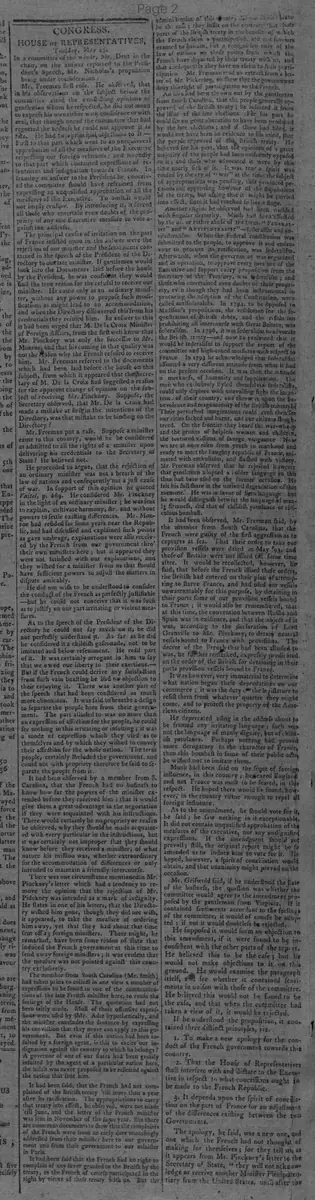
Mr. Freeman rose. He observed, that in his observations on the subject before the committee amidst the conflicting opinions of gentlemen whom he respected, he did not mean to express his own either with confidence or with zeal, that though one of the committee that had reported the address he could not approve it in toto. He had two principal objections to it.—First to that part which went to an unequivocal approbation of all the measures of the Executive respecting our foreign relations: and secondly to that part which contained expressions of resentment and indignation towards France. In framing an answer to the President he conceived the committee should have refrained from expressing an unqualified approbation of all the measures of the Executive. To omit it would not imply censure. By introducing it, it forced all those who entertain even doubts of the propriety of any one Executive measure to vote against the address.
The principal causes of irritation on the part of France insisted upon in the answer were the rejection of our minister and the sentiments contained in the speech of the President of the Directory to our late minister. If gentlemen would look into the Documents laid before the house by the President, he was confident they would find the true reason for the refusal to receive our minister. He came only as an ordinary minister, without any power to propose such modifications as might lead to an accommodation, and when the Directory discovered this from his credentials they refused him. In answer to this it had been urged that M. De la Croix Minister of Foreign Affairs, from the first well knew that Mr. Pinckney was only the successor to Mr. Monroe, and that his coming in that quality was not the reason why the French refused to receive him. Mr. Freeman referred to the documents which had been laid before the house on this subject, from which it appeared that the Secretary of M. De la Croix had suggested a reason for the apparent change of opinion on the subject of receiving Mr. Pinckney. Suppose, the Secretary observed, that Mr. De la Croix had made a mistake at first in the intentions of the Directory, was that mistake to be binding on the Directory?
Mr. Freeman put a case. Suppose a minister came to this country, would he be considered as admitted to all the rights of a minister upon delivering his credentials to the Secretary of State? He believed not.
He proceeded to argue, that the rejection of an ordinary minister was not a breach of the law of nations and consequently not a just cause of war. In support of this opinion he quoted Vattel, p. 669. He considered Mr. Pinckney in the light of an ordinary minister; he was sent to explain, cultivate harmony, &c. and without powers to settle existing differences. Mr. Monroe had resided for some years near the Republic, and had discussed and explained such points as gave umbrage, explanations were also received by the French from our government thro' their own ministers here; but it appeared they were not satisfied with our explanations, and they wished for a minister from us that should have sufficient powers to adjust the matters in dispute amicably.
He did not wish to be understood to consider the conduct of the French as perfectly justifiable—but he could not conceive that it was such as to justify on our part irritating or violent measures.
As to the speech of the President of the Directory he could not say much on it, he did not perfectly understand it. As far as he did he considered it a childish gasconade, not to be imitated and below resentment. He read part of it. It was certainly arrogant in him to say that we owed our liberty to their exertions.—But if the French could derive any satisfaction from such vain boasting he had no objection to their enjoying it. There was another part of the speech that had been considered as much more obnoxious. It was said to breathe a design to separate the people here from their government. The part alluded to was no more than an expression of affection for the people, he could see nothing in this irritating or insulting; it was a mode of expression which they used as to themselves and by which they wished to convey their affection for the whole nation. The term people, certainly included the government. and could not with propriety therefore be said to separate the people from it.
It had been observed by a member from S. Carolina, that the French had no business to know how far the powers of the minister extended before they received him: that it would give them a great advantage in the negociation if they were acquainted with his instructions. There would certainly be no propriety or reason be observed, why they should be made acquainted with every particular in the instructions, but it was certainly not improper that they should know before they received a minister, of what nature his mission was, whether extraordinary or the accommodation of differences or only intended to maintain a friendly intercourse.
There was one circumstance mentioned in Mr. Pinckney's letter which had a tendency to remove the opinion that the rejection of Mr. Pinckney was intended as a mark of indignity. He states in one of his letters, that the Directory wished him gone, though they did not wish, it appeared, to take the measure of ordering him away, yet that they had about that time sent off 13 foreign ministers. There might, he remarked, have been some reason of state that induced the French government at this time to send away foreign ministers; it was evident that the measure was not pointed against this country exclusively.
The member from South Carolina (Mr. Smith) had taken pains to collect in one view a number of expressions to be found in one of the communications of the late French minister here, to rouse the feelings of the House. The quotation had not been fairly made. Most of those offensive expressions—were used by Mr. Adet hypothetically, and the minister concludes the sentence by expressing his conviction that they never can apply to this government. But even if this nation had been insulted by a foreign agent, is this to excite our indignation against the country to which he belongs? A governor of one of our states had been grossly insulted by the agent of a particular nation here, the insult was never proposed to be resented against the nation that sent him.
It had been said, that the French had not complained of the British treaty 'till more than a year after its ratification. The appropriations to carry that treaty into effect, he observed, were not made 'till June, and the letter of the French minister was sent in November of the same year. But there are numerous documents to shew that the complaints of the French were from an early date unceasingly addressed from their minister here to our government and from their government to our minister in Paris.
It had been said that the French had no right to complain of any favor granted to the British by the treaty, as the French of course participated in the right by virtue of their treaty with us. But the administration of this country did not think so; they insist on the certainty that those parts of the British treaty in the benefit of which the French claim a participation, are most favors granted to Britain, but a recognition only of the law of nations on those points from which the French have departed by their treaty with us, and that consequently they have no claim to such participation. Mr. Freeman read an extract from a letter of Mr. Pickering, to shew that the government deny this right of participation to the French.
An idea had been thrown out by the gentleman from South Carolina, that the people generally approved of the British treaty; he inferred it from the issue of the late elections. For his part he could see no great alteration to have been produced by the late elections; and if there had been, it would not have been an evidence to his mind, that the people approved of the British treaty. He believed on his part, that the opinions of a great majority of the people had been uniformly opposed to it; and those who advocated it were by this time nearly sick of it. It was true a spirit was roused by the cry of "war" at the time the subject of appropriations was pending, that produced petitions not approving however of the stipulations of the treaty, but asking that it might be carried into effect, since it had reached so late a stage.
Another engine he observed had been wielded with singular dexterity. Much had been effected by the use or rather abuse of the term "Federalist" and "AntiFederalist"—federalism and antifederalism. When the Federal constitution was submitted to the people, to approve it and endeavour to procure its ratification, was federalism. Afterwards, when the government was organized and in operation, to approve every measure of the Executive and support every proposition from the Secretary of the Treasury, was Federalism; and those who entertained even doubts of their propriety, even though they had been instrumental in procuring the adoption of the Constitution, were called antifederalists. In 1794, to be opposed to Madison's propositions, the resolution for the sequestration of British debts, and the resolution prohibiting all intercourse with Great Britain, was federalism. In 1796, it was federalism to advocate the British treaty—and now he presumed that it would be federalism to support the report of the committee and high-toned measures with respect to France. In 1793 he acknowledged that federalism assumed a very different attitude from what it had on the present occasion. It was then the attitude of meekness, of humanity and supplication. The men who exclusively styled themselves federalists, could only deplore with unavailing sighs the impotence of their country, and throw it upon the benevolence and magnanimity of the British monarch. Their perturbed imaginations could even then see our cities sacked and burnt, and our citizens slaughtered. On the frontier they heard the war-whoop and the groans of helpless women and children, the tortured victims of savage vengeance. Now we are at once risen from youth to manhood and ready to meet the haughty republic of France, animated with enthusiasm, and flushed with victory.
Mr. Freeman observed that he rejoiced however that gentlemen adopted a bolder language on this than had been used on the former occasion. He felt his full share in the national degradation of that moment. He was in favor of firm language but he would distinguish betwixt the language of manly firmness, and that of childish petulance or ridiculous bombast.
It had been observed, Mr. Freeman said, by the member from South Carolina, that the French were guilty of the first aggression as to captures at sea. 'That their order to take our provision vessels were dated in May 93, and those of Britain were not issued till some time after. It would be recollected, however, he said, that before the French issued these orders, the British had entered on their plan of attempting to starve France, and had used our vessels unwarrantably for this purpose, by detaining in their ports some of our provision vessels bound to France; it would also be remembered, that at this time, the convention between Russia and Spain was in existence, and that the object of it was, according to the declaration of Lord Grenville to Mr. Pinckney, to detain neutral vessels bound to France with provisions. The decree of the French that had been alluded to was, he further remarked, expressly predicated on the order of the British for detaining in their ports provision vessels bound to France.
It was however, very immaterial to determine what nation began these depredations on our commerce; it was the duty of the legislature to resist them from whatever quarter they might come, and to protect the property of the American citizens.
He deprecated using in the address about to be framed any irritating language; such was not the language of manly dignity, but of childish petulance. Perhaps nothing had proved more derogatory to the character of France than this bombast in some of their public acts he wished not to imitate them.
Much had been said on the score of foreign influence, in this country; he feared England and not France was not to be feared, in this respect. He hoped there would be found, however; in the country virtue enough to repel all foreign influence.
As to the amendment, he should vote for it, he said; he saw nothing in it exceptionable. It did not contain unqualified approbation of the measures of the executive, nor any undignified expressions. If the amendment should not prevail; still, the original report might be so amended as to induce him to vote for it. He hoped, however, a spirit of conciliation would obtain, and that unanimity might prevail on the occasion.
Mr. Griswold said, if he understood the state of the business, the question was whether the committee would agree to the amendment proposed by the gentleman from Virginia. If it contained sentiments accordant to the feelings of the committee, it would of course be adopted; if not it would doubtless be rejected.
He supposed it would form an objection to this amendment, if it were found to be inconsistent with the other parts of the report. He believed this to be the case; but he would not make objections to it on this ground. He would examine the paragraph itself, and see whether it contained sentiments in unison with those of the committee. He believed this would not be found to be the case, and that when the committee had taken a view of it, it would be rejected.
If he understood the proposition, it contained three distinct principles, viz.
1. To make a new apology for the conduct of the French government towards this country.
2. That the House of Representatives Shall interfere with and dictate to the Executive in respect to what concessions ought to be made to the French Republic.
3. It depends upon the spirit of conciliation on the part of France for an adjustment of the differences existing between the two Governments.
The apology, he said, was a new one, and one which the French had not thought of making for themselves; for they tell us, as it appears from Mr. Pinckney's letters to the Secretary of State, "they will not acknowledge or receive another Minister Plenipotentiary from the United States, until after the
redress of the grievances lately made by the American government, and which the French Republic has a right to expect from it." We say (or rather the gentleman from Virginia says in his amendment) they rejected our Minister, because he had not power enough;—therefore for the apology now made for the French government they were indebted to the ingenuity of the mover.
Now, said Mr. Griswold, I do not wish that the House of Representatives should undertake to make apologies for the conduct of the French government towards this. It was true they needed apology; but he did not think it was proper for us to make them. Further, as this apology was not made by themselves, but wholly different from their own assertions it was not likely that they would fall into it. They say, "Permit us to sell our privateers in your ports, annul treaties and repeal laws, and then we will receive Mr. Pinckney, and then we will tell you on what terms we will make peace with you."
After this declaration, he did not think it would be proper to attempt any new apology for them. He therefore supposed, that so far as this proposition offered a new apology for the French Republic, it could not meet with the approbation of the committee.
The next proposition contained in the amendments was, that the House of Representatives should interfere with the Executive Power of this country, and dictate to it what sort of steps should be taken towards reconciling the French Government. He asked whether this was consonant to the principles of the Constitution? Whether the Constitution had not delegated the power of making treaties to other branches of the government? He believed it had, and that therefore we had no right to dictate to the Executive what should, or what should not be done with respect to present disputes with the French Government: On this ground, therefore, he considered it as improper.
In the next place, the amendment contained another proposition, viz. That we rely upon a spirit of conciliation on the part of France, for an accommodation of differences. And, said Mr. Griswold, do we really rely upon this? Have we such evidence as should incline us to rely upon it? Have the French government expressed any inclination to settle the differences subsisting between them and us? The communications which were received from the Supreme Executive, do not bear this complexion. The communication from the French Minister to this Executive does not wear it. Our proclamations are called insidious, our Minister is insulted and rejected; and attempts are made to divide the people of this country from their government. Is this conciliation? Does it not rather appear as if they intended to alienate the affections of the people from their government, in order to effect their own views? He was convinced it did, and that they could not rely upon a spirit of conciliation in them.
For his own part he did not rely upon it; he relied upon this country being able to convince the world that we are not a divided people; that we will not willingly abandon our government. When the French shall be convinced of this, they will not treat us with indignity. Therefore, he trusted, as the proposed amendment did not contain such sentiments as were likely to accord with the feelings of the committee, that it would be rejected.
As to entering into a lengthy discussion in behalf of different measures of government, he did not think it necessary. If, indeed, there had been a motion made to strike out any part of the reported answer, which went to an approbation of those measures, such a discussion might be indulged. As this was not the case, he should decline it.
Mr. Nicholas said he was very sorry that he should be again under the necessity of troubling the committee with an explanation of the proposition which he had submitted to their consideration.
They had been told by the gentleman last up that it had three objects, viz. to make a new apology for the French Government, to dictate what terms the Executive should use to restore a good understanding between the two countries, and to say that we rely upon a spirit of conciliation on the part of France for an accommodation.
He believed the gentlemen had wholly mistaken the proposition. In the first place it contained no apology for the conduct of France. In this respect he had not gone farther than the report itself, or the President. On the contrary, it would be found that the proposition expressed the strongest disapprobation of the conduct of the French Government to our minister, and went on to say, that if it were followed by similar measures, it would put an end to every friendly relation between the two countries. This showed a disposition for a restoration of a good understanding if it could be had; if not, that all friendship would be at an end: Did not the gentleman wish this? Did he come here with his sword ready whetted for war? He hoped not; he trusted there was not a member in that House who did not wish to preserve the peace of the country, if it could be done. If this were not the case, or if no serious expectations of success were expected from a new Envoy, Why send him?
He trusted negociations would be successful. He was seriously desirous of preserving the peace of the country; he did not leave home to attend his duty in that house for the purpose of declaring War, but of preserving Peace if possible.
That the proposition contains a kind of direction to the President, he allowed, which the gentleman might call dictating, if he pleased. He would ask what the President had done with respect to them? Had he not freely told them what he thought was proper for them to do? If they were not in return to say what they thought was proper, and upon what terms they would, or would not be reconciled to France, how could the Executive proceed with any certainty in his negociation. Was not the power of war committed to him? [No was heard from different quarters]. In effect, he said, it were so; or if they were not permitted to say to the Executive upon what terms they would with differences adjusted, they must go to war, if such terms as he if proposed were not agreed to. Suppose, said he, he should proceed to negociate with this French Republic, and should call Congress together some months hence and inform them he had been unsuccessful, should they not then be at liberty to say, Try other remedies? And if in such a case they had the liberty, why not exercise it now?
The 3d part, which the gentleman from Connecticut had given to his proposition, was not contained in it, viz. that we relied on a spirit of conciliation in France for accommodation. [He read that part of his proposition]. He did not say that there was a spirit of conciliation in that country upon which we could depend. He was sorry to say he could not even assure himself there was such a disposition in this; and if he had not an assurance of this disposition in his own country, he could not be supposed to rely upon it in France. If a mutual spirit of conciliation did exist (it was his intention to say) it would be a sufficient foundation for peace. This was his meaning, and he hoped it would not be perverted.
No member appearing inclined to rise, after Mr. Nicholas had sat down, there was a call for the question.
Mr. Giles said the subject under discussion was a very important one. It appeared to him, from various documents that all the steps taken by the Executive had a view to an eventual appeal to arms, which it was his wish (as it was the wish of many in that House) to avoid. It was proper, therefore, that the clashing opinions should be discussed. If the proposition brought forward for this purpose was not sufficiently simple and explicit, he wished it might be made more so. For he believed the question to be, whether the committee be prepared to pass a vote, approving of the whole course of the conduct of the Executive, or whether France should be put upon the same ground with the other Belligerent Powers. That she is at present upon the same footing, no gentleman had attempted to show. Gentlemen who wished to get rid of this ground, say this is a thing which should be left to the Executive. He thought it was however a proper subject for their discussion; for whatever power the Executive had with respect to making of treaties, the House had the means of checking that power. Suppose said Mr. G. I were on this occasion called upon to tax my land, was it not necessary I should enquire into the subject, and endeavour to avoid a measure which would probably prove a serious drain upon the blood and treasure of the country? He was unwilling to have his land taxed for the purpose of supporting a war on this principle. It was evident that the French took one ground in this dispute, and the United States another, and whilst this continued to be the case, no negociation would have any effect. Indeed, said he, it is war; and if the measure proposed was taken, we make war if we do not declare it.
He had merely thrown out these ideas; if no gentleman was prepared to go into the subject, he should move that the committee now rise, report progress, and ask leave to sit again.
Mr. W. Smith hoped the committee would not rise. He thought the best way of coming to an understanding of the proposition would be to discuss it. If it were not understood, it would be wrong to vote for it; but he believed it was well understood. He thought the gentleman from Connecticut (Mr. Griswold) had given a clear analysis of it. He hoped gentlemen would, therefore, either proceed in the discussion, or take a vote upon the question; for as they could not proceed with any other subject until this was disposed of, it would only be a waste of time for the committee now to rise.
Mr. Hartley commenced some observations on the amendment, when the chairman informed him the motion before them, was whether the committee should rise.
Mr. Giles withdrew his motion.
Mr. Hartley said gentlemen argued as if the adoption of the answer as reported, would be to declare war. He thought no such thing. It was the wish of the friends of the report (at least it was his wish) to preserve the country in peace, but to place it in a state of defence; but he hoped it would not be taken for granted, that every proposition in the speech of the President would be carried into effect. He hoped they should continue to discuss the question. At present he was decidedly against the amendment.
Mr. Baldwin said he had taken the liberty to express his concern several years ago, that this custom of answering the President's speech which was but a mere piece of public ceremony, should call up and demand expressions of opinion on all the important business of the session, while the members were yet standing with their hats in their hands, in the attitude of receiving the communications and had not yet read or opened the papers which were the ground of their being called together. It applied very strongly in this instance, as this was a new Congress, and a greater proportion than common of new members. He thought it an unfavourable attitude in which to be hurried into the very midst of things, and to anticipate business of such vast importance to the country, before they had time to attend to the information which had been submitted to them. He trusted some fit occasion would before long be found to disencumber themselves of a ceremony now in this country, which tended only to evil and to increasing embarrassments. He observed that it was under the influence of these impressions, he had made it a rule to himself for many sessions to vote for those amendments and those propositions in the address which were most delphic and ambiguous, and while they were respectful to the President, left the house unpledged and open to take up the business of the session as it presented itself in its ordinary course. It was on this ground he should vote for the amendment now under consideration.
He also noticed three particulars, in which he thought the proposed amendment preferable to the report of the committee. 1st. The report of the committee had in it twice repeated general and indefinite approbation of the measures of the executive towards foreign nations, when it was well known that a majority of the house had for four years past, been of a different opinion, and it must be supposed many of the present house were of a different opinion. He thought it well not to leap out of their course to express any opinion on that subject, or to court opposition. 2. He thought the address contained too many epithets and superlatives. It was a style of writing which well became youth and passion in some circumstances, more rarely the experience and gravity of advanced life, and very seldom reconcileable to the dignity of a public assembly. He also noticed indignant, inciguity, and negotiation, repeated not less than three or four times in a dozen lines. He thought it would be found difficult on trial to remove these objections from the report without proposing new sentences as the amendment had done; it was thought the amendment was too low on the other extreme; the word sensibility, in the 5th line, might be changed into indignation, for once, and in several other places by the change of a word, it might be exactly graduated to the temper of the house. 3. There was one thought in the amendment which he wished to be contained in the address, which was not in the report of the committee, viz. the hope of success from sending an envoy extraordinary to treat specially on the grievances complained of, free ships making free goods, articles of contraband, &c. on the basis of strict equality to foreign nations, as to the objection that expressing this wish is dictating to the executive on the subject of treaties, and therefore unconstitutional, he thought the objection had equal force against the whole address, and all answers to the President's speeches, which are nothing but expressions of congratulations, or opinions, or wishes on executive measures.
Yesterday in the House of Representatives, the amendment of Mr. Nicholas to the reported answer to the speech of the President, was again under consideration. Mr. Giles occupied three hours in a speech in favor of the amendment: Mr. Gallatin followed him on the same side, and the sitting was closed by a few observations from Mr. W. Smith on some expressions which fell from Mr. Gallatin. The committee of the whole reported progress, and had leave to sit again.
What sub-type of article is it?
What keywords are associated?
What entities or persons were involved?
Where did it happen?
Domestic News Details
Primary Location
House Of Representatives
Key Persons
Outcome
the committee reported progress and had leave to sit again; debate on the amendment continued without resolution.
Event Details
Debate in committee of the whole on Mr. Nicholas's amendment to the response to the President's Speech, addressing approbation of executive foreign policy measures, French rejection of U.S. minister, and avoiding irritating language toward France. Speakers critiqued the original report and defended or opposed the amendment, emphasizing peace, conciliation, and constitutional roles.