Thank you for visiting SNEWPapers!
Sign up free
Editorial
September 23, 1887
The Willimantic Journal
Willimantic, Windham County, Connecticut
What is this article about?
Editorial urges targeting neutral citizens in the prohibition debate, critiques divisions among prohibitionists over methods like political parties or total abstinence, and endorses incremental laws and efforts to weaken the rum power, per the Toledo Blade.
Clipping
OCR Quality
98%
Excellent
Full Text
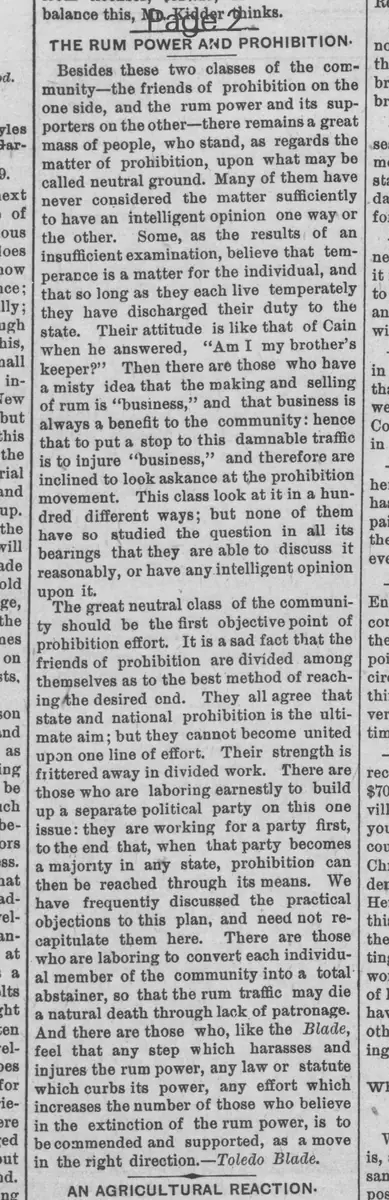
THE RUM POWER AND PROHIBITION.
Besides these two classes of the community—the friends of prohibition on the one side, and the rum power and its supporters on the other—there remains a great mass of people, who stand, as regards the matter of prohibition, upon what may be called neutral ground. Many of them have never considered the matter sufficiently to have an intelligent opinion one way or the other. Some, as the results of an insufficient examination, believe that temperance is a matter for the individual, and that so long as they each live temperately they have discharged their duty to the state. Their attitude is like that of Cain when he answered, "Am I my brother's keeper?" Then there are those who have a misty idea that the making and selling of rum is 'business,' and that business is always a benefit to the community; hence that to put a stop to this damnable traffic is to injure 'business,' and therefore are inclined to look askance at the prohibition movement. This class look at it in a hundred different ways; but none of them have so studied the question in all its bearings that they are able to discuss it reasonably, or have any intelligent opinion upon it.
The great neutral class of the community should be the first objective point of prohibition effort. It is a sad fact that the friends of prohibition are divided among themselves as to the best method of reaching the desired end. They all agree that state and national prohibition is the ultimate aim; but they cannot become united upon one line of effort. Their strength is frittered away in divided work. There are those who are laboring earnestly to build up a separate political party on this one issue: they are working for a party first, to the end that, when that party becomes a majority in any state, prohibition can then be reached through its means. We have frequently discussed the practical objections to this plan, and need not recapitulate them here. There are those who are laboring to convert each individual member of the community into a total abstainer, so that the rum traffic may die a natural death through lack of patronage. And there are those who, like the Blade, feel that any step which harasses and injures the rum power, any law or statute which curbs its power, any effort which increases the number of those who believe in the extinction of the rum power, is to be commended and supported, as a move in the right direction.—Toledo Blade.
Besides these two classes of the community—the friends of prohibition on the one side, and the rum power and its supporters on the other—there remains a great mass of people, who stand, as regards the matter of prohibition, upon what may be called neutral ground. Many of them have never considered the matter sufficiently to have an intelligent opinion one way or the other. Some, as the results of an insufficient examination, believe that temperance is a matter for the individual, and that so long as they each live temperately they have discharged their duty to the state. Their attitude is like that of Cain when he answered, "Am I my brother's keeper?" Then there are those who have a misty idea that the making and selling of rum is 'business,' and that business is always a benefit to the community; hence that to put a stop to this damnable traffic is to injure 'business,' and therefore are inclined to look askance at the prohibition movement. This class look at it in a hundred different ways; but none of them have so studied the question in all its bearings that they are able to discuss it reasonably, or have any intelligent opinion upon it.
The great neutral class of the community should be the first objective point of prohibition effort. It is a sad fact that the friends of prohibition are divided among themselves as to the best method of reaching the desired end. They all agree that state and national prohibition is the ultimate aim; but they cannot become united upon one line of effort. Their strength is frittered away in divided work. There are those who are laboring earnestly to build up a separate political party on this one issue: they are working for a party first, to the end that, when that party becomes a majority in any state, prohibition can then be reached through its means. We have frequently discussed the practical objections to this plan, and need not recapitulate them here. There are those who are laboring to convert each individual member of the community into a total abstainer, so that the rum traffic may die a natural death through lack of patronage. And there are those who, like the Blade, feel that any step which harasses and injures the rum power, any law or statute which curbs its power, any effort which increases the number of those who believe in the extinction of the rum power, is to be commended and supported, as a move in the right direction.—Toledo Blade.
What sub-type of article is it?
Temperance
Social Reform
What keywords are associated?
Prohibition
Rum Power
Temperance
Neutral Class
Social Reform
Alcohol Traffic
What entities or persons were involved?
Rum Power
Toledo Blade
Friends Of Prohibition
Editorial Details
Primary Topic
Efforts To Advance Prohibition By Targeting Neutrals And Supporting Incremental Measures
Stance / Tone
Supportive Of Prohibition And Critical Of Rum Power
Key Figures
Rum Power
Toledo Blade
Friends Of Prohibition
Key Arguments
Target Neutral Class First In Prohibition Efforts
Prohibitionists Divided On Methods Like Political Parties Or Total Abstinence
Support Any Steps That Harass And Injure The Rum Power
State And National Prohibition Is Ultimate Aim
Rum Traffic Harms Community Despite Being Seen As Business