Thank you for visiting SNEWPapers!
Sign up free
Literary
September 25, 1926
The Milwaukee Leader
Milwaukee, Milwaukee County, Wisconsin
What is this article about?
In this installment of the serialized story, Sophomore Bob Manley leads his class in a traditional flag rush at Lakeview Academy. Using strategy, the Sophomores nearly win, but Bob stops to help injured rival 'Dude' Rimley, allowing the Seniors to claim victory. The story builds toward a football game against Blenton.
Merged-components note: Serial literary story 'Bob Manley at Lakeview' with accompanying image; merged due to sequential reading order and spatial positioning.
Clipping
OCR Quality
85%
Good
Full Text
BOB MANLEY
AT LAKEVIEW
A Story of Prep School and the Football Field
By JACK GIHON
Author of "Prince Erik of Glaagsbaden," "The City of the Deep,"
"The Head Hunters of San Blas,"
etc.
When Bob Manley, a well-built young fellow of fifteen, was a Freshman at Lakeview Academy, he won the class presidency and the captaincy of the Freshman football team through his feat of planting the Freshman insignia on the flagpole during the annual class rush. Now, as a Sophomore, he displays the same sort of athletic prowess on the gridiron. Coach Rickey Dale and "Uncle Joe" Thomas, the trainer, agree he is a born football player, and through an undefeated season, he becomes the star of the team—incurring, however, the jealous enmity of "Dude" Rimley, who had failed to make the team. The team is perfectly groomed for its annual classic battle against Blenton, a neighboring school, on Thanksgiving Day. To keep the boys from going stale, Coach Dale consents to their taking part in the class rush on the Saturday evening before Thanksgiving.
NOW GO ON WITH THE STORY.
INSTALLMENT III.
"Uncle Joe" Thomas grumbled all through dinner at the training table Saturday evening.
"A fine kettle of fish this is," he mumbled. "A fine kettle of fish. How d'ye expect to play football if ye don't eat yer dinners?" he demanded. "You, Tom Waters, clean up yer plate—an' do it slow-like. An' you, you 'Runt' of a center, you're a fine 'un. I've never seen you eat so little in yer life—you, who's usually the pig o' the team!"
It was true. There was not much appetite shown at the training table that evening, for every one of the score or more boys there had his mind on the Quadrangle yard, where the class rush was to be held. The traditional rules were that the rush would start as the clock on Oakes Hall struck eight. At the north end of the Quad, the Seniors would be congregated. Directly opposite them, at the far south end, would be the Juniors. The Sophomores would start from the east end, while the Freshmen were scheduled to come charging up from the west. This was the manner in which the rush always was conducted. Each class selected a leader, who acted as an army general might during the evening; each leader was equipped with a large white flag with the class graduation year painted on it. The flags were done up in compact bundles for ease in passing from one classman to another; the students from each class wore their oldest clothes, for it promised to be a rough evening, and little respect for clothing would be shown.
It was already dusk, and during the rush the campus would be practically in darkness, which would add to the sport, for it made it harder to recognize one's own classmen, though each wore his class colors as an arm band, a scarf, or in some other manner.
By seven-thirty practically every one of the students was in his respective corner. Bob Manley was immediately and unanimously selected to lead his class in the rush, and he was busy sketching plans for them to follow. He had a plan of action which promised some success, and he had brought the others as close around him as possible to tell them what to do.
"When the clock strikes," he said, "it will be natural for everybody to rush to the center, when they'll get separated and all mixed up. Well, we'll wait a few moments, until I give the word, and as soon as they're scrambled enough, we'll come dashing in with a flying wedge, surround the flagpole with strong guard, while one of us climbs up with the flag."
So that there would be no mistake, he repeated his instructions, while the boys nodded in agreement. Bob looked over the field. To his right, he could make out the forms of the Seniors, with Steve Waters leading them. Husky "Runt" Davis was leader of the Juniors. He could not make out the Freshman leader.
The first note of the eight o'clock chimes struck, and the boys were on their toes, ready to dash toward the center. As the last note sounded, they made a concerted rush—that is, all except the Sophomores, who hovered back awaiting Bob Manley's signal. The other three factions met with a clash that echoed through the Quadrangle—a clash that must have sounded similar to that of listing knights in the days of King Arthur's court.
The battle was on. Freshman against Senior, Senior against Junior, pushing and scrambling and shouting with glee. Still Bob Manley's Sophomores held back, though they were aching to get into the fray.
Soon there was such a mix-up on the field that one hardly knew the other. It was then that Bob gave the much-wanted signal. A solid mass of boys, with a 150-pounder as the point of the wedge, came hurling its way toward the center, cutting sharply through those who blocked its way. In its center, not using too much of his energy for he knew he would need it all within the next few minutes, trotted Bob, the Sophomore flag rolled and tucked under his arm.
By this time the fight was so general that few realized this wedge was a concerted action. Opponents crumpled before the Sophomores as they went on. Nearer and nearer they came to the flagpole.
If Bob had had the whole football team on his side, victory would have been simple. As it was, he fought without the power of his teammates. Close to the flagpole, where the most feverish fighting centered, was Steve Waters, a star football player and a boy familiar with quick thinking. He saw the flying wedge as it battered its way closer, and saw, too, the victory that seemed imminent for the Sophomores.
"Rally, Seniors! Bust up the wedge!" he cried. "Tear it to pieces." A little group of Seniors rallied around him, hurling against the oncoming group—slowing them up a trifle. But still they advanced, intent on squirming their way around the staff, and forming a guard for Bob Manley.
Summoning all his strength, Steve Waters rushed at the wedge, having strategy enough to hit it on the side, instead of in front. It gave way, and he found himself in the center, close to Bob. "Ho, my buck-o," he breathed, and lunged at Bob to tackle him. But Bob saw an opening on the other side; he sidestepped, and reached the flagstaff.
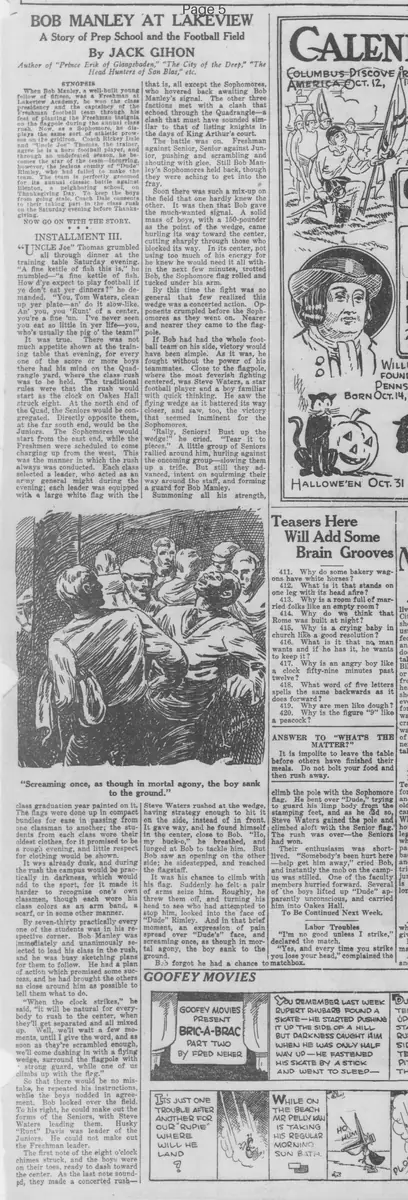
It was his chance to climb with his flag. Suddenly he felt a pair of arms seize him. Roughly, he threw them off, and turning his head to see who had attempted to stop him, looked into the face of "Dude" Rimley. And in that brief moment, an expression of pain spread over "Dude's" face, and screaming once, as though in mortal agony, the boy sank to the ground.
Bob forgot he had a chance to climb the pole with the Sophomore flag. He bent over "Dude," trying to guard his limp body from the stamping feet, and as he did so, Steve Waters gained the pole and climbed aloft with the Senior flag.
The rush was over—the Seniors had won. Their enthusiasm was short-lived. "Somebody's been hurt here—help get him away," cried Bob, and instantly the mob on the campus was stilled. One of the faculty members hurried forward. Several of the boys lifted up "Dude" apparently unconscious, and carried him into Oakes Hall.
To Be Continued Next Week.
AT LAKEVIEW
A Story of Prep School and the Football Field
By JACK GIHON
Author of "Prince Erik of Glaagsbaden," "The City of the Deep,"
"The Head Hunters of San Blas,"
etc.
When Bob Manley, a well-built young fellow of fifteen, was a Freshman at Lakeview Academy, he won the class presidency and the captaincy of the Freshman football team through his feat of planting the Freshman insignia on the flagpole during the annual class rush. Now, as a Sophomore, he displays the same sort of athletic prowess on the gridiron. Coach Rickey Dale and "Uncle Joe" Thomas, the trainer, agree he is a born football player, and through an undefeated season, he becomes the star of the team—incurring, however, the jealous enmity of "Dude" Rimley, who had failed to make the team. The team is perfectly groomed for its annual classic battle against Blenton, a neighboring school, on Thanksgiving Day. To keep the boys from going stale, Coach Dale consents to their taking part in the class rush on the Saturday evening before Thanksgiving.
NOW GO ON WITH THE STORY.
INSTALLMENT III.
"Uncle Joe" Thomas grumbled all through dinner at the training table Saturday evening.
"A fine kettle of fish this is," he mumbled. "A fine kettle of fish. How d'ye expect to play football if ye don't eat yer dinners?" he demanded. "You, Tom Waters, clean up yer plate—an' do it slow-like. An' you, you 'Runt' of a center, you're a fine 'un. I've never seen you eat so little in yer life—you, who's usually the pig o' the team!"
It was true. There was not much appetite shown at the training table that evening, for every one of the score or more boys there had his mind on the Quadrangle yard, where the class rush was to be held. The traditional rules were that the rush would start as the clock on Oakes Hall struck eight. At the north end of the Quad, the Seniors would be congregated. Directly opposite them, at the far south end, would be the Juniors. The Sophomores would start from the east end, while the Freshmen were scheduled to come charging up from the west. This was the manner in which the rush always was conducted. Each class selected a leader, who acted as an army general might during the evening; each leader was equipped with a large white flag with the class graduation year painted on it. The flags were done up in compact bundles for ease in passing from one classman to another; the students from each class wore their oldest clothes, for it promised to be a rough evening, and little respect for clothing would be shown.
It was already dusk, and during the rush the campus would be practically in darkness, which would add to the sport, for it made it harder to recognize one's own classmen, though each wore his class colors as an arm band, a scarf, or in some other manner.
By seven-thirty practically every one of the students was in his respective corner. Bob Manley was immediately and unanimously selected to lead his class in the rush, and he was busy sketching plans for them to follow. He had a plan of action which promised some success, and he had brought the others as close around him as possible to tell them what to do.
"When the clock strikes," he said, "it will be natural for everybody to rush to the center, when they'll get separated and all mixed up. Well, we'll wait a few moments, until I give the word, and as soon as they're scrambled enough, we'll come dashing in with a flying wedge, surround the flagpole with strong guard, while one of us climbs up with the flag."
So that there would be no mistake, he repeated his instructions, while the boys nodded in agreement. Bob looked over the field. To his right, he could make out the forms of the Seniors, with Steve Waters leading them. Husky "Runt" Davis was leader of the Juniors. He could not make out the Freshman leader.
The first note of the eight o'clock chimes struck, and the boys were on their toes, ready to dash toward the center. As the last note sounded, they made a concerted rush—that is, all except the Sophomores, who hovered back awaiting Bob Manley's signal. The other three factions met with a clash that echoed through the Quadrangle—a clash that must have sounded similar to that of listing knights in the days of King Arthur's court.
The battle was on. Freshman against Senior, Senior against Junior, pushing and scrambling and shouting with glee. Still Bob Manley's Sophomores held back, though they were aching to get into the fray.
Soon there was such a mix-up on the field that one hardly knew the other. It was then that Bob gave the much-wanted signal. A solid mass of boys, with a 150-pounder as the point of the wedge, came hurling its way toward the center, cutting sharply through those who blocked its way. In its center, not using too much of his energy for he knew he would need it all within the next few minutes, trotted Bob, the Sophomore flag rolled and tucked under his arm.
By this time the fight was so general that few realized this wedge was a concerted action. Opponents crumpled before the Sophomores as they went on. Nearer and nearer they came to the flagpole.
If Bob had had the whole football team on his side, victory would have been simple. As it was, he fought without the power of his teammates. Close to the flagpole, where the most feverish fighting centered, was Steve Waters, a star football player and a boy familiar with quick thinking. He saw the flying wedge as it battered its way closer, and saw, too, the victory that seemed imminent for the Sophomores.
"Rally, Seniors! Bust up the wedge!" he cried. "Tear it to pieces." A little group of Seniors rallied around him, hurling against the oncoming group—slowing them up a trifle. But still they advanced, intent on squirming their way around the staff, and forming a guard for Bob Manley.
Summoning all his strength, Steve Waters rushed at the wedge, having strategy enough to hit it on the side, instead of in front. It gave way, and he found himself in the center, close to Bob. "Ho, my buck-o," he breathed, and lunged at Bob to tackle him. But Bob saw an opening on the other side; he sidestepped, and reached the flagstaff.
It was his chance to climb with his flag. Suddenly he felt a pair of arms seize him. Roughly, he threw them off, and turning his head to see who had attempted to stop him, looked into the face of "Dude" Rimley. And in that brief moment, an expression of pain spread over "Dude's" face, and screaming once, as though in mortal agony, the boy sank to the ground.
Bob forgot he had a chance to climb the pole with the Sophomore flag. He bent over "Dude," trying to guard his limp body from the stamping feet, and as he did so, Steve Waters gained the pole and climbed aloft with the Senior flag.
The rush was over—the Seniors had won. Their enthusiasm was short-lived. "Somebody's been hurt here—help get him away," cried Bob, and instantly the mob on the campus was stilled. One of the faculty members hurried forward. Several of the boys lifted up "Dude" apparently unconscious, and carried him into Oakes Hall.
To Be Continued Next Week.
What sub-type of article is it?
Prose Fiction
What keywords are associated?
Prep School
Football Team
Class Rush
School Rivalry
Athletic Injury
What entities or persons were involved?
By Jack Gihon
Literary Details
Title
Bob Manley At Lakeview Installment Iii
Author
By Jack Gihon
Subject
A Story Of Prep School And The Football Field