Thank you for visiting SNEWPapers!
Sign up free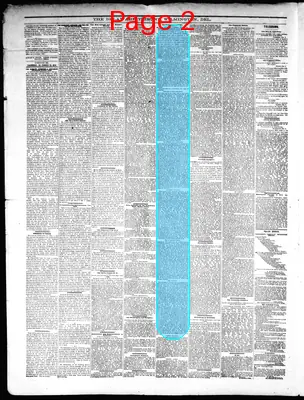
Delaware Tribune
Wilmington, New Castle County, Delaware
What is this article about?
On Monday, the President delivered his annual message to Congress, highlighting economic depression, urging resumption of specie payments, discussing Southern political issues in Louisiana and Arkansas, reviewing finances with a small surplus, noting stable foreign relations, addressing domestic matters like civil service, and promoting the 1876 Centennial Exhibition.
Clipping

OCR Quality
Full Text
Upon the re-assembling of Congress, Monday, the President sent in his annual message. The document opens with a reference to the present depressed condition of the country, and without the suggestion of any plans for its modification or removal, the President simply calls attention to the fact that both capital and labor have been abundant and largely unemployed. Debt abroad he regards as the only element that can, with a sound currency, produce a continued depression in industry and prosperity, but he deems it obligatory upon us to pay off our foreign indebtedness as contracted--in gold or its equivalent. Commerce, he says, should be encouraged, American ship building and carrying capacity increased, foreign markets sought for products of the soil, and manufactories, to the end that we may be able to pay their debts.
RESUMPTION OF SPECIE PAYMENTS.
I believe firmly there can be no prosperous and permanent revival of business and industries until a policy is adopted with legislation to carry it out looking to a return to specie basis. A revival of productive industry is needed by all classes; by none more than holders of property of whatever sort with debts to liquidate for realization upon its sale. But admitting that these two classes of citizens are to be benefitted by expansion, would it be honest to give it? Would not the general loss be too great to justify such relief? Would it not be just as honest and prudent to authorize each debtor to issue his own legal tenders to the extent of his liabilities? Than to do this would it not be safer, for fear of over issues by unscrupulous creditors, to say that all obligations are obliterated in the United States, and now we commence anew, each possessing all he has at that time free from incumbrance?
Yet every delay in preparation for final resumption partakes of this dishonesty, and is only less in the hope that a convenient time will at last arrive for the good work of redeeming our pledges to commence. It will never come, in my opinion, except by positive action by Congress, or by national disasters which will destroy for a time at least the credit of individuals and the State at large. A sound currency might be made by total bankruptcy and discredit of integrity of the nation and of individuals,
A nation dealing in a currency below that of specie in value labors under two great disadvantages. First having no use for the world's acknowledged mediums of exchange--gold and silver--these are driven out of the country because there is no demand for their use. Second. The medium of exchange in use being of a fluctuating value, for after all it is only worth just what it will purchase of gold and silver metals, having an intrinsic value just in proportion to the honest labor it takes to produce them, a larger margin must be allowed for profit by the manufacturer and producer. It is months from the date of production to the date of realization. Interest upon capital must be charged and risk of fluctuation in the value of that which is to be received in payment added; hence high prices acting as a protection to the foreign producer who receives nothing in exchange for the production of his skill and labor except a currency good at a stable value the world over.
It seems to me that nothing is clearer than that the greater part of the burden of existing prostration for the want of a sound financial system falls upon the workingman who must, after all produce the wealth, and the salaried man who superintends and conducts business.
THE BURDEN FALLS UPON THEM in two ways--by the deprivation of employment, and by the decreased purchasing power of their salaries. It is the duty of Congress to devise the method of correcting the evils which are acknowledged to exist and not mine. But I will venture to suggest two or three things which seem to me as absolutely necessary to a return to specie payments, the first great requisite in a return to prosperity. The legal tender clause to the law authorizing the issue of currency by the National Government should be repealed, to take effect as to all contracts entered into after a day fixed in the repealing act, not to apply however to the payment of salaries by Government or for other expenditures now provided by law to be paid in currency in the interval pending between repeal and final resumption. Provision should be made by which the Secretary can obtain gold as it may become necessary from time to time from the date when specie redemption commences. To this might and should be added a revenue sufficiently in excess of expenses to insure an accumulation of gold in the Treasury to sustain redemption, with resumption. Free banking may be authorized with safety, giving full protection to the holders which they have under existing laws. Indeed I would regard free banking as essential. It would give proper elasticity to the currency. As more currency should be required for the transaction of legitimate business, new banks would be started, and in turn banks would wind up their business when it was found that there was a superabundance of currency.
SOUTHERN TROUBLES.
With regard to the political situation in the South, the message recites the disturbances arising out of the rival claims to the State Government in Louisiana, and while stating that, on account of the election frauds and forgeries committed at the Gubernatorial election there in 1872, it is impossible to tell who was elected, the President had always believed that the present State officials had received a majority of the legal votes, and had recognized them; and he repeats the notification in his message of February, 1873, that if Congress takes no action to the contrary, he must continue to recognize them as the lawful Government of that State. Referring to the dispute in Arkansas, the President recites the causes which led to the rival claims for the Governorship there, and says that as Congress is now investigating the political affairs of that State he has declined to interfere. Preceding this there is a reference to the White Leagues and bands of masked and armed men with their military drills and menacing demonstrations and outrages which spread terror among those of the opposite political party, and intimidated the colored voters. Further on in the message it is intimated that the reports of these outrages may have been understated by one side, and may be overstated or exaggerated by the other, and that it may be worthwhile for Congress to inquire and ascertain by means of a committee "whether the alleged wrongs to colored citizens for political purposes are real, or the reports thereof manufactured for the occasion." The President then invites the attention of the people of the United States to the causes and effects of THESE UNHAPPY EVENTS, suggesting that there may be a disposition on one side to magnify wrongs and outrages, and on the other to belittle or justify those which really exist. He further suggests that if a corrected public opinion were so directed as to rebuke wrong where it exists, and not to assert it where it does not exist, we would the sooner have that condition of peace in the Southern country which would leave the States there free indeed to regulate their own domestic affairs. He believes that the better part of the citizens of the Southern States are disposed to be law-abiding, but asks if they do right in ignoring violence and bloodshed. He sympathizes with their prostrate condition in the trying times they have had under bad State Governments, in the oppressive taxes that have been imposed on them for wasteful purposes, and would do all in his power to relieve them, but he thinks they are not without their responsibility for their condition. The whole subject of Executive interference with the affairs of a State is repugnant to public opinion and to his own feelings. Unless most clearly on the side of the law, such interference becomes a crime: and with the law on its side it is condemned without a hearing. He earnestly desires, therefore, that all necessity for Executive direction in local affairs may become obsolete.
THE FINANCES.
The amount of receipts over expenditures has been but $2,341,832.20 for the fiscal year ending June 30, 1874, and that for the current fiscal year the estimated receipts over expenditures will not much exceed nine millions of dollars. In view of the large national debt existing and obligations to add 1 per cent per annum to the sinking fund, a sum amounting to now over $300,000 per annum, I submit whether revenues should not be increased or expenditures diminished to reach this amount of surplus. Not to provide for the sinking fund is a partial failure to comply with the contracts and obligations of the Government. At the last session of Congress a very considerable reduction was made in rates of taxation and in the number of articles submitted to taxation. The question may well be asked whether or not it was not in some instances unwise. The Secretary of the Treasury recommends economy in appropriations, calls attention to the loss of revenue from repealing the tax on tea and coffee, without benefit to the consumer, recommends an increase of ten cents a gallon on whiskey, and further, that no modification be made in the banking and currency bill passed at the last session of Congress unless modification should become necessary by reason of the adoption of measures for returning to specie payments. In these recommendations I cordially join. I would suggest to Congress the propriety of readjusting the tariff so as to increase the revenue and at the same time decrease the number of articles upon which duties are levied. Those articles which enter into our manufactures and not produced at home, it seems to me should be treated free. Those articles of manufacture which we produce a constituent part of but do not produce the whole, that part which we do not produce should enter free also.
FOREIGN RELATIONS,
During the past year nothing has occurred to disturb the general friendly relations of the United States with foreign powers. Chinese immigration, together with the importation of Chinese women of bad morals, are brought to the notice of Congress: marauding still continues on the Mexican border; Venezuela has not yet paid the awards due to citizens of the United States; Spain has not yet agreed to an adjustment of the questions in controversy between her and the United States; and the deplorable strife continues in Cuba with such lack of success on the part of Spain, after a six years' effort to suppress it, that some positive steps on the part of other powers may become a matter of self-necessity.
DOMESTIC AFFAIRS.
In our domestic concerns, the President invites the attention of Congress to the legislation necessary to settle our laws concerning expatriation, nationality, the status of children of American parents born in foreign countries, and of American women who have married aliens, &c., and also to the legislation necessary to put a stop to the procurement of fraudulent naturalization papers. Apropos to the revival of ship building, and particularly, of iron ship building, it is suggested that encouragement be given in the way of ample compensation to steamers for carrying the mails. In the matter of civil service reform, the President says the effect has been beneficial, but that it is impracticable to enforce the rules without the positive support of Congress, and unless he gets this support in the form of law, he will have to abandon the competitive examinations.
THE CENTENNIAL.
With respect to the Centennial Exhibition of 1876, the President says that he feels "that the nation at large is interested in having this Exhibition a success," and "commends to Congress such action as will secure a greater interest in it." "Already many foreign nations have signified their intention to be represented at it, and it may be expected that every civilized nation will be represented."
What sub-type of article is it?
What keywords are associated?
What entities or persons were involved?
Where did it happen?
Domestic News Details
Primary Location
United States
Event Date
Monday, December 1874
Key Persons
Event Details
The President presented his annual message to Congress, addressing the depressed condition of the country, foreign debt, encouragement of commerce, resumption of specie payments, Southern political disturbances in Louisiana and Arkansas, financial surplus, foreign relations including Chinese immigration and Cuban strife, domestic affairs like civil service reform, and the 1876 Centennial Exhibition.