Thank you for visiting SNEWPapers!
Sign up free
Pinedale Roundup
Pinedale, Sublette County, Fremont County, Wyoming
What is this article about?
Fashion article detailing spring millinery trends, including tailored hats, tricorn, sailor, cloche, and toque styles in materials like ribbon, silk, straw, felt, and duvetyne. Emphasizes becomingness, combinations with seasonal attire, and influences from Shaker, Chinese, and Persian motifs. Mentions Paris fashions and accessories like veils and handbags.
Merged-components note: Image illustrates the spring millinery fashions article.
Clipping
OCR Quality
Full Text
Tailored Hat, Tricorn, Sailor, Cloche and Toque Are Popular.
Becomingness is the point to be considered in the spring bonnet, and if the headwear should prove to be not of enduring type it still may serve on occasion, and the loss is not great. In these days, says a fashion writer in the New York Times, when seasons overlap—when chiffons are worn in mid-winter and furs in summer—a flower hat may accompany a velvet gown, and a fur-trimmed toque be worn with a spring taffeta. The exotic taste demands strawberries in January and a fox necklace in July.
At this season the canny couturiere has ready something captivating in a chapeau. Material does not particularly signify, for velvet is as fashionable in summer as tulle in winter. The hat must be suitable and becoming, and for this numberless combinations are created.
They are: The severe tailored hat of sports design, the tricorne, still sailor, cloche and toque, usually of ribbon or silk in bands, or one of the new straws. The cloche, holding tenaciously, is varied and shaped to fit many faces. More and more there is recognition of the flattering line which shows a bit of the hair softly waved or curled.
Thus a chic little model is evolved that is the very latest thing from the other side. This is a quaint suggestion in black of the Shaker bonnet, snug, shading the brow and faced with a delicate shade of pink or light green, as the original model from Rose Descat happens to be. An ornament of green beads is fastened at one side of this little cloche, and narrow black ribbons tie under the chin.
This tie effect is a novelty, particularly with the smartest French models. One of these is a small silk cloche, black, with small ribbon flowers and figures forming a pattern Chinese in character all over the crown and narrow drooping brim. A strap attached to each side of the hat, passing under the chin, is of silk, and the embroidery matches the hat. A handbag made of the same silk and needlework is entirely new.
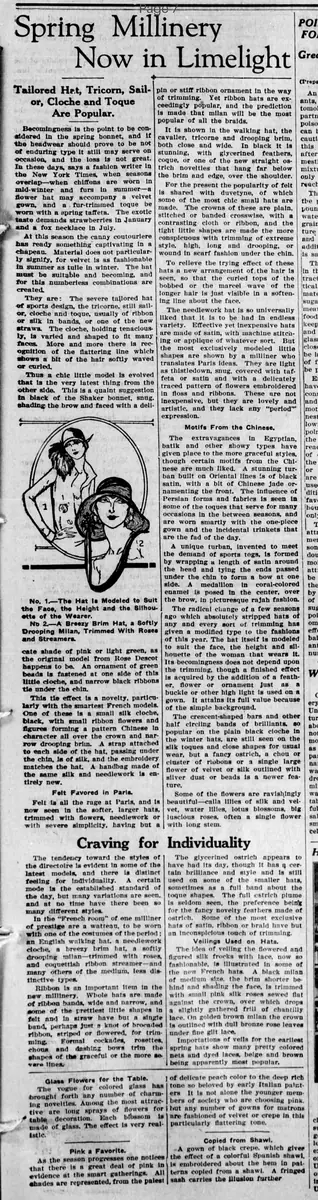
No. 1. The Hat Is Modeled to Suit the Face, the Height and the Silhouette of the Wearer.
No. 2. A Breezy Brim Hat, a Softly Drooping Milan, Trimmed With Roses and Streamers.
Felt Favored in Paris.
Felt is all the rage at Paris, and is now seen in the softer, larger hats trimmed with flowers, needlework or with severe simplicity, having but a pin or stiff ribbon ornament in the way of trimming. Yet ribbon hats are exceedingly popular, and the prediction is made that milan will be the most popular of all the braids.
It is shown in the walking hat, the cavalier, tricorne and drooping brim, both close and wide. In black it is stunning, with glycerined feathers, coque, or one of the new straight ostrich novelties that hang far below the brim and edge, over the shoulder.
For the present the popularity of felt is shared with duvetyne, of which some of the most chic small hats are made. The crowns of these are plain, stitched or banded crosswise, with a contrasting cloth or ribbon, and the tight little shapes are made the more conspicuous with trimming of extreme style, high, long and drooping, or wound in scarf fashion under the chin.
To relieve the trying effect of these hats a new arrangement of the hair is seen, so that the curled tops of the bobbed or the marcel wave of the longer hair is just visible in a softening line about the face.
The needlework hat is so universally liked that it is to be had in endless variety. Effective yet inexpensive hats are made of satin, with machine stitching or applique of whatever sort. But the most exclusively modeled little shapes are shown by a milliner who translates Paris ideas. They are light as thistledown, snug, covered with taffeta or satin and with a delicately traced pattern of flowers embroidered in floss and ribbons.
These are not inexpensive, but they are lovely and artistic, and they lack any 'period expression.'
Motifs From the Chinese.
The extravagances in Egyptian, batik and other showy types have given place to the more graceful styles, though certain motifs from the Chinese are much liked. A stunning turban built on Oriental lines is of black satin, with a bit of Chinese jade ornamenting the front. The influence of Persian forms and fabrics is seen in some of the toques that serve for many occasions in the between seasons, and are worn smartly with the one-piece gown and the incidental trinkets that are the fad of the day.
A unique turban, invented to meet the demand of sports togs, is formed by wrapping a length of satin around the head and tying the ends passed under the chin to form a bow at one side. A medallion in coral-colored enamel is posed in the center, over the brow, in picturesque rajah fashion.
The radical change of a few seasons ago which absolutely stripped hats of any and every sort of trimming has given a modified type to the fashions of this year. The hat itself is modeled to suit the face, the height and silhouette of the woman that wears it. Its becomingness does not depend upon the trimming, though a finished effect is acquired by the addition of a feather, flower or ornament just as a buckle or other high light is used on a gown. It attains its full value because of the simple background.
The crescent-shaped bars and other half circling bands of brilliants, so popular on the plain black cloche in the winter hats, are still seen on the silk toques and close shapes for usual wear, but a fancy ostrich, a chou or cluster of ribbons or a single large flower of velvet or silk outlined with silver dust or beads is a newer feature.
Some of the flowers are ravishingly beautiful—calla lilies of silk and velvet, water lilies, lotus blossoms, big luscious roses, often a single flower with long stem.
Craving for Individuality
The tendency toward the styles of the Directoire is evident in some of the latest models, and there is distinct feeling for individuality. A certain mode is the established standard of the day, but many variations are seen, and at no time have there been so many different styles.
In the 'French room' of one milliner of prestige are a Watteau, to be worn with one of the costumes of the period; an English walking hat, a needlework cloche, a breezy brim hat, a softly drooping milan trimmed with roses, and coquettish ribbon streamer—and many others of the medium, less distinctive types.
Ribbon is an important item in the new millinery. Whole hats are made of ribbon bands, wide and narrow, and some of the prettiest little shapes in felt and in straw have but a single band, perhaps just a knot of brocaded ribbon, striped or flowered, for trimming.
Formal cockades, rosettes, choux and dashing bows trim the shapes of the graceful or the more severe liner.
Glass Flowers for the Table.
The vogue for colored glass has brought forth any number of charming novelties. Among the most attractive are long sprays of flowers for table decoration. Each blossom is made of glass. The effect is very realistic.
Pink a Favorite.
As the season progresses one notices that there is a great deal of pink in evidence at the smart gatherings. All shades are represented, from the palest to the deep rich tone so beloved by early Italian painters.
The glycerined ostrich appears to have had its day, though it has a certain brilliance and style and is still used on some of the smaller hats, sometimes as a full band about the toque shapes. The full ostrich plume is seldom seen, the preference being for the fancy novelty feathers made of ostrich. Some of the most exclusive hats of satin, ribbon or braid have but an inconspicuous touch of trimming.
Veilings Used on Hats.
The idea of veiling the flowered and figured silk frocks with lace, now so fashionable, is illustrated in some of the new French hats. A black milan of medium size, the brim shorter behind and shading the face, is trimmed with small pink silk roses sewed flat against the crown, over which drops a slightly gathered frill of Chantilly lace. On golden brown milan the crown is outlined with dull bronze rose leaves under fine gilt lace.
Importations of veils for the earliest spring hats show many pretty colored nets and dyed laces, beige and brown being apparently most popular, of delicate peach color to the deep rich tone so beloved by early Italian painters.
It is not alone the younger members of society who are choosing pink, but any number of gowns for matrons are fashioned of velvet or crepe in this particularly flattering tone.
Copied from Shawl.
A gown of black crepe, which gives the effect of a colorful Spanish shawl, is embroidered about the hem in patterns copied from a shawl. A fringed sash carries the illusion further.
What sub-type of article is it?
What themes does it cover?
What keywords are associated?
What entities or persons were involved?
Where did it happen?
Story Details
Key Persons
Location
Paris
Event Date
Spring
Story Details
Description of popular spring hat styles including tailored, tricorn, sailor, cloche, and toque in various materials; trends in trims, motifs from Chinese and Persian influences; emphasis on becomingness and individuality in millinery.