Thank you for visiting SNEWPapers!
Sign up free
The Advance
Richwood, Nicholas County, West Virginia
What is this article about?
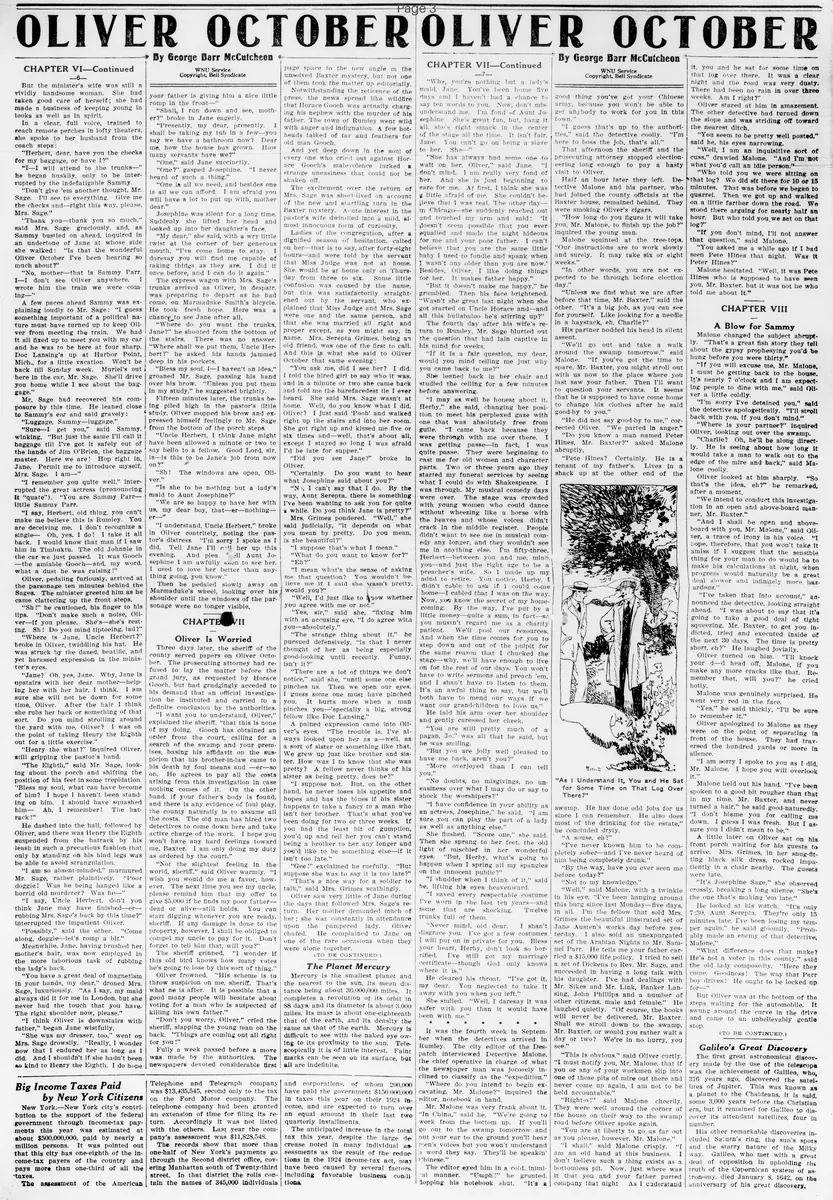
In 'Oliver October,' Chapter VI continues with the Sage family's reunion: actress Josephine Sage returns to her minister husband Herbert and daughter Jane in Rumley, with humorous adjustments to small-town life. Oliver October misses meeting them but interacts awkwardly. Chapter VII introduces tension as Horace Gooch pushes for an investigation into Baxter's disappearance, suspecting Oliver of foul play amid election politics. Josephine reveals her career decline prompted her return. Chapter VIII features detectives probing the swamp, Oliver's irritation, and hints of romance with Jane, ending with guests arriving for dinner.
Clipping
OCR Quality
Full Text
CHAPTER VI-Continued
But the minister's wife was still a vividly handsome woman. She had taken good care of herself; she had made a business of keeping young in looks as well as in spirit.
In a clear, full voice, trained to reach remote perches in lofty theaters, she spoke to her husband from the coach steps:
"Herbert, dear, have you the checks for my baggage, or have I?"
"I-I will attend to the trunks-" he began huskily, only to be interrupted by the indefatigable Sammy.
"Don't give 'em another thought, Mr. Sage. I'll see to everything. Give me the checks and-right this way, please, Mrs. Sage."
"Thank you--thank you so much," said Mrs. Sage graciously, and, as Sammy bustled on ahead, inquired in an undertone of Jane at whose side she walked: "Is that the wonderful Oliver October I've been hearing so much about?"
"No, mother-that is Sammy Parr. I don't see Oliver anywhere. I wrote him the train we were coming."
A few paces ahead Sammy was explaining loudly to Mr. Sage: "I guess something important of a political nature must have turned up to keep Oliver from meeting the train. We had it all fixed up to meet you with my car and he was to be here at four sharp. Doc Lansing's up at Harbor Point, Mich., for a little vacation. Won't be back till Sunday week. Muriel's out here in the car, Mr. Sage. She'll drive you home while I see about the baggage."
Mr. Sage had recovered his composure by this time. He leaned close to Sammy's ear and said gravely:
"Luggage, Sammy-luggage."
"Sure-I get you," said Sammy, winking. "But just the same I'll call it baggage till I've got it safely out of the hands of Jim O'Brien, the baggage master. Here we are! Hop right in, Jane. Permit me to introduce myself Mrs. Sage. I am-"
"I remember you quite well," interrupted the great actress (pronouncing it "quate"). "You are Sammy Parr- little Sammy Parr."
"I say, Herbert, old thing, you can't make me believe this is Rumley. You are deceiving me. I don't recognize a single- Oh, yes, I do! I take it all back. I would know that man if I saw him in Timbuktu. The old Johnnie in the car we just passed. It was Gooch --the amiable Gooch-and, my word, what a dust he was raising!"
Oliver, pedaling furiously, arrived at the parsonage ten minutes behind the Sages. The minister greeted him as he came clattering up the front steps.
"Sh!" he cautioned, his finger to his lips. "Don't make such a noise, Oliver-if you please. She's-she's resting. Sh! Do you mind tiptoeing, lad?"
"Where is Jane, Uncle Herbert?" broke in Oliver, twiddling his hat. He was struck by the dazed, beatific, and yet harassed expression in the minister's eyes.
"Jane? Oh, yes, Jane. Why, Jane is upstairs with her dear mother-helping her with her hair. I think. I am sure she will not be down for some time, Oliver. After the hair I think she rubs her back or something of that sort. Do you mind strolling around the yard with me, Oliver? I was on the point of taking Henry the Eighth out for a little exercise."
"Henry the what?" inquired Oliver, still gripping the pastor's hand.
"The Eighth," said Mr. Sage, looking about the porch and shifting the position of his feet in some trepidation. "Bless my soul, what can have become of him? I hope I haven't been standing on him. I should have squashed him- Ah, I remember! The hat-rack!"
He dashed into the hall, followed by Oliver, and there was Henry the Eighth suspended from the hatrack by his leash in such a precarious fashion that only by standing on his hind legs was he able to avoid strangulation.
"I am so absent-minded," murmured Mr. Sage, rather plaintively.
"Poor doggie! Was he being hanged like a horrid old murderer? Was he?"
"I say, Uncle Herbert, don't you think Jane may have finished-er- rubbing Mrs. Sage's back by this time?" interrupted the impatient Oliver.
"Possibly," said the other. "Come along, doggie--let's romp a bit."
Meanwhile, Jane, having brushed her mother's hair, was now employed in the more laborious task of rubbing the lady's back.
"You have a great deal of magnetism in your hands, my dear," droned Mrs. Sage, luxuriously. "As I say, my maid always did it for me in London, but she never had the touch that you have. The right shoulder now, please."
"I think Oliver is downstairs with father," began Jane wistfully.
"She was my dresser, too," went on Mrs. Sage drowsily. "Really, I wonder now that I endured her as long as I did. And I shouldn't if she hadn't been so kind to Henry the Eighth. I do hope-"
your father is giving him a nice little romp in the front-"
"Shall I run down and see, mother?" broke in Jane eagerly.
"Presently, my dear, presently. I shall be taking my tub in a few-you say we have a bathroom now? Dear me, how the house has grown. How many servants have we?"
"One," said Jane succinctly.
"One?" gasped Josephine.
"I never heard of such a thing."
"One is all we need, and besides one is all we can afford. I am afraid you will have a lot to put up with, mother dear."
Josephine was silent for a long time. Suddenly she lifted her head and looked up into her daughter's face.
"My dear," she said, with a wry little twist at the corner of her generous mouth, "I've come home to stay. I daresay you will find me capable of taking things as they are. I did it once before, and I can do it again."
The express wagon with Mrs. Sage's trunks arrived as Oliver, in despair, was preparing to depart as he had come, on Marmaduke Smith's bicycle. He took fresh hope. Here was a chance to see Jane after all.
"Where do you want the trunks, Jane?" he shouted from the bottom of the stairs. There was no answer.
"Where shall we put them, Uncle Herbert?" he asked, his hands jammed deep in his pockets.
"Bless my soul. I-I haven't an idea," groaned Mr. Sage, passing his hand over his brow. "Unless you put them in my study," he suggested brightly.
Fifteen minutes later, the trunks being piled high in the pastor's little study, Oliver mopped his brow and expressed himself feelingly to Mr. Sage from the bottom of the porch steps.
"Uncle Herbert, I think Jane might have been allowed a minute or two to say hello to a fellow. Good Lord, sir, is--is this to be Jane's job from now on?"
"Sh! The windows are open. Oliver."
"Is she to be nothing but a lady's maid to Aunt Josephine?"
"We are so happy to have her with us, my dear boy, that-er-nothing-er-"
"I understand, Uncle Herbert," broke in Oliver contritely, noting the pastor's distress. "I'm sorry I spoke as I did. Tell Jane I'll call her up this evening. And please tell Aunt Josephine I am awfully keen to see her. I used to love her better than anything going, you know."
Then he pedaled slowly away on Marmaduke's wheel, looking over his shoulder until the windows of the parsonage were no longer visible.
CHAPTER VII
Oliver Is Worried
Three days later, the sheriff of the county served papers on Oliver October. The prosecuting attorney had refused to lay the matter before the grand jury, as requested by Horace Gooch, but had grudgingly acceded to his demand that an official investigation be instituted and carried to a definite conclusion by the authorities.
"I want you to understand, Oliver," explained the sheriff, "that this is none of my doing. Gooch has obtained an order from the court, calling for a search of the swamp and your premises, basing his affidavit on the suspicion that his brother-in-law came to his death by foul means and -er-so on. He agrees to pay all the costs arising from this investigation in case nothing comes of it. On the other hand, if your father's body is found, and there is any evidence of foul play, the county naturally is to assume all the costs. The old man has hired two detectives to come down here and take active charge of the work. I hope you won't have any hard feelings toward me, Baxter. I am only doing my duty as ordered by the court."
"Not the slightest feeling in the world, sheriff," said Oliver warmly. "I wish you would do me a favor, however. The next time you see my uncle, please remind him that my offer to give $5,000 if he finds my poor father- dead or alive-still holds. You can start digging whenever you are ready, sheriff. If any damage is done to the property, however, I shall be obliged to compel my uncle to pay for it. Don't forget to tell him that, will you?"
The sheriff grinned. "I wonder if this old bird knows how many votes he's going to lose by this sort of thing."
Oliver frowned. "His scheme is to throw suspicion on me, sheriff. That's what he is after. It is possible that a good many people will hesitate about voting for a man who is suspected of killing his own father."
"Don't you worry, Oliver," cried the sheriff, slapping the young man on the back. "Things are coming out all right for you!"
Fully a week passed before a move was made by the authorities. The newspapers devoted considerable first page space to the new angle in the unsolved Baxter mystery, but not one of them took the matter up editorially. Notwithstanding the reticence of the press, the news spread like wildfire that Horace Gooch was actually charging his nephew with the murder of his father. The town of Rumley went wild with anger and indignation. A few hot-heads talked of tar and feathers for old man Gooch.
And yet deep down in the soul of everyone who cried out against Horace Gooch's malevolence lurked strange uneasiness that could not be shaken off.
The excitement over the return of Mrs. Sage was short-lived on account of the new and startling turn in the Baxter mystery. Acute interest in the pastor's wife dwindled into a mild, almost innocuous form of curiosity.
Ladies of the congregation, after a dignified season of hesitation, called on her-that is to say, after forty-eight hours-and were told by the servant that Miss Judge was not at home. She would be at home only on Thursday from three to six. Some little confusion was caused by the name, but this was satisfactorily straightened out by the servant, who explained that Miss Judge and Mrs. Sage were one and the same person, and that she was married all right and proper except, as you might say, in name. Mrs. Serepta Grimes, being an old friend, was one of the first to call. And this is what she said to Oliver October that same evening:
"You ask me, did I see her? I did. I told the hired girl to say who it was, and in a minute or two she came back and told me the barefacedest lie I ever heard. She said Mrs. Sage wasn't at home. Well, do you know what I did, Oliver? I just said 'Pooh' and walked right up the stairs and into her room. She got right up and kissed me five or six times and-well, that's about all, except I stayed so long I was afraid I'd be late for supper."
"Did you see Jane?" broke in Oliver.
"Certainly. Do you want to hear what Josephine said about you?"
"N. I can't say that I do. By the way, Aunt Serepta, there is something I've been wanting to ask you for quite a while. Do you think Jane is pretty?"
Mrs. Grimes pondered. "Well," she said judicially, "it depends on what you mean by pretty. Do you mean, is she beautiful?"
"I suppose that's what I mean."
"What do you want to know for?"
"Eh?"
"I mean what's the sense of asking me that question? You wouldn't believe me if I said she wasn't pretty, would you?"
"Well, I'd just like to know whether you agree with me or not."
"Yes, sir," said she, fixing him with an accusing eye, "I do agree with you-absolutely."
"The strange thing about it," he pursued defensively, "is that I never thought of her as being especially good-looking until recently. Funny, isn't it?"
"There are a lot of things we don't notice," said she, "until some one else pinches us. Then we open our eyes. I guess some one must have pinched you. It hurts more when a man pinches you-'specially a big, strong fellow like Doc Lansing."
A pained expression came into Oliver's eyes. "The trouble is, I've always looked upon her as a-well, as a sort of sister or something like that. We grew up just like brother and sister. How was I to know that she was pretty? A fellow never thinks of his sister as being pretty, does he?"
"I suppose not. But, on the other hand, he never loses his appetite and hopes and has the blues if his sister happens to take a fancy to a man who isn't her brother. That's what you've been doing for two or three weeks. If you had the least bit of gumption, you'd up and tell her you can't stand being a brother to her any longer and you'd like to be something else--if it isn't too late."
"Gee!" exclaimed he ruefully. "But suppose she was to say it is too late?"
"That's a nice way for a soldier to talk," said Mrs. Grimes scathingly.
Oliver saw very little of Jane during the days that followed Mrs. Sage's return. Her mother demanded much of her; she was constantly in attendance upon the pampered lady. Oliver chafed. He complained to Jane on one of the rare occasions when they were alone together.
"Why, you're nothing but a lady's maid, Jane. You've been home five days and I haven't had a chance to say ten words to you. Now, don't misunderstand me. I'm fond of Aunt Josephine. She's great fun, but, hang it all, she's right smack in the center of the stage all the time. It isn't fair, Jane. You can't go on being a slave to her. She-"
"She has always had some one to wait on her, Oliver," said Jane. "I don't mind. I am really very fond of her. And she is just beginning to care for me. At first, I think she was a little afraid of me. She couldn't believe that I was real. The other day- in Chicago-she suddenly reached out and touched my arm and said: 'It doesn't seem possible that you ever squalled and made the night hideous for me and your poor father. I can't believe that you are the same little baby I used to fondle and spank when I wasn't any older than you are now.' Besides, Oliver, I like doing things for her. It makes father happy."
"But it doesn't make me happy," he grumbled. Then his face brightened. "Wasn't she great last night when she got started on Uncle Horace and-and all this hullabaloo he's stirring up?"
The fourth day after his wife's return to Rumley, Mr. Sage blurted out the question that had lain captive in his mind for weeks.
"If it is a fair question, my dear, would you mind telling me just why you came back to me?"
She leaned back in her chair and studied the ceiling for a few minutes before answering.
"I may as well be honest about it, Herby," she said, changing her position to meet his perplexed gaze with one that was absolutely free from guile. "I came back because they were through with me over there. I was getting passe -in fact, I was quite passe. They were beginning to cast me for old women and character parts. Two or three years ago they started my funeral services by seeing what I could do with Shakespeare. I was through. My musical comedy days were over. The stage was crowded with young women who could dance without wheezing like a horse with the heaves and whose voices didn't crack in the middle register. People didn't want to see me in musical comedy any longer, and they wouldn't see me in anything else. I'm fifty-three, Herbert-between you and me, mind you-and just the right age to be a preacher's wife. So I made up my mind to retire. You notice, Herby, I didn't cable to ask if I could come home-I cabled that I was on the way. Now, you know the secret of my home-coming. By the way, I've put by a little money-quite a sum, in fact-so you mustn't regard me as a charity patient. We'll pool our resources. And when the time comes for you to step down and out of the pulpit for the same reason that I chucked the stage-why, we'll have enough to live on for the rest of our days. You won't have to write sermons and preach 'em, and I shan't have to listen to them. It's an awful thing to say, but we'll both have to mend our ways if we want our grandchildren to love us."
He laid his arm over her shoulder and gently caressed her cheek.
"You are still pretty much of a pagan, Jo," was all that he said, but he was smiling.
"But you are jolly well pleased to have me back, aren't you?"
"More overjoyed than I can tell you."
"No doubts, no misgivings, no uneasiness over what I may do or say to shock the worshipers?"
"I have confidence in your ability as an actress, Josephine," he said. "I am sure you can play the part of a lady as well as anything else."
She flushed. "Score one," she said. Then she sprang to her feet, the old light of mischief in her wonderful eyes. "But, Herby, what's going to happen when I spring all my spangles on the innocent public?"
"I shudder when I think of it," said he, lifting his eyes heavenward.
"I saved every respectable costume I've worn in the last ten years-and some that are shocking. Twelve trunks full of them. Never mind, old dear. I shan't disgrace you. I've got a few costumes I will put on in private for you. Bless your heart, Herby, don't look so horrified. I've still got my marriage certificate-though God only knows where it is."
He cleared his throat. "I've got it, my dear. You neglected to take it away with you when you left."
She smiled. "Well, I daresay it was safer with you than it would have been with me."
It was the fourth week in September when the detectives arrived in Rumley. The city editor of the Dispatch interviewed Detective Malone, the chief operative in charge of what the newspaper man was jocosely inclined to classify as the "expedition."
"Where do you intend to begin excavating, Mr. Malone?" inquired the editor, notebook in hand.
Mr. Malone was very frank about it.
"In China," said he. "We're going to work from the bottom up. If you'll go out to the swamp tomorrow and put your ear to the ground you'll hear men's voices but you won't understand a word they say. They'll be speaking Chinese."
The editor eyed him in a cold, inimical manner.
"Unph!" he grunted, snapping his notebook shut. "It's a good thing you've got your Chinese army, because you won't be able to get anybody to work for you in this town."
"I guess that's up to the authorities," said the detective coolly. "I'm here to boss the job, that's all."
That afternoon the sheriff and the prosecuting attorney stopped electioneering long enough to pay a hasty visit to Oliver. Half an hour later they left. Detective Malone and his partner, who had joined the county officials at the Baxter house, remained behind. They were smoking Oliver's cigars.
"How long do you figure it will take you, Mr. Malone, to finish up the job?" inquired the young man.
Malone squinted at the tree-tops.
"Our instructions are to work slowly and surely. It may take six or eight weeks."
"In other words, you are not expected to be through before election day."
"Unless we find what we are after before that time, Mr. Baxter," said the other. "It's a big job, as you can see for yourself. Like looking for a needle in a haystack, eh, Charlie?"
His partner nodded his head in silent assent.
"We'll go out and take a walk around the swamp tomorrow," said Malone. "If you've got the time to spare, Mr. Baxter, you might stroll out with us now to the place where you last saw your father. Then I'll want to question your servants. It seems that he is supposed to have come home to change his clothes after he said good-by to you."
"He did not say good-by to me," corrected Oliver. "We parted in anger."
"Do you know a man named Peter Hines, Mr. Baxter?" asked Malone abruptly.
"Pete Hines? Certainly. He is a tenant of my father's. Lives in a shack up at the other end of the swamp. He has done odd jobs for us since I can remember. He also does most of the drinking for the estate," he concluded dryly.
"A souse, eh?"
"I've never known him to be completely sober and I've never heard of him being completely drunk."
"By the way, have you ever seen me before today?"
"Not to my knowledge."
"Well," said Malone, with a twinkle in his eye, "I've been hanging around this burg since last Monday-five days in all. I'm the fellow that sold Mrs. Grimes the beautiful illustrated set of Jane Austen's works day before yesterday. I also sold an unexpurgated set of the Arabian Nights to Mr. Samuel Parr. He tells me your father carried a $15,000 life policy. I tried to sell a set of Dickens to Rev. Mr. Sage, and succeeded in having a long talk with his daughter. I've had dealings with Mr. Sikes and Mr. Link. Banker Lansing. John Phillips and a number of other citizens, male and female." He laughed quietly. "Of course, the books will never be delivered, Mr. Baxter. Shall we stroll down to the swamp, Mr. Baxter, or would you rather wait a day or two? We're in no hurry, you see."
"This is obvious," said Oliver curtly. "I must notify you, Mr. Malone, that if you or any of your workmen slip into one of those pits of mire out there and never come up again, I am not to be held accountable."
"Right-o!" said Malone cheerily.
They were well around the corner of the house on their way to the swamp road before Oliver spoke again.
"You are at liberty to go as far out as you please, however, Mr. Malone."
"I shall," said Malone crisply. "I am an old hand at this business. I don't believe such a thing exists as a bottomless pit. Now, just where was it that you and your father parted company that night? As I understand it, you and he sat for some time on that log over there?"
it, you and he sat for some time on that log over there. It was a clear night and the road was very dusty. There had been no rain in over three weeks. Am I right?"
Oliver stared at him in amazement. The other detective had turned down the slope and was striding off toward the nearest ditch.
"You seem to be pretty well posted," said he, his eyes narrowing.
"Well, I am an inquisitive sort of cuss," drawled Malone. "And I'm not what you'd call an idle person."
"Who told you we were sitting on that log? We did sit there for 10 or 15 minutes. That was before we began to quarrel. Then we got up and walked on a little farther down the road. We stood there arguing for nearly half an hour. But who told you we sat on that log?"
"If you don't mind, I'll not answer that question," said Malone.
"You asked me a while ago if I had seen Pete Hines that night. Was it Peter Hines?"
Malone hesitated. "Well, it was Pete Hines who is supposed to have seen you, Mr. Baxter, but it was not he who told me about it."
CHAPTER VIII
A Blow for Sammy
Malone changed the subject abruptly. "That's a great fish story they tell about the gypsy prophesying you'd be hung before you were thirty."
"If you will excuse me, Mr. Malone, I must be getting back to the house. It's nearly 7 o'clock and I am expecting people to dine with me," said Oliver a little coldly.
"I'm sorry I've detained you," said the detective apologetically. "I'll stroll back with you, if you don't mind."
"Where is your partner?" inquired Oliver, looking out over the swamp.
"Charlie? Oh, he'll be along directly. He is seeing about how long it would take a man to walk out to the edge of the mire and back," said Malone coolly.
Oliver looked at him sharply.
"So that's the idea, eh?" he remarked, after a moment.
"We intend to conduct this investigation in an open and above-board manner, Mr. Baxter."
"And I shall be open and above-board with you, Mr. Malone," said Oliver, a trace of irony in his voice. "I hope, therefore, that you won't take it amiss if I suggest that the sensible thing for your man to do would be to make his calculations at night, when progress would naturally be a great deal slower and infinitely more hazardous."
"I've taken that into account," announced the detective, looking straight ahead. "I was about to say that it's going to take a good deal of tight squeezing, Mr. Baxter, to get you indicted, tried and executed inside of the next 30 days. The time is pretty short, eh?" He laughed jovially.
Oliver turned on him. "I'll knock your d-d head off, Malone, if you make any more cracks like that. Remember that, will you?" he cried hotly.
Malone was genuinely surprised. He went very red in the face.
"Yes," he said thickly, "I'll be sure to remember it."
Oliver apologized to Malone as they were on the point of separating in front of the house. They had traversed the hundred yards or more in silence.
"I am sorry I spoke to you as I did, Mr. Malone. I hope you will overlook it."
Malone held out his hand. "I've been spoken to a good bit rougher than that in my time, Mr. Baxter, and never turned a hair," he said good-naturedly. "I don't blame you for calling me down. I guess I was fresh. But I assure you I didn't mean to be."
A little later on Oliver sat on his front porch waiting for his guests to arrive. Mrs. Grimes, in her snug-fitting black silk dress, rocked impatiently in a chair nearby. The guests were late.
"It's Josephine Sage," she observed crossly, breaking a long silence. "She's the one that's making 'em late."
He looked at his watch. "It's only 7:30, Aunt Serepta. They're only 15 minutes late. I've been losing my temper again," he said gloomily. "Probably made an enemy of that detective, Malone."
"What difference does that make? He's not a voter in this county," said the old lady composedly. "Here they come. Goodness! The way that Parr boy drives! He ought to be locked up for-"
But Oliver was at the bottom of the steps waiting for the automobile. It swung around the curve in the drive and came to an unbelievably gentle stop.
(TO BE CONTINUED.)
What sub-type of article is it?
What themes does it cover?
What keywords are associated?
Literary Details
Title
Oliver October
Key Lines