Thank you for visiting SNEWPapers!
Sign up free
Story
June 5, 1865
The Columbia Daily Phoenix
Columbia, Richland County, South Carolina
What is this article about?
Philosophical essay on balancing justice and humanity in criminal punishment, referencing Pliny's mercy, Schiller's story of laws creating criminals, and harsh penalties like Draco's system, using biblical allusions to Cain and Jacob.
Clipping
OCR Quality
98%
Excellent
Full Text
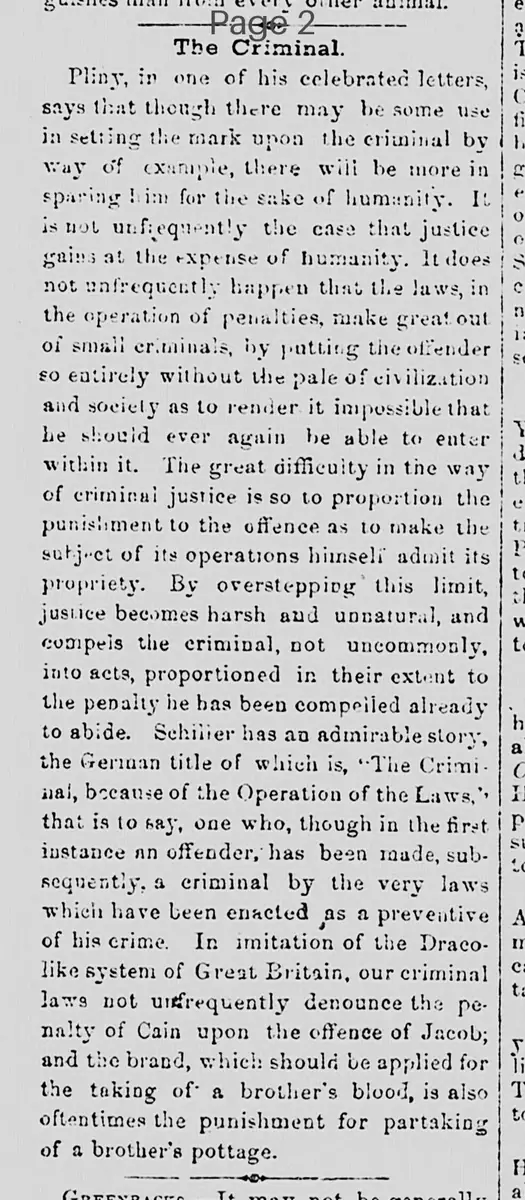
The Criminal.
Pliny, in one of his celebrated letters, says that though there may be some use in setting the mark upon the criminal by way of example, there will be more in sparing him for the sake of humanity. It is not unfrequently the case that justice gains at the expense of humanity. It does not unfrequently happen that the laws, in the operation of penalties, make great out of small criminals, by putting the offender so entirely without the pale of civilization and society as to render it impossible that he should ever again be able to enter within it. The great difficulty in the way of criminal justice is so to proportion the punishment to the offence as to make the subject of its operations himself admit its propriety. By overstepping this limit, justice becomes harsh and unnatural, and compels the criminal, not uncommonly, into acts, proportioned in their extent to the penalty he has been compelled already to abide. Schiller has an admirable story, the German title of which is, "The Criminal, because of the Operation of the Laws," that is to say, one who, though in the first instance an offender, has been made, subsequently, a criminal by the very laws which have been enacted as a preventive of his crime. In imitation of the Draco-like system of Great Britain, our criminal laws not unfrequently denounce the penalty of Cain upon the offence of Jacob; and the brand, which should be applied for the taking of a brother's blood, is also oftentimes the punishment for partaking of a brother's pottage.
Pliny, in one of his celebrated letters, says that though there may be some use in setting the mark upon the criminal by way of example, there will be more in sparing him for the sake of humanity. It is not unfrequently the case that justice gains at the expense of humanity. It does not unfrequently happen that the laws, in the operation of penalties, make great out of small criminals, by putting the offender so entirely without the pale of civilization and society as to render it impossible that he should ever again be able to enter within it. The great difficulty in the way of criminal justice is so to proportion the punishment to the offence as to make the subject of its operations himself admit its propriety. By overstepping this limit, justice becomes harsh and unnatural, and compels the criminal, not uncommonly, into acts, proportioned in their extent to the penalty he has been compelled already to abide. Schiller has an admirable story, the German title of which is, "The Criminal, because of the Operation of the Laws," that is to say, one who, though in the first instance an offender, has been made, subsequently, a criminal by the very laws which have been enacted as a preventive of his crime. In imitation of the Draco-like system of Great Britain, our criminal laws not unfrequently denounce the penalty of Cain upon the offence of Jacob; and the brand, which should be applied for the taking of a brother's blood, is also oftentimes the punishment for partaking of a brother's pottage.
What sub-type of article is it?
Legal Commentary
What themes does it cover?
Crime Punishment
Justice
Moral Virtue
What keywords are associated?
Criminal Justice
Punishment Proportionality
Harsh Laws
Humanity In Justice
Schiller Story
What entities or persons were involved?
Pliny
Schiller
Draco
Cain
Jacob
Story Details
Key Persons
Pliny
Schiller
Draco
Cain
Jacob
Story Details
Discussion on how harsh laws can turn minor offenders into major criminals, advocating for proportionate punishment to maintain humanity, with references to classical and literary examples.