Thank you for visiting SNEWPapers!
Sign up free
Daily National Intelligencer
Washington, District Of Columbia
What is this article about?
The New Jersey Legislature met in Trenton on October 26, 1814, electing Samuel Pennington as House Speaker, William Kennedy as Council Vice-President, and re-electing Governor William S. Pennington. The governor's message discussed coastal defenses, militia mobilization, War of 1812 updates, failed peace talks, and calls for financial support.
Clipping
OCR Quality
Full Text
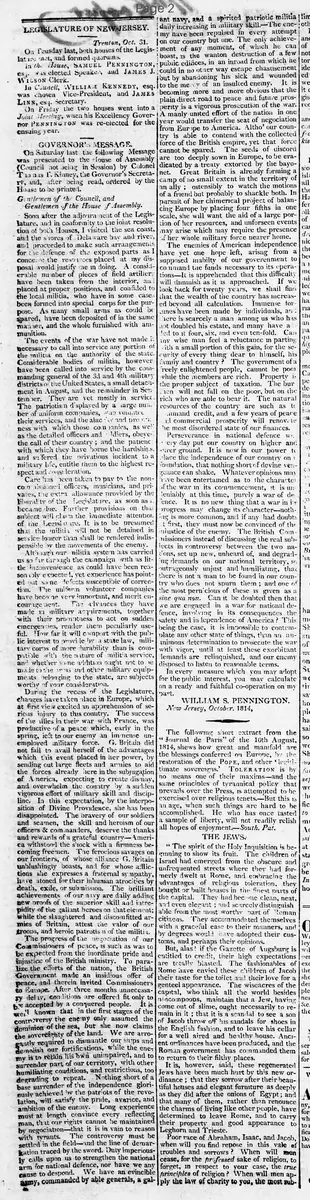
Trenton, Oct. 31.
On Tuesday last, both houses of the Legislature met, and formed quorums.
In the House, SAMUEL PENNINGTON, Esq. was elected Speaker, and JAMES J. Wilson Clerk.
In Council, WILLIAM KENNEDY, Esq. was chosen Vice-President, and JAMES LINT, Esq. Secretary.
On Friday the two houses went into a Joint Meeting, when his Excellency Governor Pennington was re-elected for the ensuing year.
GOVERNOR'S MESSAGE
On Saturday last the following Message was presented to the House of Assembly (Council not being in Session) by Colonel Thomas T. Kinney, the Governor's Secretary, and, after being read, ordered by the House to be printed.
Gentlemen of the Council, and Gentlemen of the House of Assembly.
Soon after the adjournment of the Legislature, and in conformity to the joint resolution of both Houses, I visited the sea coast, and the shores of Delaware bay and river, and proceeded to make such arrangements for the defence of the exposed parts as I conceive the resources placed at my disposal would justify me in doing. A considerable number of pieces of field artillery have been taken from the interior, and placed at proper positions, and confided to the local militia, who have in some cases been formed into special corps for the purpose. As many small arms as could be spared, have been deposited in the same manner, and the whole furnished with ammunition.
The events of the war have not made it necessary to call into service any portion of the militia on the authority of the state. Considerable bodies of militia, however, have been called into service by the commanding general of the 3d and 4th military districts of the United States, a small detachment in August, and the remainder in September. They are yet mostly in service.
The patriotism displayed by a large number of uniform companies, who volunteered their services, and the alacrity and promptness with which those companies, as well as the detailed officers and soldiers, obeyed the call of their country; and the patience with which they have borne the hardships, and suffered the privations incident to a military life, entitle them to the highest respect and consideration.
Care has been taken to pay to the non-commissioned officers, musicians, and privates, the extra allowance provided by the liberality of the Legislature, as soon as it became due. Further provisions on that subject will claim the immediate attention of the Legislature. It is to be presumed that the militia will not be detained in service longer than shall be rendered indispensable by the movements of the enemy.
Although our militia system has carried us so far through the campaign with as little inconvenience as could have been reasonably expected, yet experience has pointed out some defects susceptible of correction. The uniform volunteer companies have become very important, and merit encouragement. The advances they have made in military acquirements, together with their promptness to act on sudden emergencies, render them peculiarly useful. How far it will comport with the public interest to provide by a state law, military corps of more durability than is compatible with the nature of militia service, and whether some addition ought not to be made to the arms and other military equipments belonging to the state, are subjects worthy of your consideration.
During the recess of the Legislature, changes have taken place in Europe, which at first view excited an apprehension of serious injury to this country. The success of the allies in their war with France, was productive of a peace which, early in the spring, left to our enemy an immense unemployed military force. G. Britain did not fail to avail herself of the advantages which this event placed in her power, by sending out large fleets and armies to aid the forces already here in the subjugation of America, expecting to create dismay and overwhelm the country by a sudden vigorous effort of military skill and discipline. In this expectation, by the interposition of Divine Providence, she has been disappointed. The bravery of our soldiers and seamen, the skill and heroism of our officers & commanders, deserve the thanks and rewards of a grateful country—America withstood the shock with a firmness becoming freemen. The ferocious savages on our frontiers, of whose alliance G. Britain unblushingly boasts, and for whose alliances she expresses a fraternal sympathy, have atoned for their inhuman atrocities by death, exile, or submission. The brilliant achievements of our navy are daily adding new proofs of the superior skill and intrepidity of the gallant heroes on that element; while the slaughtered and discomfited armies of Britain, attest the valor of our troops, and heroic patriotism of the militia.
The progress of the negociation of our Commissioners of peace, is such as was to be expected from the inordinate pride and injustice of the British ministry. To paralyze the efforts of the nation, the British Government made an insidious offer of peace, and therein invited Commissioners to Europe. After three months unnecessary delay, conditions are offered fit only to be accepted by a conquered people. It is well known that in the first stages of the controversy the enemy only assumed the dominion of the sea, but she now claims the sovereignty of the land. We are arrogantly required to dismantle our ships and demolish our fortifications, while the enemy is to retain his own unimpaired, and to surrender part of our territory, with other humiliating conditions, and restrictions, too degrading to repeat. Nothing short of a base surrender of the independence gloriously achieved by the patriots of the revolution, will satisfy the pride, avarice, and ambition of the enemy. Long experience must at length convince every reflecting man, that our rights cannot be maintained by negociation—that it is in vain to reason with tyrants. The controversy must be settled in the field—and the line of demarkation traced by the sword. Duty imperiously calls upon us to strengthen the national arm for national defence, nor have we any cause to despond. We have an invincible army, commanded by able generals, a gallant navy, and a spirited patriotic militia daily increasing in military skill. The enemy have been repulsed in every attempt on our country but one. The only achievement of any moment, of which he can boast, is the wanton destruction of a few public edifices, in an inroad from which he could in no other way escape chastisement but by abandoning his sick and wounded to the mercy of an insulted enemy. It is becoming more and more obvious that the plain direct road to peace and future prosperity is a vigorous prosecution of the war. A manly united effort of the nation in one year would transfer the seat of negociation from Europe to America. Altho' our country is able to contend with the collected force of the British empire, yet that force cannot be spared. The seeds of discord are too deeply sown in Europe, to be eradicated by a treaty extorted by the bayonet. Great Britain is already forming a camp of no small extent in the territory of an ally; ostensibly to watch the motions of a friend but probably to shackle both. In pursuit of her chimerical project of balancing Europe by placing four fifths in one scale, she will want the aid of a large portion of her resources, and unforeseen events may arise which may require the presence of her whole military force nearer home.
The enemies of American independence have yet one hope left, arising from a supposed inability of our government to command the funds necessary to its operations—It is apprehended that this difficulty will diminish as it is approached. If we look back for twenty years, we shall find that the wealth of the country has increased beyond all calculation. Immense fortunes have been made by individuals, and there is scarcely a man among us who has not doubled his estate, and many have added to it four, six, and even ten-fold. Can any wise man feel a reluctance in parting with a small portion of this gain, for the security of every thing dear to himself, his family and country? The government of a free enlightened people, cannot be poor while the members are rich. Property is the proper subject of taxation. The burden will not fall on the poor, but on the rich who are able to bear it. The natural resources of the country are such as to command credit, and a few years of peace and commercial prosperity will renovate the most disordered state of our finances. Perseverance in national defence will every day put our country on higher and higher ground. It is now in our power to place the independence of our country on a foundation, that nothing short of divine vengeance can shake. Whatever opinions may have been entertained as to the character of the war in its commencement, it is undeniably at this time, purely a war of defence. It is no new thing that a war in progress may change its character—nothing is more common, and if any had doubts at first, they must now be convinced of the injustice of the enemy. The British Commissioners instead of discussing the real subjects in controversy between the two nations, set up new, unheard of, and degrading demands on our national territory, so outrageously unjust and humiliating, that there is not a man to be found in our country who does not spurn them; and one of the most pernicious of these is given as a sine qua non. Can it be doubted then that we are engaged in a war for national defence, involving in its consequences the safety and independence of America? This being the case, it is impossible to contemplate any other state of things, than an unanimous determination to prosecute the war with vigor, until at least these exorbitant demands are relinquished, and our enemy disposed to listen to reasonable terms.
In every measure which you may adopt for the public interest, you may calculate on a ready and faithful co-operation on my part.
WILLIAM S. PENNINGTON.
New-Jersey, October, 1814.
What sub-type of article is it?
What keywords are associated?
What entities or persons were involved?
Where did it happen?
Domestic News Details
Primary Location
Trenton, New Jersey
Event Date
October 1814
Key Persons
Outcome
governor pennington re-elected; coastal defenses arranged with artillery and arms distributed to militia; militia called into federal service; calls for legislative attention to militia payments, reforms, and war financing.
Event Details
The New Jersey Legislature convened on Tuesday last, electing officers in both houses and re-electing Governor Pennington in joint session. The governor's message reported on defense preparations along the coast and Delaware Bay, militia service in the War of 1812, European war impacts, failed peace negotiations with Britain, American military successes, and urged continued vigorous prosecution of the war with financial support from the wealthy.