Thank you for visiting SNEWPapers!
Sign up free
The Daily Confederate
Raleigh, Wake County, North Carolina
What is this article about?
Confederate forces routed Union troops at Monocacy Bridge near Frederick, Maryland, on July 9, 1864, in a two-hour battle, capturing 700 prisoners and later 5,000 horses and 2,500 cattle during an expedition toward Washington before retreating to Virginia. Casualties included several officers.
Clipping
OCR Quality
Full Text
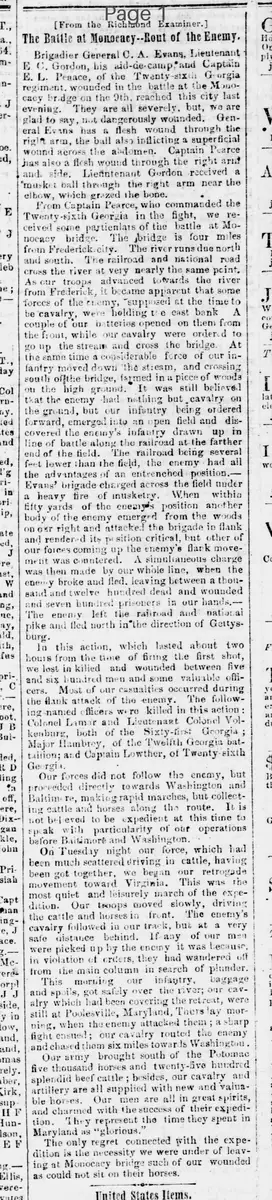
The Battle at Monocacy--Rout of the Enemy.
Brigadier General C. A. Evans, Lieutenant E. G. Gordon, his aid-de-camp, and Captain E. L. Pearce, of the Twenty-sixth Georgia regiment, wounded in the battle at the Monocacy bridge on the 9th, reached this city last evening. They are all severely, but, we are glad to say, not dangerously wounded. General Evans has a flesh wound through the right arm, the ball also inflicting a superficial wound across the abdomen. Captain Pearce has also a flesh wound through the right arm and side. Lieutenant Gordon received a musket ball through the right arm near the elbow, which grazed the bone.
From Captain Pearce, who commanded the Twenty-sixth Georgia in the fight, we received some particulars of the battle at Monocacy bridge. The bridge is four miles from Frederick city. The river runs due north and south. The railroad and national road cross the river at very nearly the same point. As our troops advanced towards the river from Frederick, it became apparent that some force of the enemy, supposed at the time to be cavalry, were holding the east bank. A couple of our batteries opened on them from the front, while our cavalry were ordered to go up the stream and cross the bridge. At the same time a considerable force of our infantry moved down the stream, and crossing south of the bridge, formed in a piece of woods on the high ground. It was still believed that the enemy had nothing but cavalry on the ground, but our infantry being ordered forward, emerged into an open field and discovered the enemy's infantry drawn up in line of battle along the railroad at the farther end of the field. The railroad being several feet lower than the field, the enemy had all the advantages of an entrenched position. Evans' brigade charged across the field under a heavy fire of musketry. When within fifty yards of the enemy's position another body of the enemy emerged from the woods on our right and attacked the brigade in flank and rendered its position critical, but other of our forces coming up the enemy's flank movement was countered. A simultaneous charge was then made by our whole line, when the enemy broke and fled, leaving between a thousand and twelve hundred dead and wounded and seven hundred prisoners in our hands. The enemy left the railroad and national pike and fled north in the direction of Gettysburg.
In this action, which lasted about two hours from the time of firing the first shot, we lost in killed and wounded between five and six hundred men and some valuable officers. Most of our casualties occurred during the flank attack of the enemy. The following named officers were killed in this action: Colonel Lamar and Lieutenant Colonel Volkenburg, both of the Sixty-first Georgia; Major Hambrey, of the Twelfth Georgia battalion; and Captain Lowther, of Twenty-sixth Georgia.
Our forces did not follow the enemy, but proceeded directly towards Washington and Baltimore, making rapid marches, but collecting cattle and horses along the route. It is not believed to be expedient at this time to speak with particularity of our operations before Baltimore and Washington.
On Tuesday night our force, which had been much scattered driving in cattle, having been got together, we began our retrograde movement toward Virginia. This was the most quiet and leisurely march of the expedition. Our troops moved slowly, driving the cattle and horses in front. The enemy's cavalry followed in our track, but at a very safe distance behind. If any of our men were picked up by the enemy it was because, in violation of orders, they had wandered off from the main column in search of plunder.
This morning our infantry, baggage and spoils, got safely over the river; our cavalry which had been covering the retreat, were still at Poolesville, Maryland, Thursday morning, when the enemy attacked them; a sharp fight ensued; our cavalry routed the enemy and chased them six miles towards Washington.
Our army brought south of the Potomac five thousand horses and twenty-five hundred splendid beef cattle; besides, our cavalry and artillery are all supplied with new and valuable horses. Our men are all in great spirits, and charmed with the success of their expedition. They represent the time they spent in Maryland as "glorious."
The only regret connected with the expedition is the necessity we were under of leaving at Monocacy bridge such of our wounded as could not sit on their horses.
What sub-type of article is it?
What themes does it cover?
What keywords are associated?
What entities or persons were involved?
Where did it happen?
Story Details
Key Persons
Location
Monocacy Bridge, Four Miles From Frederick City, Maryland
Event Date
On The 9th
Story Details
Confederate troops advanced on Monocacy Bridge, engaged Union forces initially thought to be cavalry but revealed as infantry in a strong position. Evans' brigade charged under fire, faced a flank attack that was countered, leading to a successful charge that routed the enemy, capturing prisoners and inflicting heavy casualties. The expedition then collected livestock before a leisurely retreat to Virginia, with a final cavalry skirmish.