Thank you for visiting SNEWPapers!
Sign up free
Arkansas State Gazette And Democrat
Little Rock, Pulaski County, Arkansas
What is this article about?
Benjamin F. Danley refutes the Arkansas Banner's account of an August 1851 affray at the Anthony House in Little Rock, Arkansas, involving himself, his brother C.C. Danley, Solon Borland, and others against Lt. A. Whiteley and L.J. Reardon. He accuses the paper of falsehoods, claims self-defense, and criticizes political bullying.
Clipping
OCR Quality
Full Text
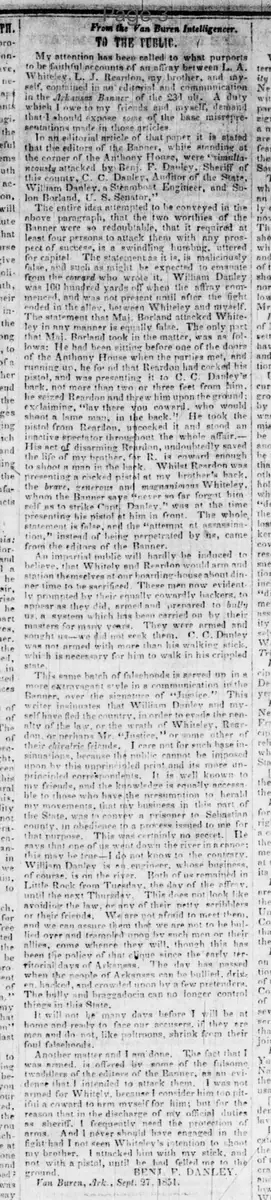
TO THE PUBLIC.
My attention has been called to what purports to be authentic accounts of an affray between Lieut. A. Whiteley, L. J. Reardon, my brother, and myself, contained in an editorial and communication in the Arkansas Banner of the 23d ult. A duty which I owe to my friends and myself, demands that I should expose some of the base misrepresentations made in those articles.
In an editorial article of that paper it is stated that the editors of the Banner, while standing at the corner of the Anthony House, were "simultaneously attacked by Benj. F. Danley, Sheriff of this county, C. C. Danley, Auditor of the State, William Danley, a Steamboat Engineer, and Solon Borland, U. S. Senator."
The entire idea attempted to be conveyed in the above paragraph, that the two worthies of the Banner were so redoubtable, that it required at least four persons to attack them with any prospect of success, is a swindling humbug, uttered for capital. The statement as it is, is maliciously false, and such as might be expected to emanate from the coward who wrote it. William Danley was two hundred yards off when the affray commenced, and was not present until after the fight ended in the alley, between Whiteley and myself.
The statement that Maj. Borland attacked Whiteley in any manner is equally false. The only part that Maj. Borland took in the matter, was as follows: He had been sitting before one of the doors of the Anthony House when the parties met, and running up, he found that Reardon had cocked his pistol, and was presenting it to C. C. Danley's back, not more than two or three feet from him, he seized Reardon and threw him upon the ground; exclaiming, "lie there you coward, who would shoot a lame man in the back." He took the pistol from Reardon, uncocked it and stood an inactive spectator throughout the whole affair.— His act of disarming Reardon, undoubtedly saved the life of my brother, or R. is coward enough to shoot a man in the back. Whilst Reardon was presenting a cocked pistol at my brother's back, the brave, generous and magnanimous Whiteley, whom the Banner says drew so far forgot himself as to strike Capt. Danley," was at the time presenting his pistol at him in front. The whole statement is false, and the "attempt at assassination," instead of being perpetrated by us, came from the editors of the Banner.
An impartial public will hardly be induced to believe, that Whiteley and Reardon would arm and station themselves at our boarding-house about dinner time to be sacrificed. These men now evidently prompted by their equally cowardly backers, to appear as they did, armed and prepared to bully us, a system which has been carried on by their masters for many years. They were armed and sought us—we did not seek them. C. C. Danley was not armed with more than his walking stick, which is necessary for him to walk in his crippled state.
This same batch of falsehoods is served up in a more extravagant style in a communication in the Banner, over the signature of "Justice." This writer insinuates that William Danley and myself have fled the country, in order to evade the penalty of the law, or the wrath of Whiteley, Reardon, or perhaps Mr. "Justice," or some other of their chivalric friends. I care not for such base insinuations, because the public cannot be imposed upon by this unprincipled print and its more unprincipled correspondents. It is well known to my friends, and the knowledge is equally necessary to those who have the presumption to herald my movements, that my business in this part of the State, was to convey a prisoner to Sebastian county, in obedience to a process issued to me for that purpose. This was certainly no secret. He says that one of us went down the river in canoe; this may be true—I do not know to the contrary. William Danley is an engineer, whose business, of course, is on the river. Both of us remained in Little Rock from Tuesday, the day of the affray, until the next Thursday. This does not look like avoiding the law, or any of their petty scribblers or their friends. We are not afraid to meet them, and we can assure them that we are not to be bullied over and trampled upon by such men or their allies, come whence they will, though this has been the policy of that clique since the early territorial days of Arkansas. The day has passed when the people of Arkansas can be bullied, driven, hoodwinked, and crowded upon by a few pretenders. The bully and braggadocia can no longer control things in this State.
It will not be many days before I will be at home and ready to face our accusers, if they are men and do not, like poltroons, shrink from their foul falsehoods.
Another matter and I am done. The fact that I was armed, is offered by some of the fulsome sycophants of the editors of the Banner, as an evidence that I intended to attack them. I was not armed for Whiteley, because I consider him too pitiful a coward to arm myself for him; but for the reason that in the discharge of my official duties as sheriff, I frequently need the protection of arms. And I never should have engaged in the fight had I not seen Whiteley's intention to shoot my brother. I attacked him with my stick, and not with a pistol, until he had felled me to the ground.
BENJ. F. DANLEY.
Van Buren, Ark., Sept. 27, 1851.
What sub-type of article is it?
What themes does it cover?
What keywords are associated?
What entities or persons were involved?
Letter to Editor Details
Author
Benj. F. Danley.
Recipient
To The Public.
Main Argument
danley refutes the arkansas banner's false portrayal of an affray as an unprovoked attack by him and associates on the editors, asserting that whiteley and reardon were the armed aggressors attempting assassination, and that his actions were in self-defense to protect his brother.
Notable Details