Thank you for visiting SNEWPapers!
Sign up free
Norfolk Gazette And Publick Ledger
Norfolk, Virginia
What is this article about?
Lord Wellington defeated French forces under Gen. Marmont near Salamanca on July 22, 1812, in a ruse de guerre battle. French losses: 10-12,000 killed, wounded, prisoners including wounded Gen. Bonnet; all artillery lost, cavalry decimated. Wellington pursued fugitives.
Clipping
OCR Quality
Full Text
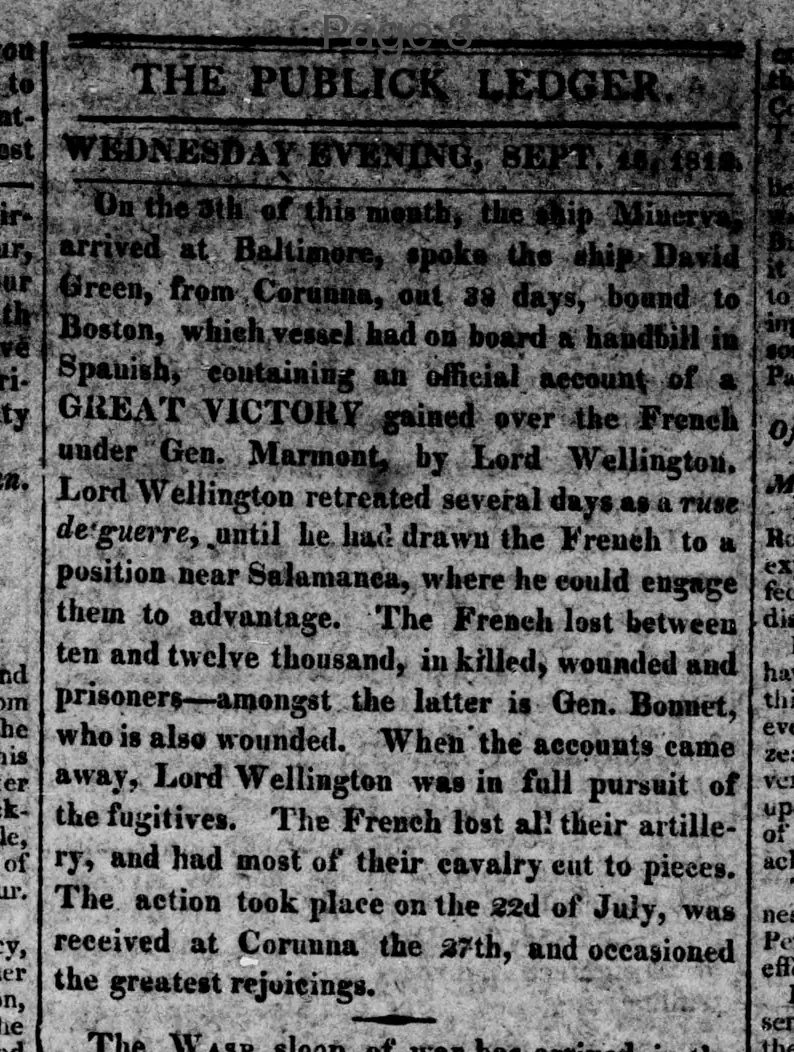
WEDNESDAY EVENING—SEPTEMBER 18, 1812
On the 6th or 7th of this month the ship Henry’s arrived at Baltimore. Spoke the ship David Green, from Corunna out 38 days, bound to Boston, which vessel had on board a handbill in Spanish, containing an official account of a
GREAT VICTORY gained over the French under Gen. Marmont by Lord Wellington,
Lord Wellington retreated several days as a ruse de guerre, until he had drawn the French to a position near Salamanca, where he could engage them to advantage. The French lost between ten and twelve thousand, in killed, wounded and prisoners—amongst the latter is Gen. Bonnet, who is also wounded. When the accounts came away, Lord Wellington was in full pursuit of the fugitives. The French lost all their artillery, and had most of their cavalry cut to pieces.
The action took place on the 22d of July, was received at Corunna the 27th, and occasioned the greatest rejoicings.
What sub-type of article is it?
What keywords are associated?
What entities or persons were involved?
Where did it happen?
Foreign News Details
Primary Location
Near Salamanca
Event Date
22d Of July
Key Persons
Outcome
the french lost between ten and twelve thousand, in killed, wounded and prisoners—amongst the latter is gen. bonnet, who is also wounded. ... lost all their artillery, and had most of their cavalry cut to pieces. lord wellington was in full pursuit of the fugitives.
Event Details
Lord Wellington retreated several days as a ruse de guerre, until he had drawn the French to a position near Salamanca, where he could engage them to advantage. ... The action took place on the 22d of July, was received at Corunna the 27th, and occasioned the greatest rejoicings.