Thank you for visiting SNEWPapers!
Sign up free
Liberty Advocate
Liberty, Amite County, Mississippi
What is this article about?
Biographical sketch of Antonio Lopez de Santa Anna, detailing his turbulent career in Mexican politics and military from 1821 to 1844, including revolutions, presidencies, exiles, and key events like the Texas campaign and Spanish invasion defeat.
Clipping
OCR Quality
Full Text
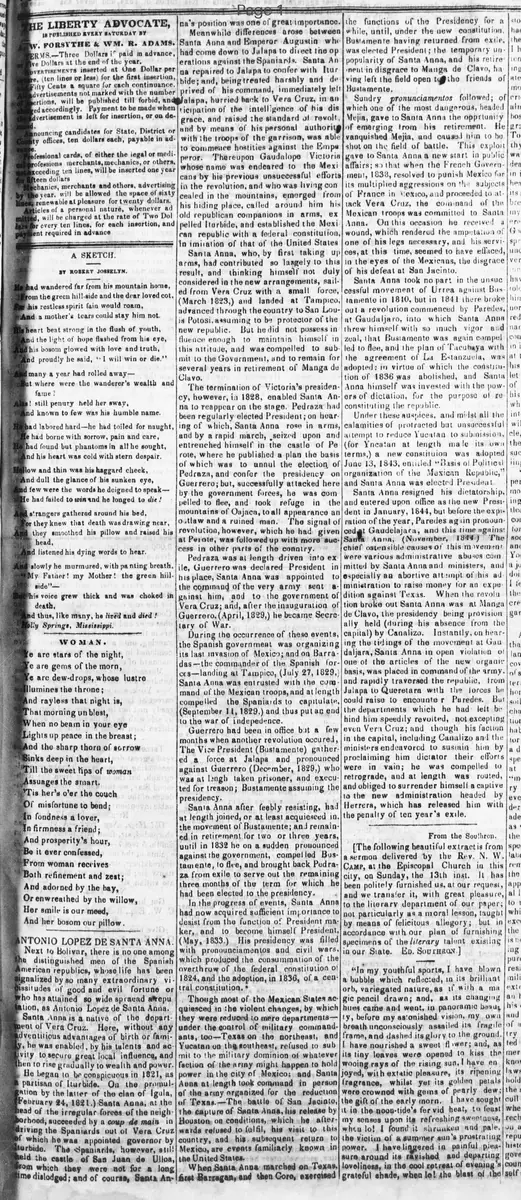
Next to Bolivar, there is no one among the distinguished men of the Spanish American republics, whose life has been signalized by so many extraordinary vicissitudes of good and evil fortune or who has attained so wide spread a reputation, as Antonio Lopez de Santa Anna.
Santa Anna is a native of the department of Vera Cruz. Here, without any adventitious advantages of birth or family, he was enabled, by his talents and activity to secure great local influence, and then to rise gradually to wealth and power.
He began to be conspicuous in 1821, as partisan of Iturbide. On the promulgation by the latter of the plan of Iguala, (February 24, 1821.) Santa Anna, at the head of the irregular forces of the neighborhood, succeeded by a coup de main in driving the Spaniards out of Vera Cruz of which he was appointed governor by Iturbide. The Spaniards, however, still held the castle of San Juan de Ulloa, from which they were not for a long time dislodged; and of course, Santa Anna's position was one of great importance.
Meanwhile differences arose between Santa Anna and Emperor Augustin who had come down to Jalapa to direct the operations against the Spaniards, Santa Anna repaired to Jalapa to confer with Iturbide; and, being treated harshly and deprived of his command, immediately left Jalapa, hurried back to Vera Cruz, in anticipation of the intelligence of his disgrace, and raised the standard of revolt and by means of his personal authority with the troops of the garrison, was able to commence hostilities against the Emperor. Thereupon Guadalupe Victoria whose name was endeared to the Mexicans by his previous unsuccessful efforts in the revolution, and who was living concealed in the mountains, emerged from his hiding place, called around him his old republican companions in arms, expelled Iturbide, and established the Mexican republic with a federal constitution, in imitation of that of the United States
Santa Anna, who, by first taking up arms, had contributed so largely to this result, and thinking himself not duly considered in the new arrangements, sailed from Vera Cruz with a small force, (March 1823,) and landed at Tampico, advanced through the country to San Louis Potosi, assuming to be protector of the new republic. But he did not possess influence enough to maintain himself in this attitude, and was compelled to submit to the Government, and to remain for several years in retirement at Manga de Clavo.
The termination of Victoria's presidency, however, in 1828, enabled Santa Anna to reappear on the stage. Pedraza had been regularly elected President; on hearing of which, Santa Anna rose in arms, and by a rapid march, seized upon and entrenched himself in the castle of Perote, where he published a plan the basis of which was to annul the election of Pedraza, and confer the presidency on Guerrero; but, successfully attacked here by the government forces, he was compelled to flee, and took refuge in the mountains of Oaxaca, to all appearance an outlaw and a ruined man. The signal of revolution, however, which he had given at Perote, was followed up with more success in other parts of the country.
Pedraza was at length driven into exile, Guerrero was declared President in his place, Santa Anna was appointed to the command of the very army sent against him, and to the government of Vera Cruz: and, after the inauguration of Guerrero, (April, 1829,) he became Secretary of War.
During the occurrence of these events, the Spanish government was organizing its last invasion of Mexico; and on Barradas--the commander of the Spanish forces--landing at Tampico, (July 27, 1829,) Santa Anna was entrusted with the command of the Mexican troops, and at length compelled the Spaniards to capitulate, (September 11, 1829,) and thus put an end to the war of independence.
Guerrero had been in office but a few months when another revolution occurred, The Vice President (Bustamente) gathered a force at Jalapa and pronounced against Guerrero (December, 1829,) who was at length taken prisoner, and executed for treason; Bustamente assuming the presidency.
Santa Anna after feebly resisting, had at length joined, or at least acquiesced in. the movement of Bustamente; and remained in retirement for two or three years. until in 1832 he on a sudden pronounced against the government, compelled Bustamente, to flee, and brought back Pedraza from exile to serve out the remaining three months of the term for which he had been elected to the presidency.
In the progress of events, Santa Anna had now acquired sufficient importance to desist from the function of President maker, and to become himself President (May, 1833.) His presidency was filled with pronunciamentos and civil wars. which produced the consummation of the overthrow of the federal constitution of 1824, and the adoption, in 1836, of a central constitution."
Though most of the Mexican States acquiesced in the violent changes, by which they were reduced to mere departments-- under the control of military commandants, too--Texas on the northeast, and Yucatan on the southeast, refused to submit to the military dominion of whatever faction of the army might happen to hold power in the city of Mexico: and Santa Anna at length took command in person of the army organized for the reduction of Texas. The battle of San Jacinto, the capture of Santa Anna, his release by Houston on conditions, which he afterwards refused to fulfill, his visit to this country, and his subsequent return to Mexico, are events familiarly known in the United States.
When Santa Anna marched on Texas, Sret Barragan, and then Goro, exercised the functions of the Presidency for a while, until, under the new constitution. Bustamente having returned from exile. was elected President; the temporary unpopularity of Santa Anna, and his retirement in disgrace to Manga de Clavo, having left the field open to the friends of Bustamente.
Sundry pronunciamentos followed; of which one of the most dangerous, headed by Mejia, gave to Santa Anna the opportunity of emerging from his retirement. He vanquished Mejia, and caused him to be shot on the field of battle. This exploit gave to Santa Anna a new start in public affairs; so that when the French Government, 1838, resolved to punish Mexico for its multiplied aggressions on the subjects of France in Mexico, and proceeded to attack Vera Cruz, the command of the Mexican troops was committed to Santa Anna. On this occasion he received a wound, which rendered the amputation of one of his legs necessary, and his services, at this time, seemed to have effaced in the eyes of the Mexicans, the disgrace of his defeat at San Jacinto,
Santa Anna took no part in the unsuccessful movement of Urrea against Bustamente in 1840, but in 1841 there broke out a revolution commenced by Paredes. at Guadalajara, into which Santa Anna threw himself with so much vigor and zeal, that Bustamente was again compelled to flee, and the plan of Tacubaya with the agreement of La Estanzuela, was adopted: in virtue of which the constitution of 1836 was abolished, and Santa Anna himself was invested with the powers of dictation, for the purpose of reconstituting the republic.
Under these auspices, and midst all the calamities of protracted but unsuccessful attempt to reduce Yucatan to submission (for Yucatan at length made its own terms,) a new constitution was adopted June 13, 1843, entitled "Basis of Political organization of the Mexican Republic," and Santa Anna was elected President
Santa Anna resigned his dictatorship and entered upon office as the new President in January, 1844, but before the expiration of the year, Paredes again pronounced at Guadalajara, and this time against Santa Anna, (November, 1844 ) The chief ostensible causes of this movement were various administrative abuses committed by Santa Anna and ministers, and especially an abortive attempt of his administration to raise money for an expedition against Texas. When the revolution broke out Santa Anna was at Manga de Clavo, the presidency being provisionally held (during his absence from the capital by Canalizo. Instantly, on hearing the tidings of the movement at Guadalajara, Santa Anna in open violation of one of the articles of the new organic basis, was placed in command of the army. and rapidly traversed the republic, from Jalapa to Queretaro with the forces he could raise to encounter Paredes. But the departments which he had left behind him speedily revolted, not excepting even Vera Cruz; and though his faction in the capital, including Canalizo and the ministers endeavored to sustain him by proclaiming him dictator their efforts were in vain; he was compelled to retrograde, and at length was routed, and obliged to surrender himself a captive to the new administration headed by Herrera, which has released him with the penalty of ten years' exile.
What sub-type of article is it?
What keywords are associated?
What entities or persons were involved?
Where did it happen?
Foreign News Details
Primary Location
Mexico
Event Date
1821 1844
Key Persons
Outcome
multiple revolutions leading to changes in presidency, constitutions, exiles, defeats including san jacinto and final surrender in 1844 with 10-year exile; defeat of spanish invasion in 1829; leg amputation in 1838 french conflict.
Event Details
Biographical account of Santa Anna's rise from Vera Cruz governor in 1821, involvement in revolutions against Iturbide, multiple presidencies (1833, 1844), overthrow of constitutions, campaigns in Texas and against Yucatan, defeats of Spanish and French forces, and final overthrow by Paredes in 1844.