Thank you for visiting SNEWPapers!
Sign up free
The New Hampshire Gazette
Portsmouth, Rockingham County, New Hampshire
What is this article about?
Major General Jacob Brown's letter reports the U.S. capture of Fort Erie on July 3, 1814, with minimal losses, and victory in the Battle of Chippewa on July 5 against British forces under Maj. Gen. Riall. American casualties: 328 total. Enemy: 298 hors de combat. Praise for Gen. Scott's brigade.
Merged-components note: The table component is a casualty summary directly embedded within the battle report text, with spatial overlap in bboxes, forming a single coherent foreign news article on the Battle at Chippewa.
Clipping
OCR Quality
Full Text
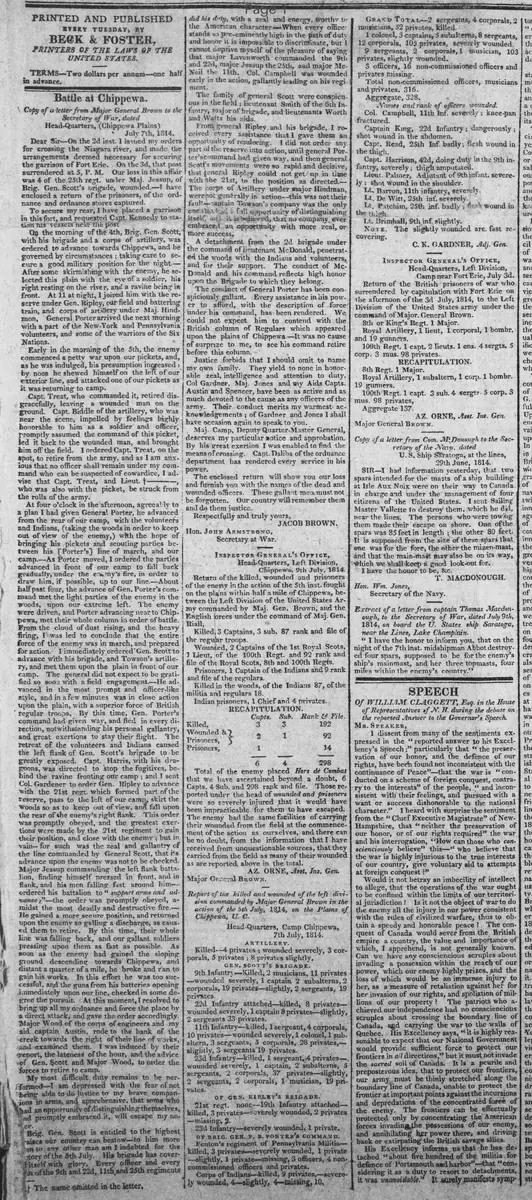
Copy of a letter from Major General Brown to the
Secretary of War, dated
Head-Quarters, (Chippewa Plains)
July 7th, 1814.
Dear Sir—On the 2d inst. I issued my orders
for crossing the Niagara river, and made the
arrangements deemed necessary for securing
the garrison of Fort Erie. On the 3d, that post
surrendered at 5, P. M. Our loss in this affair
was 4 of the 25th regt. under Maj. Jessup, of
Brig. Gen. Scott's brigade, wounded.—I have
enclosed a return of the prisoners, of the ordnance
and ordnance stores captured.
To secure my rear, I have placed a garrison
in this fort, and requested Capt. Kennedy to station
his vessels near the post.
On the morning of the 4th, Brig. Gen. Scott,
with his brigade and a corps of artillery, was
ordered to advance towards Chippewa, and be
governed by circumstances; taking care to secure
a good military position for the night.—
After some skirmishing with the enemy, he selected
this plain with the eye of a soldier, his
right resting on the river, and a ravine being in
front. At 11 at night, I joined him with the reserve
under Gen. Ripley, our field and battering
train, and corps of artillery under Maj. Hindman.
General Porter arrived the next morning
with a part of the New-York and Pennsylvania
volunteers, and some of the warriors of the Six
Nations.
Early in the morning of the 5th, the enemy
commenced a petty war upon our pickets, and,
as he was indulged, his presumption increased:
by noon he shewed himself on the left of our
exterior line, and attacked one of our pickets as
it was returning to camp.
Capt. Treat, who commanded it, retired disgracefully,
leaving a wounded man on the
ground. Capt. Biddle of the artillery, who was
near the scene, impelled by feelings highly
honorable to him as a soldier and officer,
promptly assumed the command of this picket,
led it back to the wounded man, and brought
him off the field. I ordered Capt. Treat, on the
spot, to retire from the army, and as I am anxious
that no officer shall remain under my command
who can be suspected of cowardice, I advise
that Capt. Treat, and Lieut.
who was also with the picket, be struck from
the rolls of the army.
At four o'clock in the afternoon, agreeably to
a plan I had given General Porter, he advanced
from the rear of our camp with the volunteers
and Indians, (taking the woods in order to keep
out of view of the enemy,) with the hope of
bringing his pickets and scouting parties between
his [Porter's] line of march, and our
camp.—As Porter moved, I ordered the parties
advanced in front of our camp to fall back
gradually, under the enemy's fire, in order to
draw him, if possible, up to our line.—About
half past four, the advance of Gen. Porter's command
met the light parties of the enemy in the
woods, upon our extreme left. The enemy
were driven, and Porter advancing near to Chippewa,
met their whole column in order of battle.
From the cloud of dust rising, and the heavy
firing, I was led to conclude that the entire
force of the enemy was in march, and prepared
for action. I immediately ordered Gen. Scott to
advance with his brigade, and Towson's artillery,
and met them upon the plain in front of our
camp. The general did not expect to be gratified
so soon with a field engagement.—He advanced
in the most prompt and officer-like
style, and in a few minutes was in close action
upon the plain, with a superior force of British
regular troops. By this time, Gen. Porter's
command had given way, and fled in every direction,
notwithstanding his personal gallantry,
and great exertions to stay their flight. The
retreat of the volunteers and Indians caused
the left flank of Gen. Scott's brigade to be
greatly exposed. Capt. Harris, with his dragoons,
was directed to stop the fugitives, behind
the ravine fronting our camp; and I sent
Col. Gardener to order Gen. Ripley to advance
with the 21st regt. which formed part of the
reserve, pass to the left of our camp, skirt the
woods so as to keep out of view, and fall upon
the rear of the enemy's right flank. This order
was promptly obeyed, and the greatest exertions
were made by the 21st regiment to gain
their position, and close with the enemy; but in
vain—for such was the zeal and gallantry of
the line commanded by General Scott, that its
advance upon the enemy was not to be checked.
Major Jessup commanding the left flank battalion,
finding himself pressed in front, and in
flank, and his men falling fast around him—
ordered his battalion to "support arms and advance;"
the order was promptly obeyed, amidst
the most deadly and destructive fire.—
He gained a more secure position, and returned
upon the enemy so galling a discharge, as caused
them to retire. By this time, their whole
line was falling back, and our gallant soldiers
pressing upon them as fast as possible. As
soon as the enemy had gained the sloping
ground descending towards Chippewa, and
distant a quarter of a mile, he broke and ran to
gain his works. In this effort he was too successful,
and the guns from his batteries opening
immediately upon our line, checked in some degree
the pursuit. At this moment, I resolved to
bring up all my ordnance and force the place by
a direct attack, and gave the order accordingly.
Major Wood of the corps of engineers and my
aid captain Austin, rode to the bank of the
creek towards the right of their line of works,
and examined them. I was induced by their
report, the lateness of the hour, and the advice
of Gen. Scott and Major Wood, to order the
forces to retire to camp.
My most difficult duty remains to be performed—I
am depressed with the fear of not
being able to do justice to my brave, companions
in arms, and apprehensive, that some who
had an opportunity of distinguishing themselves,
and promptly embraced it, will escape my notice.
Brig. Gen. Scott is entitled to the highest
praises our country can bestow—to him more
than to any other man am I indebted for the
victory of the 5th July. His brigade has covered
itself with glory. Every officer and every
man of the 9th and 22d, 11th and 25th regiments
did his duty, with a zeal and energy, worthy of
the American character. When every officer
stands so pre-eminently high in the path of duty
and honor it is impossible to discriminate, but I
cannot deprive myself of the pleasure of saying
that major Leavenworth commanded the 9th
and 22d, major Jessup the 25th, and major Mc.
Neil the 11th. Col. Campbell was wounded
early in the action, gallantly leading on his regiment.
The family of general Scott were conspicuous
in the field: lieutenant Smith of the 6th Infantry,
major of brigade, and lieutenants Worth
and Watts his aids.
From general Ripley, and his brigade, I received
every assistance that I gave them an
opportunity of rendering. I did not order any
part of the reserve into action, until general Porter's
command had given way, and then general
Scott's movements were so rapid and decisive,
that general Ripley could not get up in time
with the 21st, to the position as directed.—
The corps of Artillery under major Hindman,
were not generally in action—this was not their
fault captain Towson's company was the only
one which had an opportunity of distinguishing
itself, and it is believed, that no company ever
embraced an opportunity with more zeal, or
more success.
A detachment from the 2d brigade under
the command of lieutenant McDonald, penetrated
the woods with the Indians and volunteers,
and for their support. The conduct of McDonald
and his command reflects high honor
upon the Brigade to which they belong.
The conduct of General Porter has been conspicuously
gallant. Every assistance in his power
to afford, with the description of force
under his command, has been rendered. We
could not expect him to contend with the
British column of Regulars which appeared
upon the plains of Chippewa.—It was no cause
of surprize to me, to see his command retire
before this column.—
Justice forbids that I should omit to name
my own family. They yield to none in honorable
zeal, intelligence and attention to duty.
Col Gardner, Maj. Jones and my Aids Capts.
Austin and Spencer, have been as active and as
much devoted to the cause as any officers of the
army. Their conduct merits my warmest acknowledgements;
of Gardner and Jones I shall
have occasion again to speak to you.
Maj. Camp, Deputy Quarter-Master General,
deserves my particular notice and approbation.
By his great exertion I was enabled to find the
means of crossing. Capt. Dallas of the ordnance
department has rendered every service in his
power.
The enclosed return will show you our loss
and furnish you with the names of the dead and
wounded officers. These gallant men must not
be forgotten. Our country will remember them
and do them justice.
Respectfully and truly yours,
JACOB BROWN.
Hon. John Armstrong,
Secretary at War.
Inspector General's Office,
Head-Quarters. Left Division,
Chippewa, 9th July, 1814.
Return of the killed, wounded and prisoners
of the enemy in the action of the 5th inst. fought
on the plains within half a mile of Chippewa, between
the Left Division of the United States Army
commanded by Maj. Gen. Brown, and the
English forces under the command of Maj. Gen.
Riall,
Killed, 3 Captains, 3 sub. 87 rank and file of
the regular troops.
Wounded, 2 Captains of the 1st Royal Scots,
1 Lieut. of the 100th Regt. and 92 rank and
file of the Royal Scots, 8th and 100th Regts.
Prisoners, 1 Captain of the Indians and 9 rank
and file of the regulars.
Killed in the woods, of the Indians 87, of the
militia and regulars 18.
Indian prisoners, 1 Chief and 4 privates.
RECAPITULATION.
Total of the enemy placed Hors de Combat
that we have ascertained beyond a doubt, 6
Capts. 4 Sub. and 298 rank and file. Those reported
under the head of wounded and prisoners
were so severely injured that it would have
been impracticable for them to have escaped.
The enemy had the same facilities of carrying
their wounded from the field at the commencement
of the action as ourselves, and there can
be no doubt, from the information that I have
received from unquestionable sources, that they
carried from the field as many of their wounded
as are reported above in the total.
A. Z. ORNE, Asst. Ins. Gen.
Major General Brown.
Report of the killed and wounded of the left division
commanded by Major General Brown in the
action of the 5th July, 1814, on the Plains of
Chippewa, U. C.
Head-Quarters, Camp Chippewa,
7th July, 1814.
ARTILLERY.
Killed—4 privates; wounded severely, 3 corporals,
5 privates; 8 privates slightly.
GEN. SCOTT'S BRIGADE.
9th Infantry—Killed, 2 musicians, 11 privates
—wounded severely, 1 captain 2 subalterns, 2
corporals, 19 privates—slightly, 2 sergeants, 19
privates.
22d Infantry attached—killed, 8 privates—
wounded severely, 1 captain 8 privates—slightly,
2 sergeants 33 privates.
11th Infantry—killed, 1 sergeant, 4 corporals,
10 privates—wounded severely, 1 colonel, 1 sub.
altern, 3 sergeants, 5 corporals, 28 privates,
slightly, 3 sergeants 19 privates.
25th Infantry—killed, 1 sergeant, 4 privates—
wounded severely, 1 captain, 2 subalterns, 5
sergeants, 2 corporals, 37 privates—slightly,
2 sergeants, 2 corporals, 1 musician, 19 privates.
OF GEN. RIPLEY'S BRIGADE.
21st regt. none—19th Infantry attached
killed, 3 privates—severely wounded, 2 privates
—missing. 2.
25th Infantry—severely wounded, 1 private.
OF BRIG. GEN. P. B. PORTER'S COMMAND.
Fenton's regiment of Pennsylvania Militia—
killed, 3 privates severely wounded, 1 private
—slightly, 1 private—missing, 3 officers, 4 non-
commissioned officers and privates.
Corps of Indians—killed, 9 privates—severely
wounded, 4—slightly, 4—missing, 10.
GRAND TOTAL—2 sergeants, 4 corporals, 2
musicians, 52 privates, killed.
1 colonel, 3 captains, 5 subalterns, 8 sergeants.
12 corporals, 105 privates, severely wounded.
9 sergeants, 2 corporals, 1 musician, 103
privates, slightly wounded.
3 officers, 16 non-commissioned officers and
privates missing.
Total non-commissioned officers, musicians
and privates, 316.
Aggregate, 328.
Names and rank of officers wounded.
Col. Campbell, 11th Inf. severely; knee-pan
fractured.
Captain King, 22d Infantry; dangerously;
shot wound in the abdomen.
Capt. Read, 25th Inf. badly; flesh wound in
the thigh.
Capt. Harrison, 42d, doing duty in the 9th infantry,
severely: thigh amputated.
Lieut. Palmer, Adjutant of 9th infantry. severely:
shot wound in the shoulder.
Lt. Barron, 11th infantry, severely
Lt. De Witt, 25th inf. severely.
Lt. Patchin, 25th inf. badly; flesh wound in
the thigh
Lt. Brimhall, 9th inf. slightly.
Note. The slightly wounded are fast recovering.
C. K. GARDNER, Adj. Gen.
Inspector General's Office,
Head-Quarters, Left Division,
Camp near Fort Erie, July 3d.
Return of the British prisoners of war who
surrendered by capitulation with Fort Erie on
the afternoon of the 3d July, 1814, to the Left
Division of the United States army under the
command of Major. General Brown.
8th or King's Regt. 1 Major.
Royal Artillery, 1 lieut, 1 corporal, 1 bombr.
and 19 gunners.
100th Regt. 1 capt. 2 lieuts. 1 ens. 4 sergts. 5
corp. 3 mus. 98 privates.
RECAPITULATION
8th Regt. 1 Major.
Royal Artillery, 1 subaltern, 1 corp. 1 bombr.
19 gunners.
100th Regt. 1 capt. 3 sub. 4 sergts. 5 corp. 3
mus. 98 privates,
Aggregate 137.
A. Z. ORNE, Asst. Ins. Gen.
Major General Brown.
| Killed, | Capts. | Sub. | Rank & Fil |
| Wounded & Prisoners, | 3 | 3 | 192 |
| Prisoners, | 2 | 1 | 92 |
| Prisoners, | 1 | 14 |
What sub-type of article is it?
What keywords are associated?
What entities or persons were involved?
Where did it happen?
Foreign News Details
Primary Location
Chippewa Plains, Upper Canada
Event Date
July 5th, 1814
Key Persons
Outcome
american forces victorious; enemy retreated to works at chippewa. u.s. casualties: 328 total (60 killed, 220 wounded, 19 missing). enemy: 298 hors de combat (148 killed/wounded in action, 150 in woods). fort erie captured july 3 with 137 british prisoners.
Event Details
U.S. forces under Maj. Gen. Brown crossed Niagara River, captured Fort Erie on July 3. On July 5, after skirmishes, Gen. Scott's brigade engaged British regulars on Chippewa Plains. Porter's volunteers and Indians flanked but retreated. Scott's advance drove enemy back despite exposure; pursuit halted by artillery. Decision not to assault works due to hour and position.