Thank you for visiting SNEWPapers!
Sign up free
Southern Christian Advocate
Charleston, Charleston County, South Carolina
What is this article about?
Theological essay in the Southern Christian Advocate discussing justification, regeneration, and the direct witness of the Holy Spirit as assurance of adoption as God's children, contrasting it with indirect evidence from fruits of the Spirit, per Methodist doctrine and Pauline texts. Dated November 26, 1841.
Merged-components note: Theological discourse on justification and witness of the Spirit continued across pages; labeled as editorial for doctrinal opinion.
Clippings
1 of 2
OCR Quality
Full Text
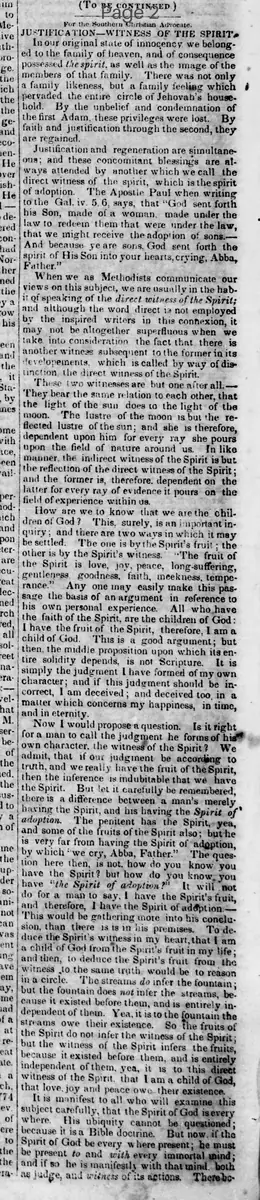
JUSTIFICATION--WITNESS OF THE SPIRIT
In our original state of innocency we belonged to the family of heaven, and of consequence possessed the spirit, as well as the image of the members of that family. There was not only a family likeness, but a family feeling which pervaded the entire circle of Jehovah's household. By the unbelief and condemnation of the first Adam, these privileges were lost. By faith and justification through the second, they are regained.
Justification and regeneration are simultaneous; and these concomitant blessings are always attended by another which we call the direct witness of the spirit, which is the spirit of adoption. The Apostle Paul when writing to the Gal. iv. 5, 6, says, that "God sent forth his Son, made of a woman, made under the law to redeem them that were under the law, that we might receive the adoption of sons.--And because ye are sons, God sent forth the spirit of His Son into your hearts, crying, Abba, Father."
When we as Methodists communicate our views on this subject, we are usually in the habit of speaking of the direct witness of the Spirit; and although the word direct is not employed by the inspired writers in this connexion, it may not be altogether superfluous when we take into consideration the fact that there is another witness subsequent to the former in its developments, which is called by way of distinction the direct witness of the Spirit.
These two witnesses are but one after all.--They bear the same relation to each other, that the light of the sun does to the light of the moon. The lustre of the moon is but the reflected lustre of the sun; and she is therefore, dependent upon him for every ray she pours upon the field of nature around us. In like manner, the indirect witness of the Spirit is but the reflection of the direct witness of the Spirit; and the former is, therefore, dependent on the latter for every ray of evidence it pours on the field of experience within us.
How are we to know that we are the children of God? This, surely, is an important inquiry; and there are two ways in which it may be settled. The one is by the Spirit's fruit; the other is by the Spirit's witness. "The fruit of the Spirit is love, joy, peace, long-suffering, gentleness, goodness, faith, meekness, temperance." Any one may easily make this passage the basis of an argument in reference to his own personal experience. All who have the fruit of the Spirit, are the children of God: I have the fruit of the Spirit, therefore, I am a child of God. This is a good argument; but then, the middle proposition upon which its entire solidity depends, is not Scripture. It is simply the judgment I have formed of my own character; and if this judgment should be incorrect, I am deceived; and deceived too, in a matter which concerns my happiness, in time, and in eternity.
Now I would propose a question. Is it right for a man to call the judgment he forms of his own character, the witness of the Spirit? We admit, that if our judgment be according to truth, and we really have the fruit of the Spirit, then the inference is indubitable that we have the Spirit. But let it carefully be remembered, there is a difference between a man's merely having the Spirit, and his having the Spirit of adoption. The penitent has the Spirit, yea, and some of the fruits of the Spirit also; but he is very far from having the Spirit of adoption, by which "we cry, Abba, Father." The question here then, is not, how do you know you have the Spirit? but how do you know you have "the Spirit of adoption?" It will not do for a man to say, I have the Spirit's fruit, and therefore, I have the Spirit of adoption. This would be gathering more into his conclusion, than there is in his premises. To deduce the Spirit's witness in my heart, that I am a child of God from the Spirit's fruit in my life; and then, to deduce the Spirit's fruit from the witness to the same truth, would be to reason in a circle. The streams do infer the fountain; but the fountain does not infer the streams, because it existed before them, and is entirely independent of them. Yea, it is to the fountain the streams owe their existence. So the fruits of the Spirit do not infer the witness of the Spirit; but the witness of the Spirit infers the fruits, because it existed before them, and is entirely independent of them, yea, it is to this direct witness of the Spirit, that I am a child of God, that love, joy and peace owe their existence.
It is manifest to all who will examine this subject carefully, that the Spirit of God is everywhere. His ubiquity cannot be questioned; because it is a Bible doctrine. But now, if the Spirit of God be everywhere present; he must be present to and with every immortal mind; and if so he is manifestly with that mind, both as judge, and witness of its actions. Therefore
NOVEMBER 26, 1841.
[Continuation from previous page, assuming based on context] ing no intermediate agencies or instrumentalities in this case, the judgment of the Spirit must be a direct judgment, and for the same reasons the witness which it bears to the consciousness of the individual must be a direct witness.
According to this view it will follow that the wicked have the direct witness of the Spirit, as well as the righteous. But as there is an opposition in the experience and character of the two, the testimony in the one case must be widely different from that of the other. The sinner must receive the Spirit because (as we said) he is everywhere present; and if he be received, he is received as a direct witness of the volitions of his mind: to him, therefore, he is "the Spirit of bondage to fear." The disobedient servant never feels the bondage of his condition, and he is never in greater fear, than when he is impressed with a conviction that the omnipotent God beholds him, as the direct witness of his aberrations. There is something within the breast of the sinner, that tells him that his course is offensive to God, and that if he persists in it, he will be lost forever. This is not the voice of conscience in the abstract:— it is the omnipresent Spirit of grace:—the witness within: "The Spirit of bondage to fear."
Let us look at the counter-part of this picture. The saint stands opposed to the sinner in his experience and character; therefore, the Spirit in him is not "the Spirit of bondage again to fear;" but it is "the Spirit of adoption," which is to him, both the Spirit of liberty and confidence. There is something within him, that "all the works are wrought in God," and that if he will be "faithful unto death," he shall have "a crown of life." This is not the voice of conscience in the abstract:—it is the omnipresent spirit of grace:—the direct witness within, even "the Spirit of adoption crying, Abba, Father." The sinner may have the direct witness of the Spirit, to the fact of his condemnation, brighter at one time, than at another, and when it is the brightest, he is most wretched.— In like manner, the saint may have the direct witness of the Spirit, to the fact of his justification and adoption brighter at one time than at another, and when he is the brightest, he is the most joyful and happy.
The rebel against his Maker may suppose that he has not the direct witness of the Spirit, to the fact that he is a child of the devil, when he really has; for what he has (religiously) at one time, he has at all times; unless his character be radically changed for the better. The saint also may, under peculiar circumstances suppose that he has not the direct witness of the Spirit, to the fact of his being a child of God, when he really has, for what he has, (religiously) at one time, he has at all times: unless his character be radically changed for the worse. The mistake of the sinner, will make him feel happier than he ought to feel: and the mistake of the believer will make him feel unhappy when there is no necessity for it. Let the sinner examine himself and pray and he will find out that his state is full of insecurity and danger. Let the saint examine himself, and pray, and believe, and he will be brought to discover that his state is full of security and hope.
God never intended that man, fallen and feeble as he is, should be left to reason out the evidence of his acceptance with him. This important matter is not to be determined alone by inferential argument founded upon the opinion we may have of our religious state. No, no, our decisions must rest upon higher ground, even "the demonstration of the Spirit and of power": a demonstration this, that mathematicians never learned, or taught, even a demonstration that finds its premises in heaven, and forces its conclusions upon the consciousness of the immortal mind renewed by grace: justified by faith, and restored to the divine favour by the blood of the covenant. For "hereby" (not we reason: we think, or we hope) but "we know, that he abideth in us, by the Spirit which he hath given us."
What sub-type of article is it?
What keywords are associated?
What entities or persons were involved?
Editorial Details
Primary Topic
Justification And The Direct Witness Of The Spirit
Stance / Tone
Doctrinal Exposition Supporting Methodist View Of Spiritual Assurance
Key Figures
Key Arguments