Thank you for visiting SNEWPapers!
Sign up free
Editorial
February 3, 1844
The North Carolinian
Fayetteville, Cumberland County, North Carolina
What is this article about?
An editorial from the St. Louis Reporter exposes a contradiction in Henry Clay's 1843 letters: in July, he claimed to have voted for the tariffs of 1816 and 1824, but in October, he admitted he did not, portraying him as politically opportunistic.
Clipping
OCR Quality
98%
Excellent
Full Text
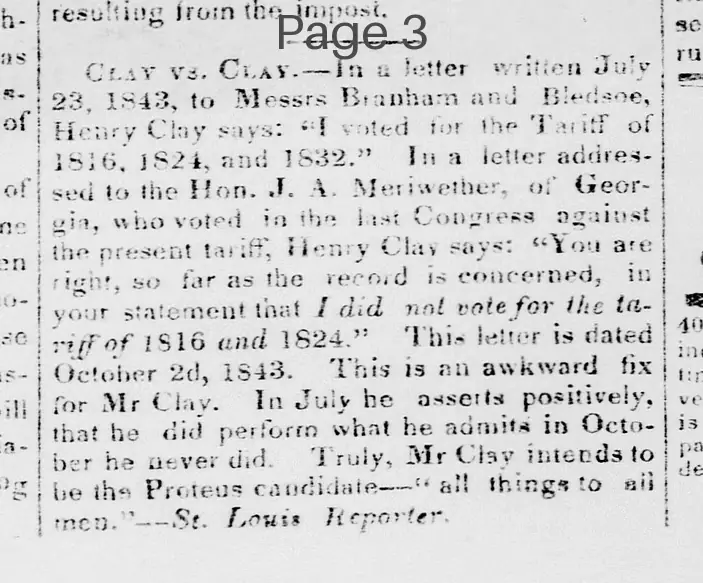
CLAY vs. Clay.—In a letter written July 23, 1843, to Messrs. Branham and Bledsoe, Henry Clay says: "I voted for the Tariff of 1816, 1824, and 1832." In a letter addressed to the Hon. J. A. Meriwether, of Georgia, who voted in the 1st Congress against the present tariff, Henry Clay says: "You are right, so far as the record is concerned, in your statement that I did not vote for the tariff of 1816 and 1824." This letter is dated October 2d, 1843. This is an awkward fix for Mr. Clay. In July he asserts positively, that he did perform what he admits in October he never did. Truly, Mr. Clay intends to be the Proteus candidate—"all things to all men." —St. Louis Reporter.
What sub-type of article is it?
Partisan Politics
Economic Policy
What keywords are associated?
Henry Clay
Tariff Votes
Political Contradiction
1843 Letters
Proteus Candidate
What entities or persons were involved?
Henry Clay
Messrs. Branham And Bledsoe
Hon. J. A. Meriwether
St. Louis Reporter
Editorial Details
Primary Topic
Henry Clay's Contradictory Statements On Tariff Votes
Stance / Tone
Critical Of Political Inconsistency
Key Figures
Henry Clay
Messrs. Branham And Bledsoe
Hon. J. A. Meriwether
St. Louis Reporter
Key Arguments
Clay Claimed In July 1843 Letter To Have Voted For Tariffs Of 1816, 1824, And 1832
In October 1843 Letter, Clay Admitted He Did Not Vote For Tariffs Of 1816 And 1824
This Contradiction Shows Clay Adapting Statements To Different Audiences