Thank you for visiting SNEWPapers!
Sign up free
Story
February 14, 1955
Trainman News
Indianapolis, Marion County, Indiana
What is this article about?
Report on U.S. poverty, with 13-14 million in dire conditions on $1,000/year incomes. Analyzes necessary budgets ($3,812-$4,454/year for family of four), advocates $1.25/hour minimum wage via Lehman's bill against Eisenhower's 90-cent proposal, refuting unemployment fears with historical data.
Clipping
OCR Quality
98%
Excellent
Full Text
From THE MACHINIST, IAM-AFL
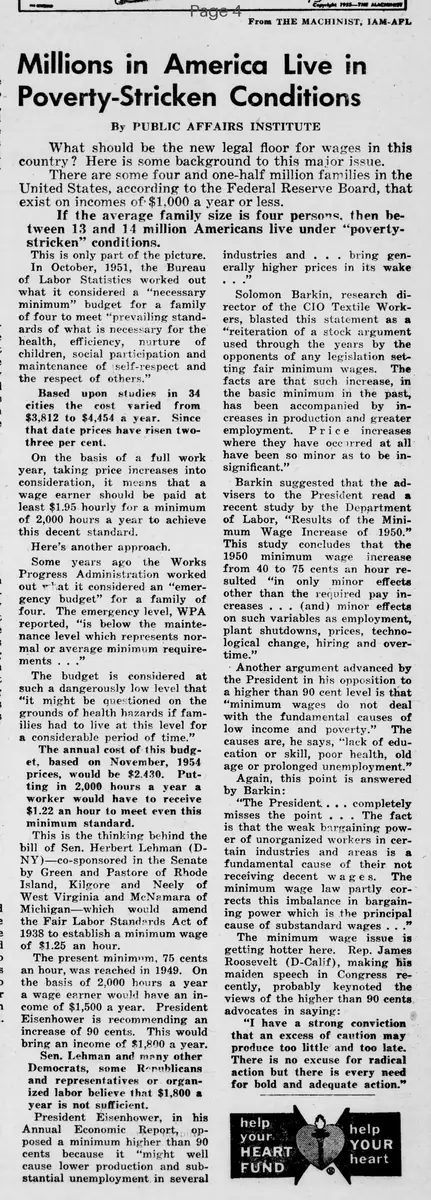
Millions in America Live in Poverty-Stricken Conditions
By PUBLIC AFFAIRS INSTITUTE
What should be the new legal floor for wages in this country? Here is some background to this major issue.
There are some four and one-half million families in the United States, according to the Federal Reserve Board, that exist on incomes of $1,000 a year or less.
If the average family size is four persons, then between 13 and 14 million Americans live under "poverty-stricken" conditions.
This is only part of the picture.
In October, 1951, the Bureau of Labor Statistics worked out what it considered a "necessary minimum" budget for a family of four to meet "prevailing standards of what is necessary for the health, efficiency, nurture of children, social participation and maintenance of self-respect and the respect of others."
Based upon studies in 34 cities the cost varied from $3,812 to $4,454 a year.
Since that date prices have risen two-three per cent.
On the basis of a full work year, taking price increases into consideration, it means that a wage earner should be paid at least $1.95 hourly for a minimum of 2,000 hours a year to achieve this decent standard.
Here's another approach.
Some years ago the Works Progress Administration worked out what it considered an "emergency budget" for a family of four. The emergency level, WPA reported, "is below the maintenance level which represents normal or average minimum requirements."
The budget is considered at such a dangerously low level that "it might be questioned on the grounds of health hazards if families had to live at this level for a considerable period of time."
The annual cost of this budget, based on November, 1954 prices, would be $2,430. Putting in 2,000 hours a year a worker would have to receive $1.22 an hour to meet even this minimum standard.
This is the thinking behind the bill of Sen. Herbert Lehman (D-NY)—co-sponsored in the Senate by Green and Pastore of Rhode Island, Kilgore and Neely of West Virginia and McNamara of Michigan—which would amend the Fair Labor Standards Act of 1938 to establish a minimum wage of $1.25 an hour.
The present minimum, 75 cents an hour, was reached in 1949. On the basis of 2,000 hours a year a wage earner would have an income of $1,500 a year. President Eisenhower is recommending an increase of 90 cents. This would bring an income of $1,800 a year.
Sen. Lehman and many other Democrats, some Republicans and representatives of organized labor believe that $1,800 a year is not sufficient.
President Eisenhower, in his Annual Economic Report, opposed a minimum higher than 90 cents because it "might well cause lower production and substantial unemployment in several industries and . . . bring generally higher prices in its wake."
Solomon Barkin, research director of the CIO Textile Workers, blasted this statement as a "reiteration of a stock argument used through the years by the opponents of any legislation setting fair minimum wages."
The facts are that such increase, in the basic minimum in the past, has been accompanied by increases in production and greater employment.
Price increases where they have occurred at all have been so minor as to be insignificant.
Barkin suggested that the advisers to the President read a recent study by the Department of Labor, "Results of the Minimum Wage Increase of 1950."
This study concludes that the 1950 minimum wage increase from 40 to 75 cents an hour resulted "in only minor effects other than the required pay increases . . . (and) minor effects on such variables as employment, plant shutdowns, prices, technological change, hiring and overtime."
Another argument advanced by the President in his opposition to a higher than 90 cent level is that "minimum wages do not deal with the fundamental causes of low income and poverty." The causes are, he says, "lack of education or skill, poor health, old age or prolonged unemployment."
Again, this point is answered by Barkin:
"The President . . . completely misses the point . . . The fact is that the weak bargaining power of unorganized workers in certain industries and areas is a fundamental cause of their not receiving decent wages.
The minimum wage law partly corrects this imbalance in bargaining power which is the principal cause of substandard wages . . ."
The minimum wage issue is getting hotter here.
Rep. James Roosevelt (D-Calif), making his maiden speech in Congress recently, probably keynoted the views of the higher than 90 cents advocates in saying:
"I have a strong conviction that an excess of caution may produce too little and too late.
There is no excuse for radical action but there is every need for bold and adequate action."
Millions in America Live in Poverty-Stricken Conditions
By PUBLIC AFFAIRS INSTITUTE
What should be the new legal floor for wages in this country? Here is some background to this major issue.
There are some four and one-half million families in the United States, according to the Federal Reserve Board, that exist on incomes of $1,000 a year or less.
If the average family size is four persons, then between 13 and 14 million Americans live under "poverty-stricken" conditions.
This is only part of the picture.
In October, 1951, the Bureau of Labor Statistics worked out what it considered a "necessary minimum" budget for a family of four to meet "prevailing standards of what is necessary for the health, efficiency, nurture of children, social participation and maintenance of self-respect and the respect of others."
Based upon studies in 34 cities the cost varied from $3,812 to $4,454 a year.
Since that date prices have risen two-three per cent.
On the basis of a full work year, taking price increases into consideration, it means that a wage earner should be paid at least $1.95 hourly for a minimum of 2,000 hours a year to achieve this decent standard.
Here's another approach.
Some years ago the Works Progress Administration worked out what it considered an "emergency budget" for a family of four. The emergency level, WPA reported, "is below the maintenance level which represents normal or average minimum requirements."
The budget is considered at such a dangerously low level that "it might be questioned on the grounds of health hazards if families had to live at this level for a considerable period of time."
The annual cost of this budget, based on November, 1954 prices, would be $2,430. Putting in 2,000 hours a year a worker would have to receive $1.22 an hour to meet even this minimum standard.
This is the thinking behind the bill of Sen. Herbert Lehman (D-NY)—co-sponsored in the Senate by Green and Pastore of Rhode Island, Kilgore and Neely of West Virginia and McNamara of Michigan—which would amend the Fair Labor Standards Act of 1938 to establish a minimum wage of $1.25 an hour.
The present minimum, 75 cents an hour, was reached in 1949. On the basis of 2,000 hours a year a wage earner would have an income of $1,500 a year. President Eisenhower is recommending an increase of 90 cents. This would bring an income of $1,800 a year.
Sen. Lehman and many other Democrats, some Republicans and representatives of organized labor believe that $1,800 a year is not sufficient.
President Eisenhower, in his Annual Economic Report, opposed a minimum higher than 90 cents because it "might well cause lower production and substantial unemployment in several industries and . . . bring generally higher prices in its wake."
Solomon Barkin, research director of the CIO Textile Workers, blasted this statement as a "reiteration of a stock argument used through the years by the opponents of any legislation setting fair minimum wages."
The facts are that such increase, in the basic minimum in the past, has been accompanied by increases in production and greater employment.
Price increases where they have occurred at all have been so minor as to be insignificant.
Barkin suggested that the advisers to the President read a recent study by the Department of Labor, "Results of the Minimum Wage Increase of 1950."
This study concludes that the 1950 minimum wage increase from 40 to 75 cents an hour resulted "in only minor effects other than the required pay increases . . . (and) minor effects on such variables as employment, plant shutdowns, prices, technological change, hiring and overtime."
Another argument advanced by the President in his opposition to a higher than 90 cent level is that "minimum wages do not deal with the fundamental causes of low income and poverty." The causes are, he says, "lack of education or skill, poor health, old age or prolonged unemployment."
Again, this point is answered by Barkin:
"The President . . . completely misses the point . . . The fact is that the weak bargaining power of unorganized workers in certain industries and areas is a fundamental cause of their not receiving decent wages.
The minimum wage law partly corrects this imbalance in bargaining power which is the principal cause of substandard wages . . ."
The minimum wage issue is getting hotter here.
Rep. James Roosevelt (D-Calif), making his maiden speech in Congress recently, probably keynoted the views of the higher than 90 cents advocates in saying:
"I have a strong conviction that an excess of caution may produce too little and too late.
There is no excuse for radical action but there is every need for bold and adequate action."
What sub-type of article is it?
Policy Debate
Economic Report
What themes does it cover?
Misfortune
Justice
Social Manners
What keywords are associated?
Poverty
Minimum Wage
Family Budget
Labor Standards
Economic Policy
Wage Increase
What entities or persons were involved?
Herbert Lehman
President Eisenhower
Solomon Barkin
James Roosevelt
Where did it happen?
United States
Story Details
Key Persons
Herbert Lehman
President Eisenhower
Solomon Barkin
James Roosevelt
Location
United States
Event Date
1950s
Story Details
Article discusses poverty affecting millions of American families on low incomes, proposes minimum wage increases based on budget studies, critiques President's 90-cent proposal, supports $1.25 via Lehman's bill, citing past increases' minimal negative effects.