Thank you for visiting SNEWPapers!
Sign up free
Atlanta Daily World
Atlanta, Fulton County, Georgia
What is this article about?
Southern War Labor Conference urges equal rights for Negroes, repeal of poll tax, and fair treatment in industry. Rev. W. M. Jones speaks on civil rights; resolutions address labor policies, no-strike pledge, and post-war jobs. Attended by 2,500 white and 300 colored delegates from 11 southern states.
Merged-components note: Continuation of labor conference report from page 1 to page 4; unified label as narrative article.
Clippings
1 of 2
OCR Quality
Full Text
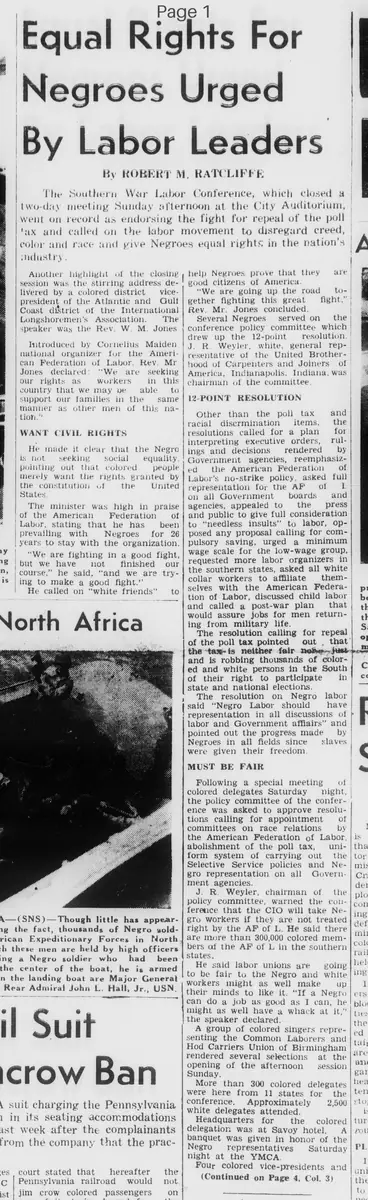
By ROBERT M. RATCLIFFE
The Southern War Labor Conference, which closed a two-day meeting Sunday afternoon at the City Auditorium, went on record as endorsing the fight for repeal of the poll tax and called on the labor movement to disregard creed, color and race and give Negroes equal rights in the nation's industry.
Another highlight of the closing session was the stirring address delivered by a colored district vice-president of the Atlantic and Gulf Coast district of the International Longshoremen's Association. The speaker was the Rev. W. M. Jones. Introduced by Cornelius Maiden, national organizer for the American Federation of Labor, Rev. Mr. Jones declared: "We are seeking our rights as workers in this country that we may be able to support our families in the same manner as other men of this nation."
WANT CIVIL RIGHTS
He made it clear that the Negro is not seeking social equality pointing out that colored people merely want the rights granted by the constitution of the United States. The minister was high in praise of the American Federation of Labor, stating that he has been prevailing with Negroes for 26 years to stay with the organization. "We are fighting in a good fight, but we have not finished our course," he said, "and we are trying to make a good fight."
He called on "white friends" to help Negroes prove that they are good citizens of America. "We are going up the road together fighting this great fight," Rev. Mr. Jones concluded.
Several Negroes served on the conference policy committee which drew up the 12-point resolution. J. R. Wevler, white, general representative of the United Brotherhood of Carpenters and Joiners of America, Indianapolis, Indiana, was chairman of the committee.
12-POINT RESOLUTION
Other than the poll tax and racial discrimination items, the resolutions called for a plan for interpreting executive orders, rulings and decisions rendered by Government agencies, reemphasized the American Federation of Labor's no-strike policy, asked full representation for the AF of L on all Government boards and agencies, appealed to the press and public to give full consideration to "needless insults" to labor, opposed any proposal calling for compulsory saving, urged a minimum wage scale for the low-wage group, requested more labor organizers in the southern states, asked all white collar workers to affiliate themselves with the American Federation of Labor, discussed child labor and called a post-war plan that would assure jobs for men returning from military life.
The resolution calling for repeal of the poll tax pointed out that the tax is neither fair nor just and is robbing thousands of colored and white persons in the South of their right to participate in state and national elections.
The resolution on Negro labor said "Negro Labor should have representation in all discussions of labor and Government affairs" and pointed out the progress made by Negroes in all fields since slaves were given their freedom.
MUST BE FAIR
Following a special meeting of colored delegates Saturday night, the policy committee of the conference was asked to approve resolutions calling for appointment of committees on race relations by the American Federation of Labor, abolishment of the poll tax, uniform system of carrying out the Selective Service policies and Negro representation on all Government agencies.
J. R. Wevler, chairman of the policy committee, warned the conference that the CIO will take Negro workers if they are not treated right by the AF of L. He said there are more than 300,000 colored members of the AF of L in the southern states.
He said labor unions are going to be fair to the Negro and white workers might as well make up their minds to like it. "If a Negro can do a job as good as I can, he might as well have a whack at it," the speaker declared.
A group of colored singers representing the Common Laborers and Hod Carriers Union of Birmingham rendered several selections at the opening of the afternoon session Sunday.
More than 300 colored delegates were here from 11 states for the conference. Approximately 2,500 white delegates attended. Headquarters for the colored delegation was at Savoy hotel. A banquet was given in honor of the Negro representatives Saturday night at the YMCA. Four colored vice-presidents and
(Continued on Page 4, Col. 3)
Equal Rights
(Continued from Page 1)
several colored organizers were here. Negro leaders occupied space on the platform during most of the sessions.
In a statement after the final session, Pat Dailey, business agent for several locals in Pascagoula Mississippi, said his group has organized a labor and management war board for the purpose of solving problems confronting the members. He said the organization has benefitted many of the 1,500 colored members in that section.
The War Labor Conference was under auspices of the executive boards of the 11 southern state federations of labor, the organization department of the American Federation of Labor and the labor division of the War Production Board.
What sub-type of article is it?
What themes does it cover?
What keywords are associated?
What entities or persons were involved?
Where did it happen?
Story Details
Key Persons
Location
City Auditorium, Southern States
Story Details
The Southern War Labor Conference endorses repeal of the poll tax and equal rights for Negroes in industry, disregarding creed, color, and race. Rev. W. M. Jones delivers a speech urging civil rights and praise for the American Federation of Labor. The 12-point resolution covers various labor issues including no-strike policy, minimum wage, and post-war jobs. Over 300 colored delegates from 11 states attend.