Thank you for visiting SNEWPapers!
Sign up free
Virginia Argus
Richmond, Virginia
What is this article about?
U.S. Congress proceedings on November 11: Senate debates and advances army enlistment bill rejecting amendment on minors; House handles petitions from Bank of Alexandria and conscientious objectors, reports on revenue and claims bills, conference on loan and armed vessels, and postpones classification bill.
Merged-components note: Sequential components detailing the same congressional session proceedings on page 2, forming a single coherent domestic news report.
Clipping
OCR Quality
Full Text
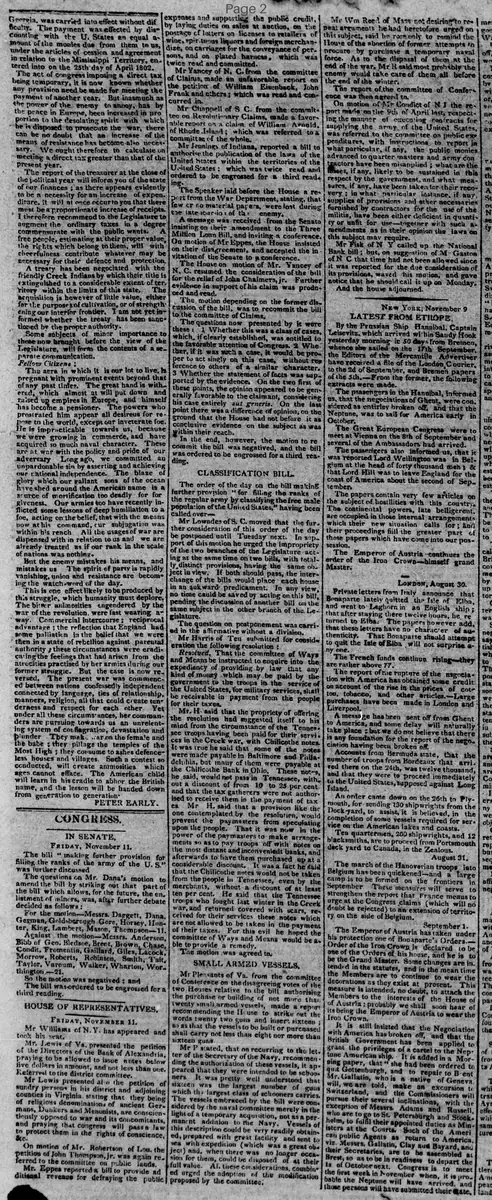
IN SENATE,
Friday, November 11.
The bill 'making further provision for filling the ranks of the army of the U. S.' was further discussed.
The questions on Mr. Dana's motion to amend the bill by striking out that part of the bill which allows, for the future, the enlistment of minors, was, after further debate, decided as follows:
For the motion--Messrs. Daggett, Dana, German, Goldsborough, Gore, Horsey, Hunter, King, Lambert, Mason, Thompson--11.
Against the motion--Messrs. Anderson, Bibb of Geo. Bledsoe, Brent, Brown, Chase, Condit, Fromentin, Gaillard, Giles, Lacock, Morrow, Roberts, Robinson, Smith, Tait, Taylor, Varnum, Walker, Wharton, Worthington--21.
So the motion was negatived: and
The bill was ordered to be engrossed for a third reading.
HOUSE OF REPRESENTATIVES.
Friday, November 11.
Mr. Williams of N. Y. has appeared and took his seat.
Mr. Lewis of Va. presented the petition of the Directors of the Bank of Alexandria, praying to be allowed to issue notes below five dollars in amount, and not less than one. Referred to the district committee.
Mr. Lewis presented also the petition of sundry persons in his district and adjoining counties in Virginia, stating that they being of religious denominations of ancient Germans, Dunkers and Menonists, are conscientiously opposed to war and its concomitants, and praying that congress will pass a law to protect them in the rights of conscience, &c.
On motion of Mr. Robertson of Lou. the petition of John Thompson, jr. was again referred to the committee on public lands.
Mr. Eppes reported a bill to provide additional revenue for defraying the public expenses and supporting the public credit, by laying duties on sales at auction, on the postage of letters on licenses to retailers of wine, spirituous liquors and foreign merchandise, on carriages for the conveyance of persons, and on plated harness, which was twice read and committed.
Mr. Yancey of N. C. from the committee of Claims, made an unfavorable report on the petition of William Eisenback, John Frank and others; which was read and concurred in.
Mr. Chappell of S. C. from the committee on Revolutionary Claims, made a favorable report on a claim of William Arnold, of Rhode Island; which was referred to a committee of the whole.
Mr. Jennings of Indiana, reported a bill to authorise the publication of the laws of the United States within the territories of the United States: which was twice read and ordered to be engrossed for a third reading.
The Speaker laid before the House a report from the War Department, stating, that few or no material papers, were lost during the late incursion of the enemy.
A message was received from the Senate insisting on their amendment to the Three Million Loan Bill, and inviting a conference.
On motion of Mr. Eppes, the House insisted on their disagreement, and accepted the invitation of the Senate to a conference.
The House on motion of Mr. Yancey of N. C. resumed the consideration of the bill for the relief of John Chalmers, jr. Further evidence in support of his claim was produced and read.
The motion depending on the former discussion of the bill, was to recommit the bill to the committee of Claims.
The questions now presented by it were these: 1. Whether this was a class of cases, which, if clearly established, was entitled to the favorable attention of Congress. 2. Whether, if it was such a case, it would be proper to act singly on this case, without reference to others of a similar character. 3. Whether the statement of facts was supported by the evidence. On the two first of these points, the opinion appeared to be generally favorable to the claimant, considering his case entirely sui generis. On the last point there was a difference of opinion, on the ground that the House had not before it as conclusive evidence on the subject as was within their reach.
In the end, however, the motion to recommit the bill was negatived, and the bill was ordered to be engrossed for a third reading.
CLASSIFICATION BILL.
The order of the day on the bill making further provision 'for filling the ranks of the regular army by classifying the free male population of the United States,' having been called up.
Mr. Lowndes of S. C. moved that the further consideration of this order of the day be postponed until Tuesday next. In support of this motion he urged the impropriety of the two branches of the Legislature acting at the same time on two bills, with totally distinct provisions, having the same object in view. If both should pass, the interchange of the bills would place each house in an awkward predicament. In any view, no time could be saved by acting on this bill, pending the discussion of another bill on the same subject in the other branch of the Legislature.
The question on postponement was carried in the affirmative without a division.
Mr. Harris of Ten. submitted for consideration the following resolution:
Resolved, That the committee of Ways and Means be instructed to enquire into the expediency of providing by law that any kind of money which may be paid by the government to the troops in the service of the United States, for military services, shall be receivable in payment from the people for their taxes.
Mr. H. said that the propriety of offering the resolution had suggested itself to his mind from the circumstance of the Tennessee troops having been paid for their services in the Creek war, with Chillicothe notes. It was true he said that some of the notes were made payable in Baltimore and Philadelphia, but many of them were payable at the Chillicothe Bank in Ohio. These notes, he said, would not pass in Tennessee, without a discount of from 10 to 25 per cent and that the tax gatherers were not authorised to receive them in the payment of taxes.
Mr. H. said that a provision like the one contemplated by the resolution, would prevent the paymasters from speculating upon the people. That it was now in the power of the paymasters to make arrangements so as to pay troops off with notes on the most distant and inconvenient banks, and afterwards to have them purchased up at a considerable discount. It was a fact he said that the Chillicothe notes would not be taken from the people in Tennessee, even by the merchants, without a discount of at least ten per cent. He said that the Tennessee troops who fought last winter in the Creek war, and returned covered with scars, received for their services these notes which are not allowed to be taken in the payment of their taxes. For this evil he hoped the committee of Ways and Means would be able to provide a remedy.
The motion was agreed to.
SMALL ARMED VESSELS
Mr. Pleasants of Va. from the committee of Conference on the disagreeing votes of the two Houses relative to the bill authorising the purchase or building of not more than twenty small armed vessels, made a report recommending the House to strike out the words twenty two guns and insert sixteen; so as that the vessels to be built or purchased shall carry not less than eight nor more than sixteen guns.
Mr. P. stated, that on recurring to the letter of the Secretary of the Navy, recommending the authorization of these vessels, it appeared that they were intended to be schooners. It was pretty well understood that sixteen was the largest number of guns which the largest class of schooners carries. The vessels embraced by the bill were considered by the naval committee merely in the light of a temporary acquisition, not as a permanent addition to the Navy. Vessels of this description could be very readily obtained, prepared with great facility and sent to sea with expedition (which was a great object) and, when there was no longer occasion for them, could be disposed of at their full value. All these considerations, combined urged the adoption of the modification proposed by the committee.
Mr. Wm. Reed of Mass. not desiring to repeat arguments he had heretofore urged on this subject, said he rose only to remind the House of the abortion of former attempts to procure by purchase a temporary naval force. As to the disposal of them at the end of the war, Mr. R. said most probably the enemy would take care of them all before the end of the winter.
The report of the committee of Conference was then agreed to.
On motion of Mr. Condict of N. J. the report made on the 9th of April last, respecting the manner of executing contracts for supplying the army of the United States, was referred to the committee on public expenditures, with instructions to report in what particular, if any, the public monies advanced to quarter masters and army contractors have been misapplied; what are the losses, if any, likely to be sustained in this respect by the government, and what measures, if any, have been taken for their recovery; in what particular instance, if any, supplies of provisions and other necessaries furnished by contractors for the use of the militia, have been either deficient in quantity or unfit for use--together with such amendments as in their opinion the laws on this subject may require.
Mr. Fisk of N. Y. called up the National Bank bill; but, on suggestion of Mr. Gaston of N. C. that time had not been allowed since it was reported for the due consideration of its provisions, waved his motion, and gave notice that he should call it up on Monday.
And the house adjourned.
What sub-type of article is it?
What keywords are associated?
What entities or persons were involved?
Domestic News Details
Event Date
Friday, November 11.
Key Persons
Outcome
senate negatived motion to strike enlistment of minors (11-21), ordered army bill engrossed; house advanced revenue bill, unfavorable report on eisenback claim, favorable on arnold claim, postponed classification bill, agreed to conference report on armed vessels (8-16 guns), insisted on loan bill disagreement, negatived recommit on chalmers bill.
Event Details
Senate discussed bill for filling army ranks, debated and rejected amendment barring future enlistment of minors, ordered engrossment. House: Mr. Williams seated; petitions from Bank of Alexandria and religious objectors (Dunkers, Menonists) referred; Thompson petition re-referred; Eppes reported revenue duties bill committed; unfavorable report on Eisenback petition concurred; favorable on Arnold claim to committee; Jennings reported territories laws bill engrossed; War Dept report on papers; Senate message on loan bill led to conference; resumed Chalmers relief bill, negatived recommit, ordered engrossment; Lowndes postponed classification bill to Tuesday; Harris resolution on troop pay for taxes agreed; Pleasants conference report on small armed vessels (16 guns max) agreed; Condict referred army contracts report; Fisk deferred National Bank bill.