Thank you for visiting SNEWPapers!
Sign up free
Domestic News
December 24, 1926
The Ely Miner
Ely, Saint Louis County, Minnesota
What is this article about?
Explanation of using salt on green hay to attract moisture, inhibit bacteria, and prevent spontaneous combustion; alternatives like lime or phosphate rock noted to cause dustiness.
Clipping
OCR Quality
100%
Excellent
Full Text
Salt Attracts Moisture: When Scattered on Hay
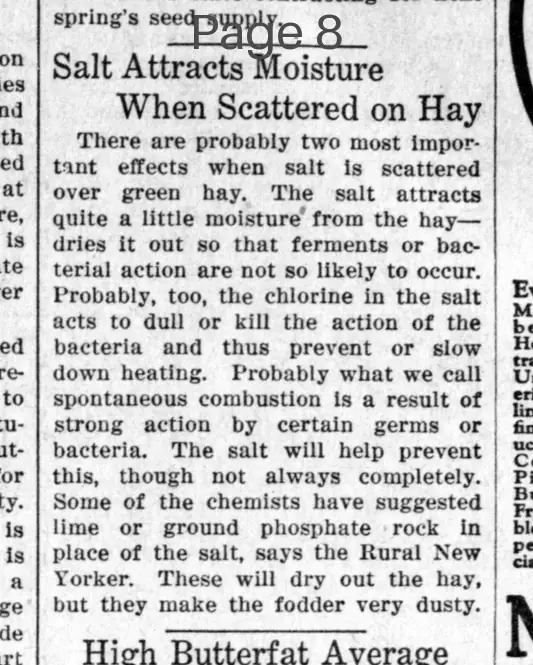
There are probably two most important effects when salt is scattered over green hay. The salt attracts quite a little moisture from the hay-dries it out so that ferments or bacterial action are not so likely to occur. Probably, too, the chlorine in the salt acts to dull or kill the action of the bacteria and thus prevent or slow down heating. Probably what we call spontaneous combustion is a result of strong action by certain germs or bacteria. The salt will help prevent this, though not always completely.
Some of the chemists have suggested lime or ground phosphate rock in place of the salt, says the Rural New Yorker. These will dry out the hay, but they make the fodder very dusty.
There are probably two most important effects when salt is scattered over green hay. The salt attracts quite a little moisture from the hay-dries it out so that ferments or bacterial action are not so likely to occur. Probably, too, the chlorine in the salt acts to dull or kill the action of the bacteria and thus prevent or slow down heating. Probably what we call spontaneous combustion is a result of strong action by certain germs or bacteria. The salt will help prevent this, though not always completely.
Some of the chemists have suggested lime or ground phosphate rock in place of the salt, says the Rural New Yorker. These will dry out the hay, but they make the fodder very dusty.
What sub-type of article is it?
Agriculture
What keywords are associated?
Salt On Hay
Moisture Attraction
Bacterial Action
Spontaneous Combustion
Lime Alternative
Phosphate Rock
Rural New Yorker
Domestic News Details
Event Details
Salt scattered on green hay attracts moisture to dry it out, reducing likelihood of fermentation or bacterial action; chlorine in salt dulls or kills bacteria to prevent or slow heating and spontaneous combustion, though not always completely. Chemists suggest lime or ground phosphate rock as alternatives, which dry hay but make it dusty, per Rural New Yorker.