Thank you for visiting SNEWPapers!
Sign up free
The Durant News
Durant, Holmes County, Mississippi
What is this article about?
Labor shortage from war-era industrial wages prompts farmers in eastern Holmes County to shift from row crops to pastures and livestock. County Agent I. W. Carson visits a farmer who replaced tenants with a tractor, expanded to 30 brood cows and more hogs, and plans pasture improvements using soil analysis from Starkville lab.
Clipping
OCR Quality
Full Text
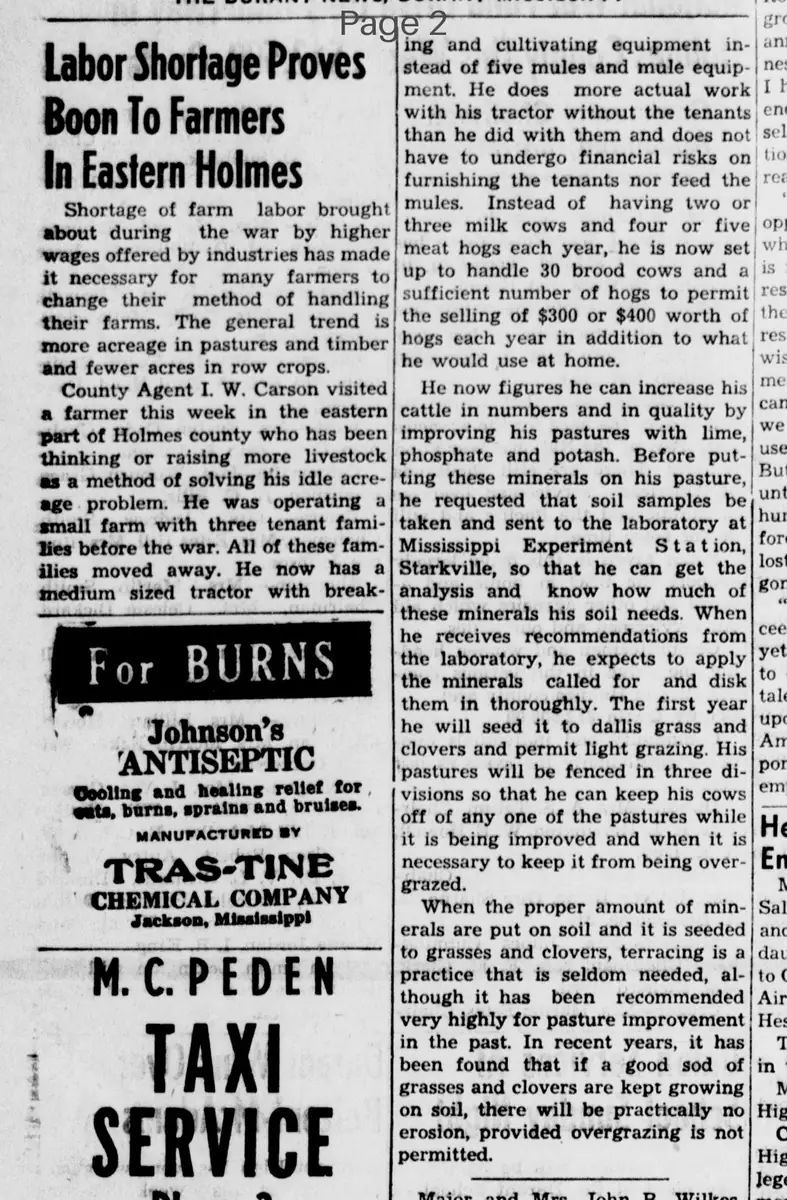
Shortage of farm labor brought about during the war by higher wages offered by industries has made it necessary for many farmers to change their method of handling their farms. The general trend is more acreage in pastures and timber and fewer acres in row crops.
County Agent I. W. Carson visited a farmer this week in the eastern part of Holmes county who has been thinking of raising more livestock as a method of solving his idle acreage problem. He was operating a small farm with three tenant families before the war. All of these families moved away. He now has a medium sized tractor with breaking and cultivating equipment instead of five mules and mule equipment. He does more actual work with his tractor without the tenants than he did with them and does not have to undergo financial risks on furnishing the tenants nor feed the mules. Instead of having two or three milk cows and four or five meat hogs each year, he is now set up to handle 30 brood cows and a sufficient number of hogs to permit the selling of $300 or $400 worth of hogs each year in addition to what he would use at home.
He now figures he can increase his cattle in numbers and in quality by improving his pastures with lime, phosphate and potash. Before putting these minerals on his pasture, he requested that soil samples be taken and sent to the laboratory at Mississippi Experiment Station, Starkville, so that he can get the analysis and know how much of these minerals his soil needs. When he receives recommendations from the laboratory, he expects to apply the minerals called for and disk them in thoroughly. The first year he will seed it to dallis grass and clovers and permit light grazing. His pastures will be fenced in three divisions so that he can keep his cows off of any one of the pastures while it is being improved and when it is necessary to keep it from being overgrazed.
When the proper amount of minerals are put on soil and it is seeded to grasses and clovers, terracing is a practice that is seldom needed, although it has been recommended very highly for pasture improvement in the past. In recent years, it has been found that if a good sod of grasses and clovers are kept growing on soil, there will be practically no erosion, provided overgrazing is not permitted.
What sub-type of article is it?
What keywords are associated?
What entities or persons were involved?
Where did it happen?
Domestic News Details
Primary Location
Eastern Part Of Holmes County
Event Date
This Week
Key Persons
Outcome
farmer replaces three tenant families with tractor, increases to 30 brood cows and sufficient hogs for $300-$400 annual sales plus home use; plans pasture improvements to boost cattle numbers and quality without erosion if not overgrazed.
Event Details
Shortage of farm labor due to higher industrial wages during the war leads farmers to expand pastures and timber, reduce row crops. County Agent I. W. Carson visits eastern Holmes County farmer who lost tenants, adopted tractor for more efficient work without financial risks of tenants or mules. Farmer shifts from few milk cows and hogs to larger livestock operation, requests soil samples for mineral analysis at Mississippi Experiment Station in Starkville to improve pastures with lime, phosphate, potash, seeding to dallis grass and clovers, divided fencing to manage grazing and prevent overgrazing. Proper sod reduces need for terracing and erosion.