Thank you for visiting SNEWPapers!
Sign up free
Editorial
February 25, 1848
The Democratic Pioneer
Upper Sandusky, Wyandot County, Ohio
What is this article about?
In 1848, Democratic Ohio senators address constituents, justifying their Senate walkout to block an unconstitutional apportionment bill by the Whig majority that divides counties for partisan gain, violating equal representation and oaths. They pledge to return if the bill is purged of flaws.
Clipping
OCR Quality
95%
Excellent
Full Text
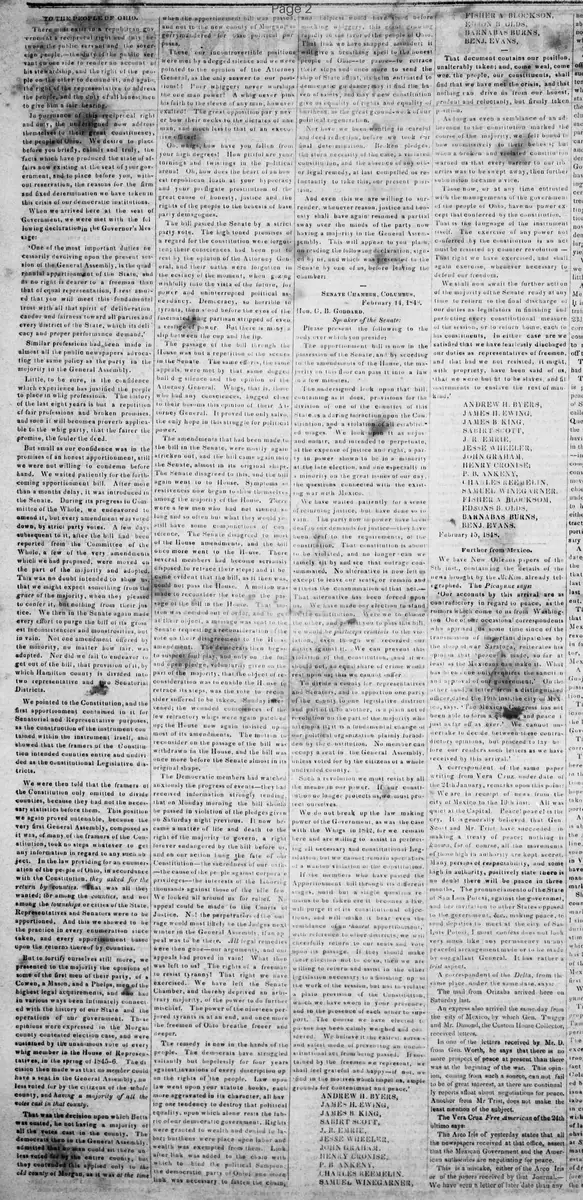
There must exist in a republican government a reciprocal right and duty between the public servant and the sovereign people,--the duty of the public servant on one side to render an account of his stewardship, and the right of the people on the other to demand it, and again the right of the representative to address the people, and the duty of all honest men to give him a fair hearing.
In pursuance of this reciprocal right and duty, the undersigned now address themselves to their great constituency, the people of Ohio. We desire to place before you briefly, calmly and truly, the facts which have produced the state of affairs now existing at the seat of your government, and to place before you, without reservation, the reasons for the firm and fixed determination we have taken in this crisis of our democratic institutions.
When we arrived here at the seat of Government, we were met with the following declaration in the Governor's Message:
"One of the most important duties necessarily devolving upon the present session of the General Assembly, is the quadrennial apportionment of the State, and as no right is dearer to a freeman than that of equal representation, I rest assured that you will meet this fundamental trust with all that spirit of deliberation, candor and fairness toward all parties and every district of the State, which its delicacy and proper performance demand."
Similar professions had been made in almost all the public newspapers advocating the same policy as the party in the majority in the General Assembly.
Little, to be sure, is the confidence which experience has justified the people to place in whig professions. The history of the last eight years is but a repetition of fair professions and broken promises, and soon it will become a proverb applicable to the whig party, that the fairer the promise, the fouler the deed.
But small as our confidence was in the promises of an honest apportionment, still we were not willing to condemn before hand. We waited patiently for the forthcoming apportionment bill. After more than a month's delay, it was introduced in the Senate. During its progress in Committee of the Whole, we endeavored to amend it, but every amendment was voted down, by strict party votes. A few days subsequent to it, after the bill had been reported from the Committee of the Whole, a few of the very amendments which we had proposed, were moved on the part of the majority and adopted.
This was no doubt intended to show us, that we might expect something from the grace of the majority, when they pleased to confer it, but nothing from their justice. We then in the Senate again made every effort to purge the bill of its grossest inconsistencies and monstrosities, but in vain. Not one amendment offered by the minority, no matter how fair, was adopted. Nor did we fail to endeavor to get out of the bill, that provision of it, by which Hamilton county is divided into two representative and no Senatorial Districts.
We pointed to the Constitution, and the first apportionment contained in it for Senatorial and Representative purposes, as the construction of the instrument contained within the instrument itself, and showed that the framers of the Constitution intended counties entire and undivided as the Constitutional Legislative districts.
We were then told that the framers of the Constitution only omitted to divide counties, because they had not the necessary statistics before them. This position we again proved untenable, because the very first General Assembly, composed as it was, of many of the framers of the Constitution, took no steps whatever to get any information in regard to any such object. In the law providing for an enumeration of the people of Ohio, in accordance with the Constitution, they asked for the return by counties. That was all they wanted; for among the counties, and not among the townships or cities of the State, Representatives and Senators were to be apportioned. And this we showed to be the practice in every enumeration since taken, and every apportionment based upon the returns thereof by counties.
But to fortify ourselves still more, we presented to the majority the opinions of some of the first men of their party, of a Cowen, a Mason, and a Phelps, men of the highest legal acquirements, and who had in various ways been intimately connected with the history of our State and the operations of our government. These opinions were expressed in the Morgan county contested election case, and were sustained by the unanimous vote of every whig member in the House of Representatives, in the spring of 1845-6. The decision then made was that no member could have a seat in the General Assembly, unless voted for by the citizens of the whole county, and having a majority of all the votes cast in that county.
That was the decision upon which Betts was ousted, he not having a majority of all the votes cast in the county. The democrats then in the General Assembly admitted that no man could sit there unless voted for by the entire county, but they contended this applied only to the old county of Morgan, as it was at the time when the apportionment bill was passed, and not to the new county of Morgan, as gerrymandered for base political purposes.
These our incontrovertible positions were met by a dogged silence and we were pointed to the opinion of the Attorney General, as the only answer to our positions!! Poor whiggery never worships the one man power! A whig never pins his faith to the sleeve of any man, however exalted! The great opposition party never bow their necks to the dictates of one man, and much less to that of an executive officer!
Oh, whigs, how have you fallen from your high degrees! How pitiful are your turnings and twistings in the political arena! Oh, how does the heart of an honest republican loath at your hypocrisy and your profligate prostitution of the great cause of honesty, justice and the rights of the people to the behoofs of base party demagogues.
The bill passed the Senate by a strict party vote. The high toned promises of a regard for the constitution were forgotten; their consciences had been put to rest by the opinion of the Attorney General, and their oaths were forgotten in the ecstasy of the moment, when gazing wishfully into the vista of the future, for power and uninterrupted political ascendancy. Democracy, so horrible to tyrants, then stood before the eyes of the fascinated whig partisan stripped of even a vestige of power. But there is many a slip between the cup and the lip.
The passage of the bill through the House was but a repetition of the scenes in the Senate. The same efforts, the same appeals, were met by that same dogged bull dog silence and the opinion of the Attorney General. Whigs, that is, those who had any consciences, hugged close to their bosoms this opinion of their Attorney General. It proved the only salvo, the only hope in this struggle for political power.
The amendments that had been made to the bill in the Senate, were mostly again stricken out, and the bill came again into the Senate, almost in its original shape. The Senate disagreed to this, and the bill again went to the House. Symptoms of restiveness now began to show themselves among the majority of the House. There were a few men who had not sinned so long and so often but what they would yet still have some compunctions of conscience. The Senate disagreed to most of the House amendments, and the bill once more went to the House. There several members had become seriously disposed to retrace their steps; and it became evident that the bill, as it then was, could not pass the House. A motion was made to reconsider the vote on the passage of the bill in the House. That motion was decided out of order, and to get at their object, a message was sent to the Senate requesting a reconsideration of the vote on their disagreement to the House amendment. The democrats then began to suspect foul play, and only on the full and open pledge, voluntarily given on the part of the majority, that the object of reconsideration was to enable the House to retrace its steps, was the vote to reconsider suffered to be taken. Sunday intervened; the wounded consciences of the few refractory whigs were again patched up; the House now again insisted upon most of its amendments. The motion to reconsider on the passage of the bill was withdrawn in the House, and the bill was once more before the Senate almost in its original shape.
The Democratic members had watched anxiously the progress of events-they had received information strongly tending that on Monday morning the bill should be passed in violation of the pledges given on Saturday night previous. It now became a matter of life and death to the right of the majority to govern, a right forever endangered by the bill before us, and on our action hung the fate of our Constitution-the sacredness of our oaths--the cause of the people against corporate privileges--the interests of the laboring thousands against those of the idle few.
We looked all around us for relief. No appeal could be made to the Courts of Justice. No! the perpetrators of the outrage would most likely be the judges next winter in the General Assembly, if an appeal was to be there. All legal remedies were then gone-our arguments, and our appeals had proved in vain! What then was left to us? The rights of a freeman to resist tyranny! That right we have exercised. We have left the Senate Chamber, and thereby deprived an arbitrary majority, of the power to do further mischief. The power of the nineteen perjured tyrants is at an end, and once more the freemen of Ohio breathe freer and deeper.
The remedy is now in the hands of the people. The democrats have struggled valiantly but hopelessly for four years against invasions of every description upon the rights of the people. Law upon law went upon your statute books, each more aggravated in its character, all having one tendency to destroy that political equality, upon which alone rests the fabric of our democratic government. Rights were granted to wealth and denied to labor; burdens were placed upon labor and wealth was exempted from them. Link after link was added to the chain with which to bind the political Sampson: the democratic party of Ohio; one more link was necessary to fasten the chain, and helpless would have stood before mocking whiggery, this giant growing
That link we have snapped asunder; it will give a breathing spell to the honest people of Ohio--to pause--to retrace their steps and once more to send the ship of State afloat, its helm entrusted to democratic guidance: may it find the haven of safety, and may a new constitution give us equality of rights and equality of burdens, as the great ground-work of our political regeneration.
Nor have we been wanting in careful and deep reflection, before we took our final determination. Broken pledges, the stern necessity of the case, a violated constitution, and the absence of any other legal remedy, at last compelled us reluctantly to take this, our present position.
And even this we are willing to surrender, whenever reason, justice and honesty shall have again resumed a partial sway over the minds of the party now having a majority in the General Assembly. This will appear to you plain, on reading the following declaration, signed by us, and which was presented to the Senate by one of us, before leaving the chamber:
SENATE CHAMBER, COLUMBUS,
February 14, 1848.
Hon. C. B. GODDARD,
Speaker of the Senate:
Please present the following to the body over which you preside:
The apportionment bill is now in the possession of the Senate, and by acceding to the amendments of the House, the majority on this floor can pass it into a law in a few minutes.
The undersigned look upon that bill, containing as it does, provisions for the division of one of the counties of this State, as a daring infraction upon the Constitution, and a violation of all established usages. We look upon it as unjust and unfair, and intended to perpetuate, at the expense of justice and right, a party in power shown to be in a minority at the late election, and one especially in a minority on the great issues of our day, the questions connected with the existing war with Mexico.
We have waited patiently for a sense of returning justice, but have done so in vain. The party now in power have been deaf to our demands for justice--they have been deaf to the requirements of the constitution. That constitution is about to be violated, and no longer can we tamely sit by and see that outrage consummated. No alternative is now left us except to leave our seats, or remain and witness the Consummation of that act. That alternative has been forced upon us. We have made our election to stand by the constitution. Were we to choose the other, and permit you to pass this bill, we would be particeps criminis to the violation, even though we recorded our names against it. We can prevent this violation of the constitution, and if we should not, an equal share of crime would rest upon us; this we cannot suffer.
To divide a county for representatives and Senators, and to apportion one party of the county to one legislative district and part of it to another, is a plain act of revolution on the part of the majority who attempts it; it is a fundamental change of our political organization plainly forbidden by the Constitution. No member can occupy a seat in the General Assembly, unless voted for by the citizens of a whole undivided county.
Such a revolution we must resist by all the means in our power. If our constitution no longer protects us, we must protect ourselves.
We do not break up the law making power of the Government, as was the case with the Whigs in 1842, for we remain here and are willing to assist in perfecting all necessary and constitutional Legislation, but we cannot remain spectators of a wanton violation of the Constitution.
If the members who have passed the Apportionment bill through its different stages, upon but a single question remains to be taken ere it becomes a law. If they will purge it of its constitutional objections, and will make it bear even the semblance of an honest apportionment, with reference to other districts, we will cheerfully return to our seats and vote upon its passage. If they should make their election not to do so, then we are willing to return and assist in the other legislation necessary to a finishing up of the work of the session, but not to violate a plain provision of the Constitution, which we have sworn in your presence, and in the presence of each other to support. The course we have elected to pursue has been calmly weighed and considered. We believe it the easiest and safest mode of preventing an unconstitutional act from being passed. If sustained by the freemen we represent, we shall feel grateful and happy-if not, we find in the motives which impel us, ample grounds for contentment and peace.
ANDREW H. BYERS,
JAMES H. EWING,
JAMES B. KING,
SABIRT SCOTT,
J.R. EMRIC,
JESSE WHEELER,
JOHN GRAHAM,
HENRY CRONISE,
P.B. ANKENY,
CHARLES REEMELIN,
SAMUEL WINEGARNER
That document contains our position unalterably taken; and, come weal, come woe, the people, our constituents, shall find that we have met the crisis, and that nothing can drive us from our honest, prudent and reluctantly, but firmly taken position.
As long as even a semblance of an adherence to the constitution marked the course of the majority, we felt bound to bow submissively to their behests; but when a broken and violated constitution warned us that every barrier to our liberties was to be swept away, then further submission became a vice.
Those now, or at any time entrusted with the managements of the Government of the people of Ohio, have no power except that conferred by the Constitution. That is the language of the instrument itself. The exercise of any power not conferred by the Constitution is an act must be resisted by counter revolution.
That right we have exercised, and shall again exercise, whenever necessary to defend our freedom.
We shall now await the further action of the majority of the Senate ready at any time to return to the final discharge of our duties as legislators in finishing and perfecting every constitutional measure of the session, or to return home, each to his constituents. In either case are we satisfied that we have fearlessly discharged our duties as representatives of freemen, and that had we not resisted, it might, with propriety, have been said of us, 'that we were not fit to be slaves, and fit instruments to enslave the rest of mankind.'
ANDREW H. BYERS,
JAMES H. EWING,
JAMES B. KING,
SABIRT SCOTT,
J. R. EMRIE,
JESSE WHEELER,
JOHN GRAHAM,
HENRY CRONISE,
P.B. ANKENY,
CHARLES REEMELIN,
SAMUEL WINEGARNER,
WILLIAM A. BLACKSOM,
EDSON B. OLDS,
BARNABAS BURNS,
BENJ. EVANS.
In pursuance of this reciprocal right and duty, the undersigned now address themselves to their great constituency, the people of Ohio. We desire to place before you briefly, calmly and truly, the facts which have produced the state of affairs now existing at the seat of your government, and to place before you, without reservation, the reasons for the firm and fixed determination we have taken in this crisis of our democratic institutions.
When we arrived here at the seat of Government, we were met with the following declaration in the Governor's Message:
"One of the most important duties necessarily devolving upon the present session of the General Assembly, is the quadrennial apportionment of the State, and as no right is dearer to a freeman than that of equal representation, I rest assured that you will meet this fundamental trust with all that spirit of deliberation, candor and fairness toward all parties and every district of the State, which its delicacy and proper performance demand."
Similar professions had been made in almost all the public newspapers advocating the same policy as the party in the majority in the General Assembly.
Little, to be sure, is the confidence which experience has justified the people to place in whig professions. The history of the last eight years is but a repetition of fair professions and broken promises, and soon it will become a proverb applicable to the whig party, that the fairer the promise, the fouler the deed.
But small as our confidence was in the promises of an honest apportionment, still we were not willing to condemn before hand. We waited patiently for the forthcoming apportionment bill. After more than a month's delay, it was introduced in the Senate. During its progress in Committee of the Whole, we endeavored to amend it, but every amendment was voted down, by strict party votes. A few days subsequent to it, after the bill had been reported from the Committee of the Whole, a few of the very amendments which we had proposed, were moved on the part of the majority and adopted.
This was no doubt intended to show us, that we might expect something from the grace of the majority, when they pleased to confer it, but nothing from their justice. We then in the Senate again made every effort to purge the bill of its grossest inconsistencies and monstrosities, but in vain. Not one amendment offered by the minority, no matter how fair, was adopted. Nor did we fail to endeavor to get out of the bill, that provision of it, by which Hamilton county is divided into two representative and no Senatorial Districts.
We pointed to the Constitution, and the first apportionment contained in it for Senatorial and Representative purposes, as the construction of the instrument contained within the instrument itself, and showed that the framers of the Constitution intended counties entire and undivided as the Constitutional Legislative districts.
We were then told that the framers of the Constitution only omitted to divide counties, because they had not the necessary statistics before them. This position we again proved untenable, because the very first General Assembly, composed as it was, of many of the framers of the Constitution, took no steps whatever to get any information in regard to any such object. In the law providing for an enumeration of the people of Ohio, in accordance with the Constitution, they asked for the return by counties. That was all they wanted; for among the counties, and not among the townships or cities of the State, Representatives and Senators were to be apportioned. And this we showed to be the practice in every enumeration since taken, and every apportionment based upon the returns thereof by counties.
But to fortify ourselves still more, we presented to the majority the opinions of some of the first men of their party, of a Cowen, a Mason, and a Phelps, men of the highest legal acquirements, and who had in various ways been intimately connected with the history of our State and the operations of our government. These opinions were expressed in the Morgan county contested election case, and were sustained by the unanimous vote of every whig member in the House of Representatives, in the spring of 1845-6. The decision then made was that no member could have a seat in the General Assembly, unless voted for by the citizens of the whole county, and having a majority of all the votes cast in that county.
That was the decision upon which Betts was ousted, he not having a majority of all the votes cast in the county. The democrats then in the General Assembly admitted that no man could sit there unless voted for by the entire county, but they contended this applied only to the old county of Morgan, as it was at the time when the apportionment bill was passed, and not to the new county of Morgan, as gerrymandered for base political purposes.
These our incontrovertible positions were met by a dogged silence and we were pointed to the opinion of the Attorney General, as the only answer to our positions!! Poor whiggery never worships the one man power! A whig never pins his faith to the sleeve of any man, however exalted! The great opposition party never bow their necks to the dictates of one man, and much less to that of an executive officer!
Oh, whigs, how have you fallen from your high degrees! How pitiful are your turnings and twistings in the political arena! Oh, how does the heart of an honest republican loath at your hypocrisy and your profligate prostitution of the great cause of honesty, justice and the rights of the people to the behoofs of base party demagogues.
The bill passed the Senate by a strict party vote. The high toned promises of a regard for the constitution were forgotten; their consciences had been put to rest by the opinion of the Attorney General, and their oaths were forgotten in the ecstasy of the moment, when gazing wishfully into the vista of the future, for power and uninterrupted political ascendancy. Democracy, so horrible to tyrants, then stood before the eyes of the fascinated whig partisan stripped of even a vestige of power. But there is many a slip between the cup and the lip.
The passage of the bill through the House was but a repetition of the scenes in the Senate. The same efforts, the same appeals, were met by that same dogged bull dog silence and the opinion of the Attorney General. Whigs, that is, those who had any consciences, hugged close to their bosoms this opinion of their Attorney General. It proved the only salvo, the only hope in this struggle for political power.
The amendments that had been made to the bill in the Senate, were mostly again stricken out, and the bill came again into the Senate, almost in its original shape. The Senate disagreed to this, and the bill again went to the House. Symptoms of restiveness now began to show themselves among the majority of the House. There were a few men who had not sinned so long and so often but what they would yet still have some compunctions of conscience. The Senate disagreed to most of the House amendments, and the bill once more went to the House. There several members had become seriously disposed to retrace their steps; and it became evident that the bill, as it then was, could not pass the House. A motion was made to reconsider the vote on the passage of the bill in the House. That motion was decided out of order, and to get at their object, a message was sent to the Senate requesting a reconsideration of the vote on their disagreement to the House amendment. The democrats then began to suspect foul play, and only on the full and open pledge, voluntarily given on the part of the majority, that the object of reconsideration was to enable the House to retrace its steps, was the vote to reconsider suffered to be taken. Sunday intervened; the wounded consciences of the few refractory whigs were again patched up; the House now again insisted upon most of its amendments. The motion to reconsider on the passage of the bill was withdrawn in the House, and the bill was once more before the Senate almost in its original shape.
The Democratic members had watched anxiously the progress of events-they had received information strongly tending that on Monday morning the bill should be passed in violation of the pledges given on Saturday night previous. It now became a matter of life and death to the right of the majority to govern, a right forever endangered by the bill before us, and on our action hung the fate of our Constitution-the sacredness of our oaths--the cause of the people against corporate privileges--the interests of the laboring thousands against those of the idle few.
We looked all around us for relief. No appeal could be made to the Courts of Justice. No! the perpetrators of the outrage would most likely be the judges next winter in the General Assembly, if an appeal was to be there. All legal remedies were then gone-our arguments, and our appeals had proved in vain! What then was left to us? The rights of a freeman to resist tyranny! That right we have exercised. We have left the Senate Chamber, and thereby deprived an arbitrary majority, of the power to do further mischief. The power of the nineteen perjured tyrants is at an end, and once more the freemen of Ohio breathe freer and deeper.
The remedy is now in the hands of the people. The democrats have struggled valiantly but hopelessly for four years against invasions of every description upon the rights of the people. Law upon law went upon your statute books, each more aggravated in its character, all having one tendency to destroy that political equality, upon which alone rests the fabric of our democratic government. Rights were granted to wealth and denied to labor; burdens were placed upon labor and wealth was exempted from them. Link after link was added to the chain with which to bind the political Sampson: the democratic party of Ohio; one more link was necessary to fasten the chain, and helpless would have stood before mocking whiggery, this giant growing
That link we have snapped asunder; it will give a breathing spell to the honest people of Ohio--to pause--to retrace their steps and once more to send the ship of State afloat, its helm entrusted to democratic guidance: may it find the haven of safety, and may a new constitution give us equality of rights and equality of burdens, as the great ground-work of our political regeneration.
Nor have we been wanting in careful and deep reflection, before we took our final determination. Broken pledges, the stern necessity of the case, a violated constitution, and the absence of any other legal remedy, at last compelled us reluctantly to take this, our present position.
And even this we are willing to surrender, whenever reason, justice and honesty shall have again resumed a partial sway over the minds of the party now having a majority in the General Assembly. This will appear to you plain, on reading the following declaration, signed by us, and which was presented to the Senate by one of us, before leaving the chamber:
SENATE CHAMBER, COLUMBUS,
February 14, 1848.
Hon. C. B. GODDARD,
Speaker of the Senate:
Please present the following to the body over which you preside:
The apportionment bill is now in the possession of the Senate, and by acceding to the amendments of the House, the majority on this floor can pass it into a law in a few minutes.
The undersigned look upon that bill, containing as it does, provisions for the division of one of the counties of this State, as a daring infraction upon the Constitution, and a violation of all established usages. We look upon it as unjust and unfair, and intended to perpetuate, at the expense of justice and right, a party in power shown to be in a minority at the late election, and one especially in a minority on the great issues of our day, the questions connected with the existing war with Mexico.
We have waited patiently for a sense of returning justice, but have done so in vain. The party now in power have been deaf to our demands for justice--they have been deaf to the requirements of the constitution. That constitution is about to be violated, and no longer can we tamely sit by and see that outrage consummated. No alternative is now left us except to leave our seats, or remain and witness the Consummation of that act. That alternative has been forced upon us. We have made our election to stand by the constitution. Were we to choose the other, and permit you to pass this bill, we would be particeps criminis to the violation, even though we recorded our names against it. We can prevent this violation of the constitution, and if we should not, an equal share of crime would rest upon us; this we cannot suffer.
To divide a county for representatives and Senators, and to apportion one party of the county to one legislative district and part of it to another, is a plain act of revolution on the part of the majority who attempts it; it is a fundamental change of our political organization plainly forbidden by the Constitution. No member can occupy a seat in the General Assembly, unless voted for by the citizens of a whole undivided county.
Such a revolution we must resist by all the means in our power. If our constitution no longer protects us, we must protect ourselves.
We do not break up the law making power of the Government, as was the case with the Whigs in 1842, for we remain here and are willing to assist in perfecting all necessary and constitutional Legislation, but we cannot remain spectators of a wanton violation of the Constitution.
If the members who have passed the Apportionment bill through its different stages, upon but a single question remains to be taken ere it becomes a law. If they will purge it of its constitutional objections, and will make it bear even the semblance of an honest apportionment, with reference to other districts, we will cheerfully return to our seats and vote upon its passage. If they should make their election not to do so, then we are willing to return and assist in the other legislation necessary to a finishing up of the work of the session, but not to violate a plain provision of the Constitution, which we have sworn in your presence, and in the presence of each other to support. The course we have elected to pursue has been calmly weighed and considered. We believe it the easiest and safest mode of preventing an unconstitutional act from being passed. If sustained by the freemen we represent, we shall feel grateful and happy-if not, we find in the motives which impel us, ample grounds for contentment and peace.
ANDREW H. BYERS,
JAMES H. EWING,
JAMES B. KING,
SABIRT SCOTT,
J.R. EMRIC,
JESSE WHEELER,
JOHN GRAHAM,
HENRY CRONISE,
P.B. ANKENY,
CHARLES REEMELIN,
SAMUEL WINEGARNER
That document contains our position unalterably taken; and, come weal, come woe, the people, our constituents, shall find that we have met the crisis, and that nothing can drive us from our honest, prudent and reluctantly, but firmly taken position.
As long as even a semblance of an adherence to the constitution marked the course of the majority, we felt bound to bow submissively to their behests; but when a broken and violated constitution warned us that every barrier to our liberties was to be swept away, then further submission became a vice.
Those now, or at any time entrusted with the managements of the Government of the people of Ohio, have no power except that conferred by the Constitution. That is the language of the instrument itself. The exercise of any power not conferred by the Constitution is an act must be resisted by counter revolution.
That right we have exercised, and shall again exercise, whenever necessary to defend our freedom.
We shall now await the further action of the majority of the Senate ready at any time to return to the final discharge of our duties as legislators in finishing and perfecting every constitutional measure of the session, or to return home, each to his constituents. In either case are we satisfied that we have fearlessly discharged our duties as representatives of freemen, and that had we not resisted, it might, with propriety, have been said of us, 'that we were not fit to be slaves, and fit instruments to enslave the rest of mankind.'
ANDREW H. BYERS,
JAMES H. EWING,
JAMES B. KING,
SABIRT SCOTT,
J. R. EMRIE,
JESSE WHEELER,
JOHN GRAHAM,
HENRY CRONISE,
P.B. ANKENY,
CHARLES REEMELIN,
SAMUEL WINEGARNER,
WILLIAM A. BLACKSOM,
EDSON B. OLDS,
BARNABAS BURNS,
BENJ. EVANS.
What sub-type of article is it?
Constitutional
Partisan Politics
What keywords are associated?
Ohio Apportionment
Constitutional Violation
Gerrymandering
Whig Hypocrisy
Democratic Walkout
Equal Representation
Party Politics
Senate Resistance
What entities or persons were involved?
Andrew H. Byers
James H. Ewing
James B. King
Sabirt Scott
J.R. Emric
Jesse Wheeler
John Graham
Henry Cronise
P.B. Ankeny
Charles Reemelin
Samuel Winegarner
William A. Blacksom
Edson B. Olds
Barnabas Burns
Benj. Evans
Whig Party
Democratic Party
Governor Of Ohio
Attorney General
C. B. Goddard
Editorial Details
Primary Topic
Opposition To Unconstitutional County Division In Ohio Apportionment Bill
Stance / Tone
Strongly Pro Constitutional Defense Against Whig Gerrymandering
Key Figures
Andrew H. Byers
James H. Ewing
James B. King
Sabirt Scott
J.R. Emric
Jesse Wheeler
John Graham
Henry Cronise
P.B. Ankeny
Charles Reemelin
Samuel Winegarner
William A. Blacksom
Edson B. Olds
Barnabas Burns
Benj. Evans
Whig Party
Democratic Party
Governor Of Ohio
Attorney General
C. B. Goddard
Key Arguments
Reciprocal Duty Of Representatives To Account To People
Apportionment Bill Divides Counties, Violating Ohio Constitution
Historical Practice And Framers' Intent Require Undivided Counties For Districts
Whig Majority Ignores Amendments, Oaths, And Justice For Partisan Power
Walkout Prevents Unconstitutional Act And Tyranny
Pledge To Return If Bill Is Purged Of Flaws
Resistance To Protect Democratic Equality Against Wealth Privileges