Thank you for visiting SNEWPapers!
Sign up free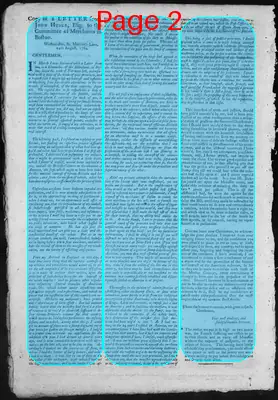
The New Hampshire Gazette And Historical Chronicle
Portsmouth, Greenland, Rockingham County, New Hampshire
What is this article about?
John Huske defends his parliamentary actions to the Boston Merchants' Committee, detailing efforts to amend the Sugar Act, reduce molasses duties, and postpone the Stamp Duty until colonial input. He urges them to provide objections and reasons against the stamp tax for the next session, emphasizing mutual British-colonial interests.
Clipping
OCR Quality
Full Text
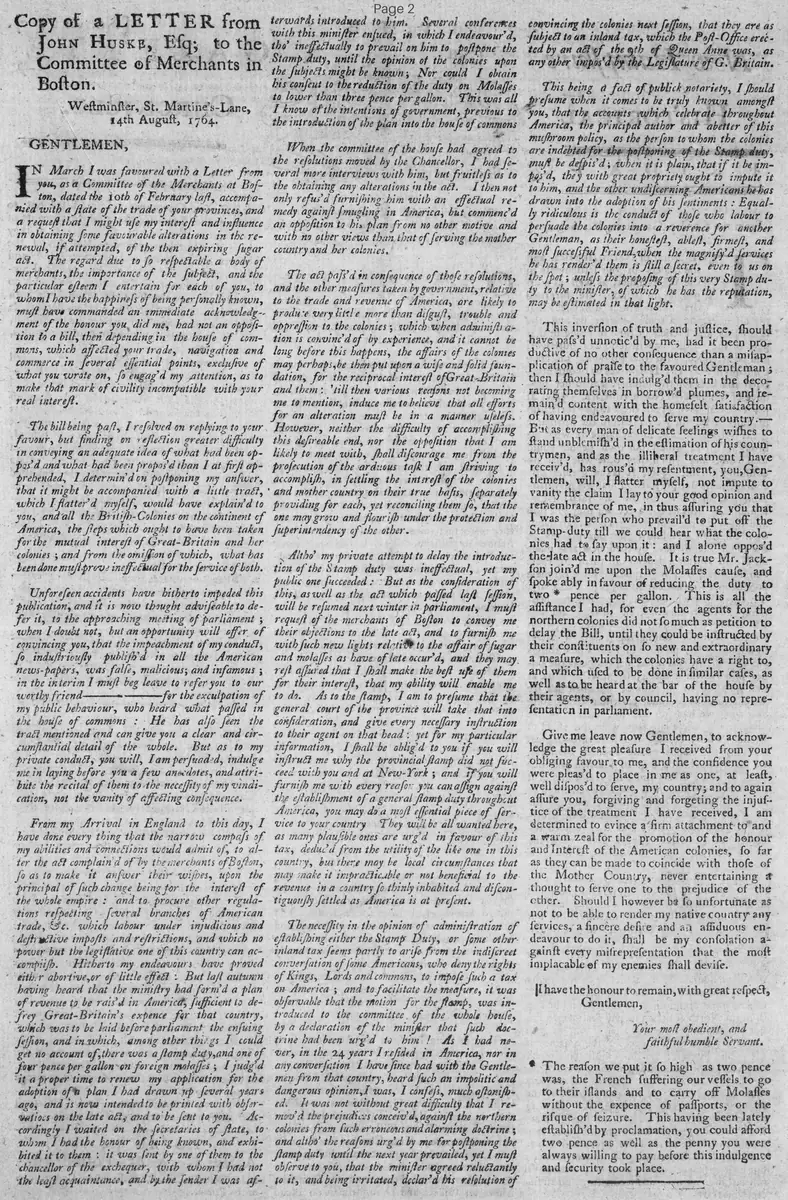
JOHN HUSKE, Esq; to the
Committee of Merchants in
Boston.
Westminster, St. Martin's-Lane,
14th August, 1764.
GENTLEMEN,
On March I was favoured with a Letter from you, as a Committee of the Merchants at Boston, dated the 10th of February last, accompanied with a state of the trade of your provinces, and a request that I might use my interest and influence in obtaining some favourable alterations in the renewal, if attempted, of the then expiring sugar act. The regard due to a respectable body of merchants, the importance of the subject, and the particular esteem I entertain for each of you, to whom I have the happiness of being personally known, must have commanded an immediate acknowledgment of the honour you did me, had not an opposition to a bill, then depending in the house of commons, which affected your trade, navigation and commerce in several essential points, exclusive of what you wrote on, so engag'd my attention, as to make that mark of civility incompatible with your real interest.
The bill being passed, I resolved on replying to your favour, but finding on reflection greater difficulty in conveying an adequate idea of what had been opposed and what had been propos'd than I at first apprehended, I determin'd on postponing my answer, that it might be accompanied with a little tract, which I flatter'd myself, would have explain'd to you, and all the British Colonies on the continent of America, the steps which ought to have been taken for the mutual interest of Great-Britain and her colonies; and from the omission of which, what has been done must prove ineffectual for the service of both.
Unforeseen accidents have hitherto impeded this publication, and it is now thought advisable to defer it, to the approaching meeting of parliament: when I doubt not, but an opportunity will offer of convincing you, that the impeachment of my conduct, so industriously publish'd in all the American news-papers, was false, malicious, and infamous; in the interim I must beg leave to refer you to our worthy friend Mr. --- for the exculpation of my public behaviour, who heard what passed in the house of commons: He has also seen the tract mentioned and can give you a clear and circumstantial detail of the whole. But as to my private conduct, you will, I am persuaded, indulge me in laying before you a few anecdotes, and attribute the recital of them to the necessity of my vindication, not the vanity of affecting consequence.
From my Arrival in England to this day, I have done every thing that the narrow compass of my abilities and connections would admit of, to alter the act complain'd of by the merchants of Boston, so as to make it answer their wishes, upon the principle of such change being for the interest of the whole empire: and to procure other regulations respecting several branches of American trade, &c. which labour under injudicious and destructive impositions and restrictions, and which no power but the legislative one of this country can accomplish. Hitherto my endeavours have proved either abortive, or of little effect: But last autumn having heard that the ministry had form'd a plan of revenue to be rais'd in America, sufficient to defray Great-Britain's expence for that country, which was to be laid before parliament the ensuing session, and in which, among other things I could get no account of, there was a stamp duty, and one of four pence per gallon on foreign molasses; I judg'd it a proper time to renew my application for the adoption of a plan I had drawn up several years ago, and is now intended to be printed with observations on the late act, and to be sent to you. Accordingly I waited on the secretaries of state, to whom I had the honour of being known, and exhibited it to them: it was sent by one of them to the chancellor of the exchequer, with whom I had not the least acquaintance, and by the sender I was afterwards introduced to him. Several conferences with this minister ensued, in which I endeavour'd, tho' ineffectually to prevail on him to postpone the Stamp duty, until the opinion of the colonies upon the Subject might be known: Nor could I obtain his consent to the reduction of the duty on Molasses to lower than three pence per gallon. This was all I know of the intentions of government, previous to the introduction of the plan into the house of commons.
When the committee of the house had agreed to the resolutions moved by the Chancellor, I had several more interviews with him, but fruitless as to the obtaining any alterations in the act. I then not only refus'd furnishing him with an effectual remedy against smuggling in America, but commenc'd an opposition to his plan from no other motive and with no other views than that of serving the mother country and her colonies.
The act pass'd in consequence of those resolutions, and the other measures taken by government, relative to the trade and revenue of America, are likely to produce very little more than disgust, trouble and oppression to the colonies; which when administration is convinc'd of by experience, and it cannot be long before this happens, the affairs of the colonies may perhaps, be then put upon a wise and solid foundation, for the reciprocal interest of Great-Britain and them: 'till then various reasons not becoming me to mention, induce me to believe that all efforts for an alteration must be in a manner useless.
However, neither the difficulty of accomplishing this desirable end, nor the opposition that I am likely to meet with, shall discourage me from the prosecution of the arduous task I am striving to accomplish, in settling the interest of the colonies and mother country on their true basis, separately providing for each, yet reconciling them so, that the one may grow and flourish under the protection and superintendency of the other.
Altho' my private attempt to delay the introduction of the Stamp duty was ineffectual, yet my public one succeeded: But as the consideration of this, as well as the act which passed last session, will be resumed next winter in parliament, I must request of the merchants of Boston to convey me their objections to the late act, and to furnish me with such new lights relative to the affair of sugar and molasses as have of late occur'd, and they may rest assured that I shall make the best use of them for their interest, that my ability will enable me to do. As to the stamp, I am to presume that the general court of the province will take that into consideration, and give every necessary instruction to their agent on that head: yet for my particular information, I shall be oblig'd to you if you will instruct me why the provincial stamp did not succeed with you and at New-York; and if you will furnish me with every reason you can assign against the establishment of a general stamp duty throughout America, you may do a most essential piece of service to your country. They will be all wanted here, as many plausible ones are urg'd in favour of this tax, deduced from the utility of the like one in this country, but there may be local circumstances that may make it impracticable or not beneficial to the revenue in a country so thinly inhabited and discontiguously settled as America is at present.
The necessity in the opinion of administration of establishing either the Stamp Duty, or some other inland tax seems partly to arise from the indiscreet conversation of some Americans, who deny the rights of Kings, Lords and commons, to impose such a tax on America; and to facilitate the measure, it was observable that the motion for the stamp, was introduced to the committee of the whole house, by a declaration of the minister that such doctrine had been urg'd to him! As I had never, in the 24 years I resided in America, nor in any conversation I have since had with the Gentlemen from that country, heard such an impolitic and dangerous opinion, I was, I confess, much astonished. It was not without great difficulty that I remov'd the prejudices conceiv'd, against the northern colonies from such erroneous and alarming doctrine: and altho' the reasons urg'd by me for postponing the stamp duty until the next year prevailed, yet I must observe to you, that the minister agreed reluctantly to it, and being irritated, declar'd his resolution of convincing the colonies next session, that they are as subject to an inland tax, which the Post-Office erected by an act of the 9th of Queen Anne was, as any other impos'd by the Legislature of G. Britain.
This being a fact of publick notoriety, I should presume when it comes to be truly known amongst you, that the accounts which celebrate throughout America, the principal author and abetter of this mushroom policy, as the person to whom the colonies are indebted for the postponing of the Stamp duty, must be despis'd; when it is plain, that if it be impos'd, they with great propriety ought to impute it to him, and the other undiscern ing Americans he has drawn into the adoption of his sentiments: Equally ridiculous is the conduct of those who labour to persuade the colonies into a reverence for another Gentleman, as their honestest, ablest, firmest, and most successful Friend—when the magnify'd services he has render'd them is still a secret, even to us on the spot; unless the proposing of this very Stamp duty to the minister, of which he has the reputation, may be estimated in that light.
This inversion of truth and justice should have pass'd unnotic'd by me, had it been productive of no other consequence than a misapplication of praise to the favoured Gentleman; then I should have indulg'd them in the decorating themselves in borrow'd plumes, and remain'd content with the homefelt satisfaction of having endeavoured to serve my country.—
But as every man of delicate feelings wishes to stand unblemish'd in the estimation of his countrymen, and as the illiberal treatment I have receiv'd, has rous'd my resentment, you, Gentlemen, will, I flatter myself, not impute to vanity the claim I lay to your good opinion and remembrance of me, in thus assuring you that I was the person who prevail'd to put off the Stamp-duty till we could hear what the colonies had to say upon it: and I alone oppos'd the date act in the house. It is true Mr. Jackson join'd me upon the Molasses cause, and spoke ably in favour of reducing the duty to two pence per gallon. This is all the assistance I had, for even the agents for the northern colonies did not so much as petition to delay the Bill, until they could be instructed by their constituents on so new and extraordinary a measure, which the colonies have a right to, and which used to be done in similar cases, as well as to be heard at the bar of the house by their agents, or by council, having no representation in parliament.
Give me leave now Gentlemen, to acknowledge the great pleasure I received from your obliging favour to me, and the confidence you were pleas'd to place in me as one, at least, well dispos'd to serve, my country; and to again assure you, forgiving and forgetting the injustice of the treatment I have received, I am determined to evince a firm attachment to and a warm Zeal for the promotion of the honour and Interest of the American colonies, so far as they can be made to coincide with those of the Mother Country, never entertaining a thought to serve one to the prejudice of the other. Should I however be so unfortunate as not to be able to render my native country any services, a sincere desire and an assiduous endeavour to do it, shall be my consolation against every misrepresentation that the most implacable of my enemies shall devise.
I have the honour to remain, with great respect,
Gentlemen,
Your most obedient, and
faithful humble Servant.
JOHN HUSKE
The reason we put it so high as two pence was, the French suffering our vessels to go to their islands and to carry off Molasses without the expence of passports, or the risque of seizure. This having been lately establish'd by proclamation, you could afford two pence as well as the penny you were always willing to pay before this indulgence and security took place.
What sub-type of article is it?
What themes does it cover?
What keywords are associated?
What entities or persons were involved?
Letter to Editor Details
Author
John Huske
Recipient
Committee Of Merchants In Boston
Main Argument
john huske defends his efforts in parliament to amend the sugar act, reduce molasses duties, and successfully postpone the stamp duty for colonial input, while criticizing others' claims and urging the merchants to provide detailed objections against the acts for the upcoming session to serve mutual british-colonial interests.
Notable Details