Thank you for visiting SNEWPapers!
Sign up free
Story
July 30, 1905
Daily Press
Newport News, Virginia
What is this article about?
An article explains the towering height of cumulus thunder clouds, up to eight miles, with dramatic temperature changes and layers that form hailstones through cycles of freezing and coating.
Clipping
OCR Quality
98%
Excellent
Full Text
Height of Thunder Clouds.
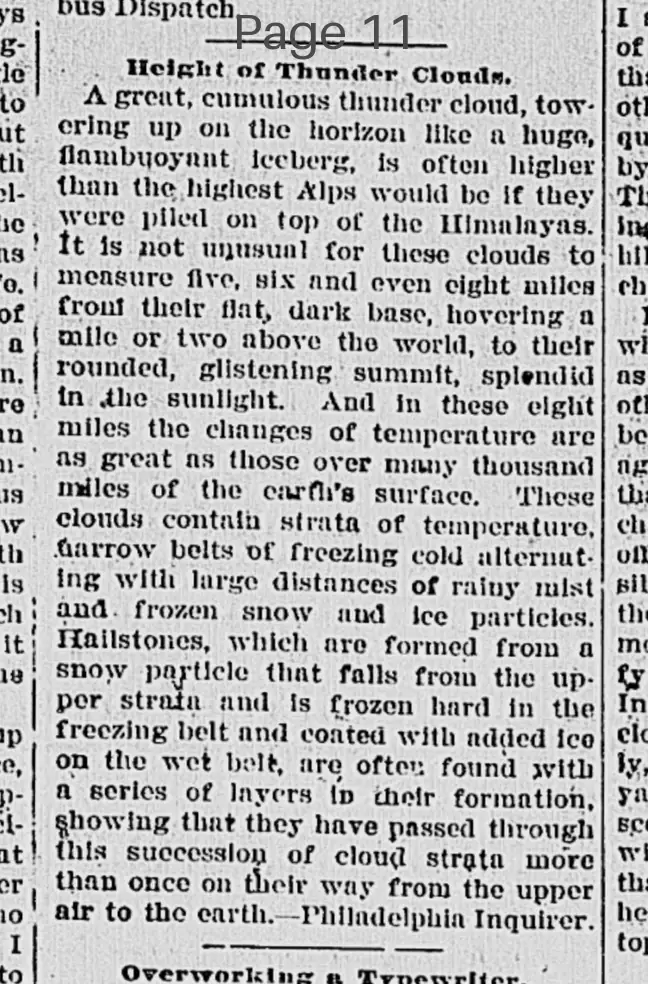
A great cumulous thunder cloud, towering up on the horizon like a huge, flamboyant iceberg, is often higher than the highest Alps would be if they were piled on top of the Himalayas. It is not unusual for these clouds to measure five, six and even eight miles from their flat, dark base, hovering a mile or two above the world, to their rounded, glistening summit, splendid in the sunlight. And in these eight miles the changes of temperature are as great as those over many thousand miles of the earth's surface. These clouds contain strata of temperature, narrow belts of freezing cold alternating with large distances of rainy mist and frozen snow and ice particles. Hailstones, which are formed from a snow particle that falls from the upper strata and is frozen hard in the freezing belt and coated with added ice on the wet belt, are often found with a series of layers in their formation, showing that they have passed through this succession of cloud strata more than once on their way from the upper air to the earth. —Philadelphia Inquirer.
A great cumulous thunder cloud, towering up on the horizon like a huge, flamboyant iceberg, is often higher than the highest Alps would be if they were piled on top of the Himalayas. It is not unusual for these clouds to measure five, six and even eight miles from their flat, dark base, hovering a mile or two above the world, to their rounded, glistening summit, splendid in the sunlight. And in these eight miles the changes of temperature are as great as those over many thousand miles of the earth's surface. These clouds contain strata of temperature, narrow belts of freezing cold alternating with large distances of rainy mist and frozen snow and ice particles. Hailstones, which are formed from a snow particle that falls from the upper strata and is frozen hard in the freezing belt and coated with added ice on the wet belt, are often found with a series of layers in their formation, showing that they have passed through this succession of cloud strata more than once on their way from the upper air to the earth. —Philadelphia Inquirer.
What sub-type of article is it?
Curiosity
What themes does it cover?
Nature
What keywords are associated?
Thunder Clouds
Cumulus Clouds
Hailstone Formation
Temperature Strata
Natural Phenomena
Story Details
Story Details
Cumulus thunder clouds can reach heights of five to eight miles, with extreme temperature variations including freezing cold, rainy mist, snow, and ice; hailstones form through multiple passes through these strata, layering ice.