Thank you for visiting SNEWPapers!
Sign up free
Gazette Of The United States, & Daily Advertiser
Philadelphia, Philadelphia County, Pennsylvania
What is this article about?
Pseudonymous letter from Philadelphia dated August 16, 1800, harshly criticizing Vice President Thomas Jefferson's character, irreligion, and Jacobin ties, warning against his presidential bid and invoking Christianity's role in American trials.
Merged-components note: Merged sequential components continuing the same letter to the editor (Letter III to Thomas Jefferson), including the anecdote about Mazzei and criticisms of Jefferson's character and associations.
Clippings
1 of 2
OCR Quality
Full Text
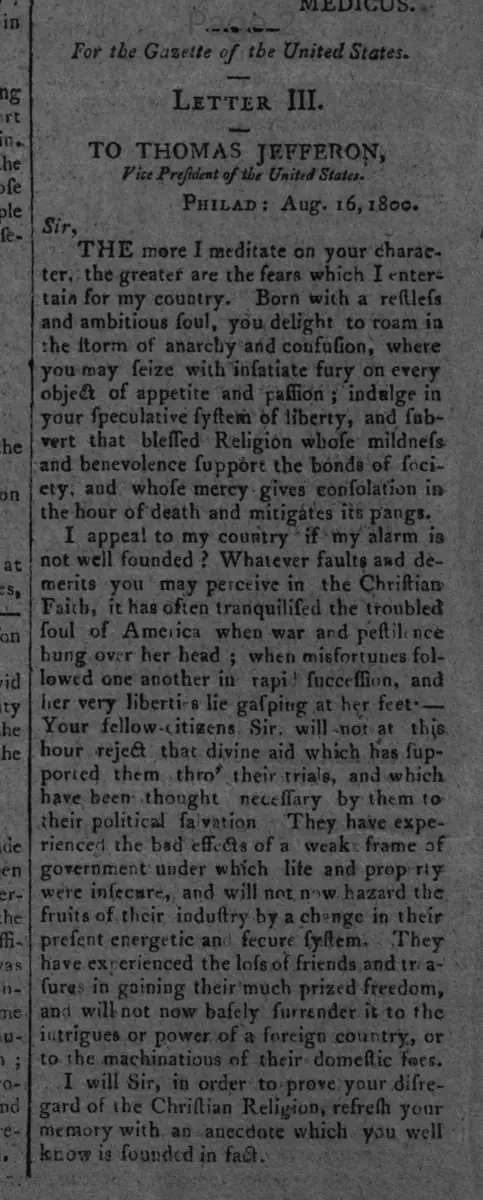
LETTER III.
TO THOMAS JEFFERSON,
Vice President of the United States.
PHILAD. Aug. 16, 1800.
Sir,
THE more I meditate on your character. the greater are the fears which I entertain for my country. Born with a restless and ambitious soul, you delight to roam in the storm of anarchy and confusion, where you may seize with insatiate fury on every object of appetite and passion; indulge in your speculative system of liberty, and subvert that blessed Religion whose mildness and benevolence support the bonds of society, and whose mercy gives consolation in the hour of death and mitigates its pangs.
I appeal to my country if my alarm is not well founded ? Whatever faults and demerits you may perceive in the Christian Faith, it has often tranquilized the troubled soul of America when war and pestilence hung over her head : when misfortunes followed one another in rapid succession, and her very liberties lay gasping at her feet—
Your fellow-citizens Sir. will not at this hour reject that divine aid which has supported them thro' their trials, and which have been thought necessary by them to their political salvation They have experienced the bad effects of a weak frame of government under which life and property were insecure,, and will not now hazard the fruits of their industry by a change in their present energetic and secure system. They have experienced the loss of friends and treasures in gaining their much prized freedom, and will not now basely surrender it to the intrigues or power of a foreign country, or to the machinations of their domestic foes.
I will Sir, in order to prove your disregard of the Christian Religion, refresh your memory with an anecdote which you well know is founded in fact.
When your worthy friend Mazzei and yourself were riding together one day, he observed his surprise that the people of this country suffered their public buildings to go to decay, at the same time pointing to a Church which was falling to ruins. You answered, "certainly it was good enough for him who was born in a manger." This sentiment may suit the Philosophers of France and it may have pleased the ear of your friend Mazzei; but I trust by your fellow citizens it will be considered as blasphemy. I trust they will think as I do, that the man who would utter such an expression is unworthy to rule over them.
Indulge me Sir for a moment, while I sketch the outlines of that character you might have supported with your fellow-citizens and which you have forfeited by your iniquity—contrast it with what you now are, and I dare assert a momentary blush will suffuse your cheek.
Favoured in a profuse manner with the richest gifts of nature, you early in life assumed a conspicuous station, and engaged in the cause of liberty which your country was struggling for. Respected for your talents and beloved for the services you rendered her, your country cast her eyes on you as one of her first patriots and most illustrious of citizens—the highest public stations to which ambition could aspire, she would proudly have conferred upon you; and when death should have deprived her of the services of a man, to whom all the world did homage your countrymen, 'tis probable would have unanimously raised you to that dignified chair, which you are now meanly striving to attain by the help of traitors, foreigners and the most worthless part of America. But behold the adverse scene!
having formed a base connection with the Philosophers of France, you deserted every honourable companion of your earlier life to associate with men destitute of every principle and respectability and who like hungry wolves watch every opportunity to prey on the vitals of their country,
As every exertion that an ambitious mind could make, and every vicious means that depravity could suggest have been employed by your friends and by yourself to elevate you to the Presidential chair, if there is a moment left for reflection, I advise you to pause and take a view of a picture of those follies and cruelties which will characterize your administration; a picture drawn from the public life of H.M. who by the same means and party has mounted to the Government of Pennsylvania He has only fulfilled his duty as a Jacobin and acted up to the spirit of his party. As your friend we may naturally suppose there will be a resemblance in actions as there is in character.—If your heart is tenderer than his, more the pity for you. He has exposed the system of Jacobinism, and you must act up to it; your companion must be turned into hardness of heart, and the feelings of your nature accommodate themselves to the feelings of your party. How nobly does your friend act! He can listen to the wretch who knocks at his door for pity—unmoved at his complaints for that mercy which has fled with the winds. He can bear the lisping infant call on his father for bread; the parent sue for the office which once provided it, and unfeelingly reply "I will teach you and your babes to starve" He can hear with the exulting pride of a tyrant contemplating his power; the groans of a dying officer calling on God to protect his wife and children whom he had robbed of their pittance to gratify the avarice of a son.
Our Governor "is a friend to republican institutions;" yet I understand he has turned from office, because in the freedom of suffrage they voted against him. He has declared himself the Governor of the Jacobin party by denouncing half the state for apostate whigs, tories, British merchants and expectants of offices. He has made one thief a justice of peace and the other a major general. All these things sir, you must do as the head of that party; it is expected of you. You dare not refuse—and will not say how far they will accord with your inclinations.
The spirit of Jacobinism when it seizes on a man intoxicates and bewilders him. He is hurried on to extremes, for which, oftentimes neither his mind or his temper qualify him. for however venomous the heart, the nerves will sometimes refuse their office, and thereby prevent his reaping that full harvest of brutal pleasure which keen revenge had ravenously expected. This, sir, I suppose, to be your case; you will fret away your peace of mind, perhaps your life, in schemes of Jacobinic ambition. while the imbecility of your temper will baffle your efforts to execute them.
COLUMBUS.
What sub-type of article is it?
What themes does it cover?
What keywords are associated?
What entities or persons were involved?
Letter to Editor Details
Author
Columbus
Recipient
Thomas Jefferson, Vice President Of The United States.
Main Argument
the writer expresses fears for the country's future under jefferson's potential leadership, accusing him of irreligion, ambition, ties to french jacobins, and disregard for christianity, urging citizens to reject him as unworthy to rule.
Notable Details