Thank you for visiting SNEWPapers!
Sign up free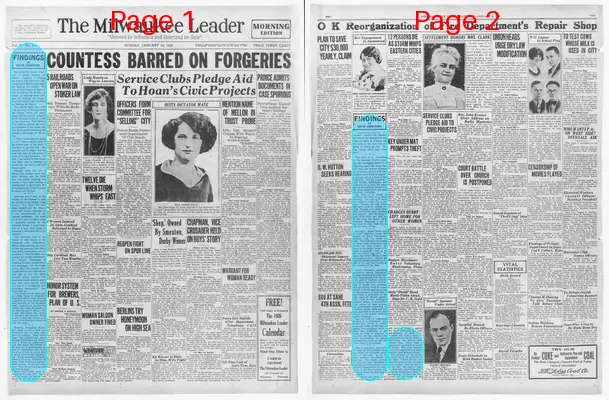
The Milwaukee Leader
Milwaukee, Milwaukee County, Wisconsin
What is this article about?
Editorial by Oscar Ameringer critiques American farmers' persistent poverty despite aid, blaming individualism and failed individualistic strategies like new crop breeds leading to surpluses. Advocates farmer unions for regulated production, cooperative marketing, and allied political action to emulate Danish success and eliminate middlemen.
Merged-components note: Continuation of editorial 'Findings by Oscar Ameringer' from page 1 to page 2, sequential reading order.
Clippings

1 of 2
OCR Quality
Full Text
FINDINGS BY OSCAR AMERINGER.
Blessed be the farmer. Somebody is always helping the farmer. Congress is helping the farmer. The Agriculture Departments of 48 sovereign states are helping the farmer. The Federal Department of Agriculture is helping the farmer. A couple of hundred farm journals are helping the farmer. Even the bankers and Coolidge are helping the farmer.
One should think that with such an array of helping hands the farmer would get somewhere, but he doesn't, unless it be to the poor house or a job on the street car. Poor farmer.
They used to call him the brown and backbone of the nation and now he is rapidly becoming the backdoor and beggar of the nation.
I wish I could help the farmer, for I have a hunch that if the farmer goes to the devil, I will have to go with him. My stomach will be empty and my back will bear all the outward signs of a bare existence. In fact, I am afraid in that situation there will be nothing in future for me but a cold and hungry grave.
Though, while I'm not a farmer and perhaps know less about farming than the folks who are always advising the farmer, I can't resist lending a helping hand to the farmer, for self-preservation is the first law of nature, so I'm told.
Now the way I look at the trouble of the farmers is that the trouble of the farmer is the farmer. God helps him who helps himself and the farmer don't help himself although he is the personification of benighted selfishness. So much so, in fact, that if I had to make a composite picture of the American farmer, I would draw him as a lone wolf trying to surround a jackrabbit all by his lonesome.
This particular trait of the farmer is well known to his helpmates and well-wishers. Hence, when advising the farmer they say precious little about team work, co-operation and organization. The remedies they propose are purely individualistic. Farmer Clodhopper is breaking his back raising wheat and mortgages. Do the bright young men who provide clodhoppers mental nourishment advise him to join the wheat growers' union! ascertain the amount of wheat required, plant only that much and no more and deliver it through his own marketing association? Not much they do.
The remedy for too much and too cheap wheat is Mongolian Mastodon wheat which raises 40 bushels to the acre. Never mind what becomes of the increased yield. Anybody can see that the farmer who raises 40 bushels to the acre has got it all over the farmer who raises only twelve to the acre, and the main thing is not to help the farmer as a class but to help one farmer to beat the other.
However, Mongolian Mastodon wheat is just a little too productive and the price goes down to nothing. What next? Easy. The United States Agricultural Department has discovered a brand of Afghanistan corn that raises 200 bushels to the acre and is self-husking. So now it's Afghanistan corn, until the price of corn is so low that it doesn't pay for the self-husking. Much scratching of heads, chewing of straw, wrinkling of brows, deep thinking at agricultural schools. At last the solution. Feed the corn to hogs and get rich on hogs.
Boars and brood sows increase in the corn belt. So do notes in banks. By the time the posterity of the blue-blooded
Turn to Page Two, Column Two.
Findings by Oscar Ameringer.
Continued From Page One.
-1
breeders reaches the market the bottom has dropped out and hogs are down to nothing, but the notes in the corn belt are going as strong as ever. No, hog raising don't pay, what next?
Why, here it is. According to The Bonanza Poultry Journal, the one-legged widow of a blind hog raiser who hung himself when the bottom dropped out of the hog market, with nine children and a Ford to support, is getting rich on a flock of 200 Leghorns. "Me for Leghorns," cries Brother Clodhopper, and Leghorns it is, until the white spot on his farm has spread over the whole countryside and eggs are down to nothing.
No, there is no money in chickens, but there is in dairy farming. One cow gave twice her weight in butter fat in one year. Another did still better and gave birth to triplets besides. Besides, cows mean skim milk, buttermilk, hogs, chickens and manure. Just the thing to keep debts down and land up.
In due time, the Bandit Dairy Company announces a cut in the price of milk from 3½ to 2¾ per pint. Finis.
But hark. Jasper Tuber over in Yokel township raised 600 bushels of "Early Precocious" potatoes from one bushel of seed. Next fall when the bushel of three dollar Precocious has grown into forty bushels, the price at the potato house is 30 cents a hundred. And so on and on without end, amen. Always, one farmer trying to beat his neighbors to it. Always the individual seeking salvation outside of his class and usually at the expense of his class.
Unions of farmers, regulating production among themselves, buying and selling through their own organizations with the ultimate goal of reaching consumers without the divine intervention of middle men, gamblers and speculators—such an organization could lift agriculture out of the morass it is weltering in and bring it eventually to the high level of Danish agriculture. Add to this, intelligent political action, in conjunction with unions of wage earners, the government ownership of railroads, mines, water and forests, and there is no doubt that the lot of the farmer could be greatly improved.
But the task of organizing farmers is a tremendous one. Either they do not or cannot trust each other, or the sight of seeing their neighbors share in their own prosperity is too much for them, or whatever it may be, the fact remains that farm organizations are almost impossible to build up and still more difficult to maintain.
The co-operative creameries of some of the northern states constitute an honorable exception to this rule. So do the fruit growers' associations of the west. The tobacco growers of Kentucky also succeeded in building and maintaining a very efficient organization by killing those of the dear brothers who failed to realize the blessings of solidarity.
The wheat and cotton growers' associations, however, are still battling valiantly against the blind selfishness and rank individualism of their kind.
Farmers who joined these organizations are all too prone to backsliding the minute some private buyer offers them a penny more per bushel or pound of cotton. That such behavior is as short-sighted as it is reprehensible goes without saying.
The salvation of the farmer is bound up in the salvation of his class. Unless he can conform his action to the old labor union slogan, "One for all and all for one," his name is mud, for those who cannot help themselves by helping each other are beyond help. In short, the main trouble of the farmer is the farmer himself.
What sub-type of article is it?
What keywords are associated?
What entities or persons were involved?
Editorial Details
Primary Topic
Individualism Hindering Farmer Prosperity And Need For Cooperative Organization
Stance / Tone
Critical Of Farmer Individualism, Advocating Collective Action And Unionization
Key Figures
Key Arguments