Thank you for visiting SNEWPapers!
Sign up free
Literary
October 3, 1833
Morning Star
Limerick, York County, Maine
What is this article about?
A religious essay titled 'A Verse-a-Day' examines biblical verses from Matthew, Timothy, Galatians, and Corinthians to argue that ministers deserve comfortable maintenance from those they teach, emphasizing it as a divine obligation rather than charity, with concluding remarks on equity and church discipline.
Clipping
OCR Quality
95%
Excellent
Full Text
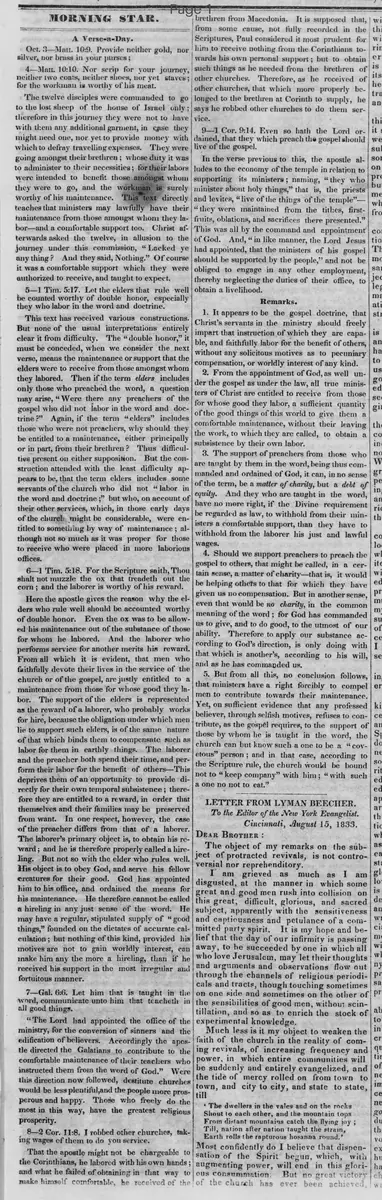
A Verse-a-Day.
Oct. 3 Matt. 10:9. Provide neither gold, nor silver, nor brass in your purses;
Matt. 10:10. Nor scrip for your journey, neither two coats, neither shoes, nor yet staves; for the workman is worthy of his meat.
The twelve disciples were commanded to go to the lost sheep of the house of Israel only: therefore in this journey they were not to have with them any additional garment, in case they might need one, nor yet to provide money with which to defray travelling expenses. They were going amongst their brethren; whose duty it was to administer to their necessities; for their labors were intended to benefit those amongst whom they were to go, and the workman is surely worthy of his maintenance. This text directly teaches that ministers may lawfully have their maintenance from those amongst whom they labor—and a comfortable support too. Christ afterwards asked the twelve, in allusion to the journey under this commission, "Lacked ye any thing? And they said, Nothing." Of course it was a comfortable support which they were authorized to receive, and taught to expect.
I Tim. 5:17. Let the elders that rule well be counted worthy of double honor, especially they who labor in the word and doctrine.
This text has received various constructions. But none of the usual interpretations entirely clear it from difficulty. The "double honor," it must be conceded, when we consider the next verse, means the maintenance or support that the elders were to receive from those amongst whom they labored. Then if the term elders includes only those who preached the word, a question may arise, "Were there any preachers of the gospel who did not labor in the word and doctrine?" Again, if the term "elders" includes those who were not preachers, why should they be entitled to a maintenance, either principally or in part, from their brethren? Thus difficulties present on either supposition. But the construction attended with the least difficulty appears to be, that the term elders includes some servants of the church who did not "labor in the word and doctrine;" but who, on account of their other services, which, in those early days of the church might be considerable, were entitled to something by way of maintenance; although not so much as it was proper for those to receive who were placed in more laborious offices.
I Tim. 5:18. For the Scripture saith, Thou shalt not muzzle the ox that treadeth out the corn; and the laborer is worthy of his reward.
Here the apostle gives the reason why the elders who rule well should be accounted worthy of double honor. Even the ox was to be allowed his maintenance out of the substance of those for whom he labored. And the laborer who performs service for another merits his reward. From all which it is evident, that men who faithfully devote their lives in the service of the church or of the gospel, are justly entitled to a maintenance from those for whose good they labor. The support of the elders is represented as the reward of a laborer, who probably works for hire, because the obligation under which men lie to support such elders, is of the same nature of that which binds them to compensate such as labor for them in earthly things. The laborer and the preacher both spend their time, and perform their labor for the benefit of others--This deprives them of an opportunity to provide directly for their own temporal subsistence; therefore they are entitled to a reward, in order that themselves and their families may be preserved from want. In one respect, however, the case of the preacher differs from that of a laborer. The laborer's primary object is, to obtain his reward; and he is therefore properly called a hireling. But not so with the elder who rules well. His object is to obey God, and serve his fellow creatures for their good. God has appointed him to his office, and ordained the means for his maintenance. He therefore cannot be called a hireling in any just sense of the word. He may have a regular, stipulated supply of "good things," founded on the dictates of accurate calculation; but nothing of this kind, provided his motives are not to gain worldly interest, can make him any the more a hireling, than if he received his support in the most irregular and fortuitous manner.
Gal. 6:6. Let him that is taught in the word, communicate unto him that teacheth in all good things
"The Lord had appointed the office of the ministry, for the conversion of sinners and the edification of believers. Accordingly the apostle directed the Galatians to contribute to the comfortable maintenance of their teachers who instructed them from the word of God." Were this direction now followed, destitute churches would be less plentiful, and the people more prosperous and happy. Those who freely do the most in this way, have the greatest religious prosperity.
2 Cor. 11:8. I robbed other churches, taking wages of them to do you service.
That the apostle might not be chargeable to the Corinthians, he labored with his own hands; and what he failed of obtaining in that way to make himself comfortable, he received of the brethren from Macedonia. It is supposed that, from some cause, not fully recorded in the Scriptures, Paul considered it most prudent for him to receive nothing from the Corinthians towards his own personal support; but to obtain such things as he needed from the brethren of other churches. Therefore, as he received of other churches, that which more properly belonged to the brethren at Corinth to supply, he says he robbed other churches to do them service.
I Cor. 9:14. Even so hath the Lord ordained, that they which preach the gospel should live of the gospel.
In the verse previous to this, the apostle alludes to the economy of the temple in relation to supporting its ministers; naming, "they who minister about holy things," that is, the priests and levites, "live of the things of the temple"— "they were maintained from the tithes, first-fruits, oblations, and sacrifices there presented." This was all by the command and appointment of God. And, "in like manner, the Lord Jesus had appointed, that the ministers of his gospel should be supported by the people," and not be obliged to engage in any other employment. thereby neglecting the duties of their office, to obtain a livelihood.
Remarks.
1. It appears to be the gospel doctrine, that Christ's servants in the ministry should freely impart that instruction of which they are capable, and faithfully labor for the benefit of others. without any solicitous motives as to pecuniary compensation, or worldly interest of any kind.
2. From the appointment of God, as well under the gospel as under the law, all true ministers of Christ are entitled to receive from those for whose good they labor, a sufficient quantity of the good things of this world to give them a comfortable maintenance, without their leaving the work, to which they are called, to obtain a subsistence by their own labor.
3. The support of preachers from those who are taught by them in the word, being thus commanded and ordained of God, it can, in no sense of the term, be a matter of charity, but a debt of equity. And they who are taught in the word have no more right, if the Divine requirement be regarded as law, to withhold from their ministers a comfortable support, than they have to withhold from the laborer his just and lawful wages.
4. Should we support preachers to preach the gospel to others, that might be called, in a certain sense, a matter of charity—that is, it would be helping others to that for which they have given us no compensation. But in another sense. even that would be no charity, in the common meaning of the word; for God has commanded us to give, and to do good, to the utmost of our ability. Therefore to apply our substance according to God's direction, is only doing with that which is another's, according to his will. and as he has commanded us.
5. But from all this, no conclusion follows. that ministers have a right forcibly to compel men to contribute towards their maintenance. Yet, on sufficient evidence that any professed believer, through selfish motives, refuses to contribute, as the gospel requires, to the support of those by whom he is taught in the word, the church can but know such a one to be a "covetous" person; and in that case, according to the Scripture rule, the church would be bound not to "keep company" with him; "with such a one no not to eat."
Oct. 3 Matt. 10:9. Provide neither gold, nor silver, nor brass in your purses;
Matt. 10:10. Nor scrip for your journey, neither two coats, neither shoes, nor yet staves; for the workman is worthy of his meat.
The twelve disciples were commanded to go to the lost sheep of the house of Israel only: therefore in this journey they were not to have with them any additional garment, in case they might need one, nor yet to provide money with which to defray travelling expenses. They were going amongst their brethren; whose duty it was to administer to their necessities; for their labors were intended to benefit those amongst whom they were to go, and the workman is surely worthy of his maintenance. This text directly teaches that ministers may lawfully have their maintenance from those amongst whom they labor—and a comfortable support too. Christ afterwards asked the twelve, in allusion to the journey under this commission, "Lacked ye any thing? And they said, Nothing." Of course it was a comfortable support which they were authorized to receive, and taught to expect.
I Tim. 5:17. Let the elders that rule well be counted worthy of double honor, especially they who labor in the word and doctrine.
This text has received various constructions. But none of the usual interpretations entirely clear it from difficulty. The "double honor," it must be conceded, when we consider the next verse, means the maintenance or support that the elders were to receive from those amongst whom they labored. Then if the term elders includes only those who preached the word, a question may arise, "Were there any preachers of the gospel who did not labor in the word and doctrine?" Again, if the term "elders" includes those who were not preachers, why should they be entitled to a maintenance, either principally or in part, from their brethren? Thus difficulties present on either supposition. But the construction attended with the least difficulty appears to be, that the term elders includes some servants of the church who did not "labor in the word and doctrine;" but who, on account of their other services, which, in those early days of the church might be considerable, were entitled to something by way of maintenance; although not so much as it was proper for those to receive who were placed in more laborious offices.
I Tim. 5:18. For the Scripture saith, Thou shalt not muzzle the ox that treadeth out the corn; and the laborer is worthy of his reward.
Here the apostle gives the reason why the elders who rule well should be accounted worthy of double honor. Even the ox was to be allowed his maintenance out of the substance of those for whom he labored. And the laborer who performs service for another merits his reward. From all which it is evident, that men who faithfully devote their lives in the service of the church or of the gospel, are justly entitled to a maintenance from those for whose good they labor. The support of the elders is represented as the reward of a laborer, who probably works for hire, because the obligation under which men lie to support such elders, is of the same nature of that which binds them to compensate such as labor for them in earthly things. The laborer and the preacher both spend their time, and perform their labor for the benefit of others--This deprives them of an opportunity to provide directly for their own temporal subsistence; therefore they are entitled to a reward, in order that themselves and their families may be preserved from want. In one respect, however, the case of the preacher differs from that of a laborer. The laborer's primary object is, to obtain his reward; and he is therefore properly called a hireling. But not so with the elder who rules well. His object is to obey God, and serve his fellow creatures for their good. God has appointed him to his office, and ordained the means for his maintenance. He therefore cannot be called a hireling in any just sense of the word. He may have a regular, stipulated supply of "good things," founded on the dictates of accurate calculation; but nothing of this kind, provided his motives are not to gain worldly interest, can make him any the more a hireling, than if he received his support in the most irregular and fortuitous manner.
Gal. 6:6. Let him that is taught in the word, communicate unto him that teacheth in all good things
"The Lord had appointed the office of the ministry, for the conversion of sinners and the edification of believers. Accordingly the apostle directed the Galatians to contribute to the comfortable maintenance of their teachers who instructed them from the word of God." Were this direction now followed, destitute churches would be less plentiful, and the people more prosperous and happy. Those who freely do the most in this way, have the greatest religious prosperity.
2 Cor. 11:8. I robbed other churches, taking wages of them to do you service.
That the apostle might not be chargeable to the Corinthians, he labored with his own hands; and what he failed of obtaining in that way to make himself comfortable, he received of the brethren from Macedonia. It is supposed that, from some cause, not fully recorded in the Scriptures, Paul considered it most prudent for him to receive nothing from the Corinthians towards his own personal support; but to obtain such things as he needed from the brethren of other churches. Therefore, as he received of other churches, that which more properly belonged to the brethren at Corinth to supply, he says he robbed other churches to do them service.
I Cor. 9:14. Even so hath the Lord ordained, that they which preach the gospel should live of the gospel.
In the verse previous to this, the apostle alludes to the economy of the temple in relation to supporting its ministers; naming, "they who minister about holy things," that is, the priests and levites, "live of the things of the temple"— "they were maintained from the tithes, first-fruits, oblations, and sacrifices there presented." This was all by the command and appointment of God. And, "in like manner, the Lord Jesus had appointed, that the ministers of his gospel should be supported by the people," and not be obliged to engage in any other employment. thereby neglecting the duties of their office, to obtain a livelihood.
Remarks.
1. It appears to be the gospel doctrine, that Christ's servants in the ministry should freely impart that instruction of which they are capable, and faithfully labor for the benefit of others. without any solicitous motives as to pecuniary compensation, or worldly interest of any kind.
2. From the appointment of God, as well under the gospel as under the law, all true ministers of Christ are entitled to receive from those for whose good they labor, a sufficient quantity of the good things of this world to give them a comfortable maintenance, without their leaving the work, to which they are called, to obtain a subsistence by their own labor.
3. The support of preachers from those who are taught by them in the word, being thus commanded and ordained of God, it can, in no sense of the term, be a matter of charity, but a debt of equity. And they who are taught in the word have no more right, if the Divine requirement be regarded as law, to withhold from their ministers a comfortable support, than they have to withhold from the laborer his just and lawful wages.
4. Should we support preachers to preach the gospel to others, that might be called, in a certain sense, a matter of charity—that is, it would be helping others to that for which they have given us no compensation. But in another sense. even that would be no charity, in the common meaning of the word; for God has commanded us to give, and to do good, to the utmost of our ability. Therefore to apply our substance according to God's direction, is only doing with that which is another's, according to his will. and as he has commanded us.
5. But from all this, no conclusion follows. that ministers have a right forcibly to compel men to contribute towards their maintenance. Yet, on sufficient evidence that any professed believer, through selfish motives, refuses to contribute, as the gospel requires, to the support of those by whom he is taught in the word, the church can but know such a one to be a "covetous" person; and in that case, according to the Scripture rule, the church would be bound not to "keep company" with him; "with such a one no not to eat."
What sub-type of article is it?
Essay
What themes does it cover?
Religious
Moral Virtue
What keywords are associated?
Ministerial Support
Biblical Commentary
Gospel Doctrine
Church Maintenance
Divine Obligation
Scriptural Equity
Literary Details
Title
A Verse A Day.
Key Lines
Provide Neither Gold, Nor Silver, Nor Brass In Your Purses;
For The Workman Is Worthy Of His Meat.
Let The Elders That Rule Well Be Counted Worthy Of Double Honor, Especially They Who Labor In The Word And Doctrine.
Even So Hath The Lord Ordained, That They Which Preach The Gospel Should Live Of The Gospel.
The Support Of Preachers From Those Who Are Taught By Them In The Word, Being Thus Commanded And Ordained Of God, It Can, In No Sense Of The Term, Be A Matter Of Charity, But A Debt Of Equity.