Thank you for visiting SNEWPapers!
Sign up free
The Virginia Gazette
Williamsburg, Virginia
What is this article about?
British House of Commons debate on the Address concludes with speeches by Thomas Townshend criticizing government preparedness against potential French war and American campaign handling, Lord North defending ministry and detailing military readiness, and others; motion passes 242-87.
Merged-components note: Direct textual continuation of the parliamentary debate on the address from page 1 to page 2, maintaining the same topic and flow.
Clippings
1 of 2
OCR Quality
Full Text
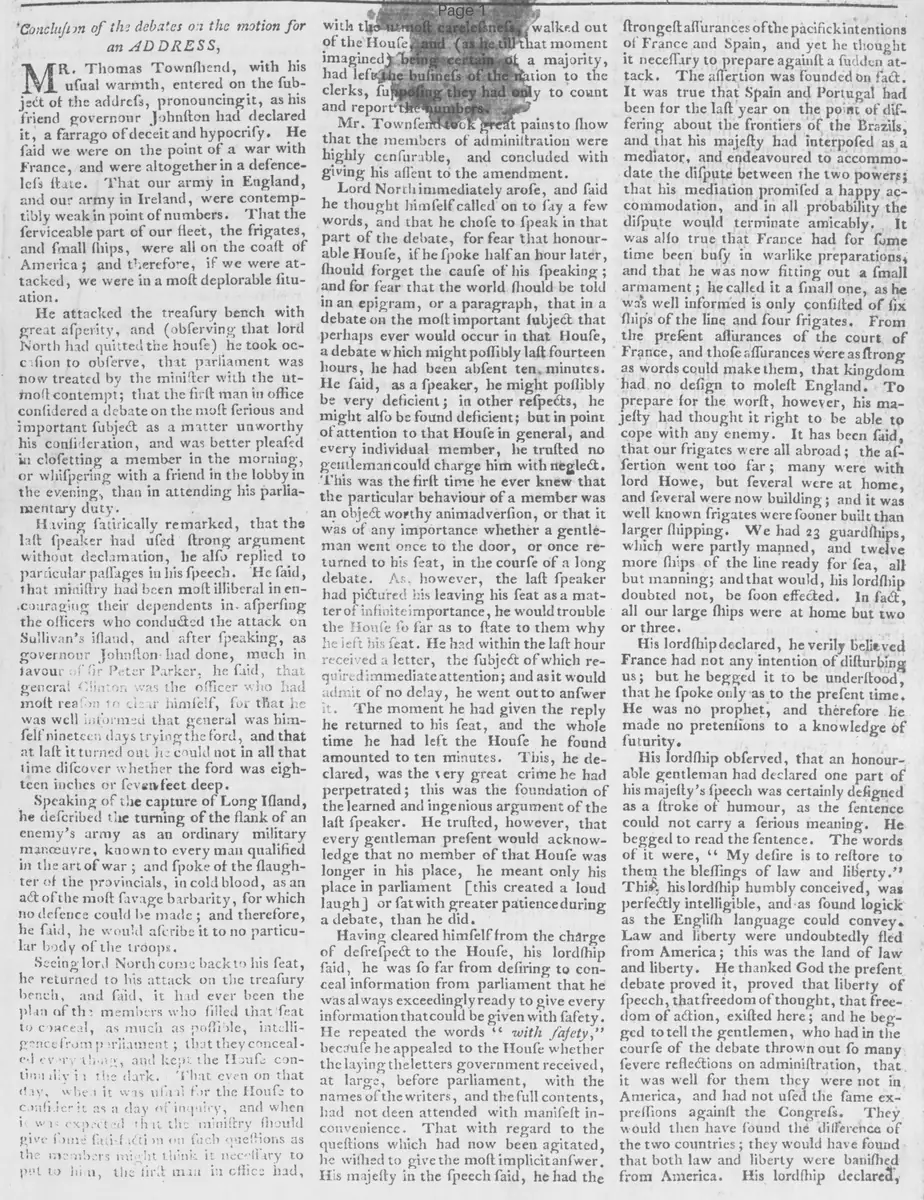
Rt. Thomas Townshend, with his usual warmth, entered on the subject of the address, pronouncing it, as his friend governor Johnston had declared it, a farrago of deceit and hypocrisy. He said we were on the point of a war with France, and were altogether in a defenceless state. That our army in England, and our army in Ireland, were contemptibly weak in point of numbers. That the serviceable part of our fleet, the frigates, and small ships, were all on the coast of America; and therefore, if we were attacked, we were in a most deplorable situation.
He attacked the treasury bench with great asperity, and (observing that lord North had quitted the house) he took occasion to observe, that parliament was now treated by the minister with the utmost contempt; that the first man in office considered a debate on the most serious and important subject as a matter unworthy his consideration, and was better pleased in closeting a member in the morning, or whispering with a friend in the lobby in the evening, than in attending his parliamentary duty.
Having satirically remarked, that the last speaker had used strong argument without declamation, he also replied to particular passages in his speech. He said, that ministry had been most illiberal in encouraging their dependents in aspersing the officers who conducted the attack on Sullivan's island, and after speaking, as governor Johnston had done, much in favour of Sir Peter Parker, he said, that general Clinton was the officer who had most reason to clear himself, for that he was well informed that general was himself nineteen days trying the ford, and that at last it turned out he could not in all that time discover whether the ford was eighteen inches or seven feet deep.
Speaking of the capture of Long Island, he described the turning of the flank of an enemy's army as an ordinary military manoeuvre, known to every man qualified in the art of war; and spoke of the slaughter of the provincials, in cold blood, as an act of the most savage barbarity, for which no defence could be made: and therefore, he said, he would ascribe it to no particular body of the troops.
Seeing lord North come back to his seat, he returned to his attack on the treasury bench, and said, it had ever been the plan of the members who filled that seat to conceal, as much as possible, intelligence from parliament: that they concealed every thing, and kept the House continually in the dark. That even on that day, when it was usual for the House to consider it as a day of inquiry, and when it was expected that the ministry should give some satisfaction on such questions as the members might think it necessary to put to him, the first man in office had, with the utmost carelessness walked out of the House and (as he still that moment imagined) being certain of a majority, had left the business of the nation to the clerks, supposing they had only to count and report the numbers.
Mr. Townshend took great pains to show that the members of administration were highly censurable, and concluded with giving his assent to the amendment.
Lord North immediately arose, and said he thought himself called on to say a few words, and that he chose to speak in that part of the debate, for fear that honourable House, if he spoke half an hour later, should forget the cause of his speaking; and for fear that the world should be told in an epigram, or a paragraph, that in a debate on the most important subject that perhaps ever would occur in that House, a debate which might possibly last fourteen hours, he had been absent ten minutes.
He said, as a speaker, he might possibly be very deficient; in other respects, he might also be found deficient; but in point of attention to that House in general, and every individual member, he trusted no gentleman could charge him with neglect.
This was the first time he ever knew that the particular behaviour of a member was an object worthy animadversion, or that it was of any importance whether a gentleman went once to the door, or once returned to his seat, in the course of a long debate. As, however, the last speaker had pictured his leaving his seat as a matter of infinite importance, he would trouble the House so far as to state to them why he left his seat. He had within the last hour received a letter, the subject of which required immediate attention; and as it would admit of no delay, he went out to answer it. The moment he had given the reply he returned to his seat, and the whole time he had left the House he found amounted to ten minutes. This, he declared, was the very great crime he had perpetrated; this was the foundation of the learned and ingenious argument of the last speaker. He trusted, however, that every gentleman present would acknowledge that no member of that House was longer in his place, he meant only his place in parliament [this created a loud laugh] or sat with greater patience during a debate, than he did.
Having cleared himself from the charge of disrespect to the House, his lordship said, he was so far from desiring to conceal information from parliament that he was always exceedingly ready to give every information that could be given with safety. He repeated the words "with Safety," because he appealed to the House whether the laying the letters government received, at large, before parliament, with the names of the writers, and the full contents, had not been attended with manifest inconvenience. That with regard to the questions which had now been agitated, he wished to give the most implicit answer. His majesty in the speech said, he had the strongest assurances of the pacific intentions of France and Spain, and yet he thought it necessary to prepare against a sudden attack. The assertion was founded on fact. It was true that Spain and Portugal had been for the last year on the point of differing about the frontiers of the Brazils, and that his majesty had interposed as a mediator, and endeavoured to accommodate the dispute between the two powers; that his mediation promised a happy accommodation, and in all probability the dispute would terminate amicably. It was also true that France had for some time been busy in warlike preparations, and that he was now fitting out a small armament; he called it a small one, as he was well informed it only consisted of six ships of the line and four frigates. From the present assurances of the court of France, and those assurances were as strong as words could make them, that kingdom had no design to molest England. To prepare for the worst, however, his majesty had thought it right to be able to cope with any enemy. It has been said that our frigates were all abroad; the assertion went too far; many were with lord Howe, but several were at home, and several were now building; and it was well known frigates were sooner built than larger shipping. We had 23 guardships, which were partly manned, and twelve more ships of the line ready for sea, all but manning; and that would, his lordship doubted not, be soon effected. In fact, all our large ships were at home but two or three.
His lordship declared, he verily believed France had not any intention of disturbing us; but he begged it to be understood, that he spoke only as to the present time. He was no prophet, and therefore he made no pretensions to a knowledge of futurity.
His lordship observed, that an honourable gentleman had declared one part of his majesty's speech was certainly designed as a stroke of humour, as the sentence could not carry a serious meaning. He begged to read the sentence. The words of it were, "My desire is to restore to them the blessings of law and liberty." This, his lordship humbly conceived, was perfectly intelligible, and as sound logick as the English language could convey. Law and liberty were undoubtedly fled from America; this was the land of law and liberty. He thanked God the present debate proved it, proved that liberty of speech, that freedom of thought, that freedom of action, existed here; and he begged to tell the gentlemen, who had in the course of the debate thrown out so many severe reflections on administration, that it was well for them they were not in America, and had not used the same expressions against the Congress. They would then have found the difference of the two countries; they would have found that both law and liberty were banished from America. His lordship declared,
He applauded the spirit of inquiry which actuated the gentlemen who thought differently from administration; and although he was in consequence the frequent object of their attack, he wished it might continue.
His lordship denied that our troops, or those employed by us, had massacred any of the rebels in cold blood, and particularly cleared the Hessians from the aspersion, proving that 450 of the prisoners were taken by the Hessians. His lordship said, that in the heat of the battle some of the rebels might first fire, then run, and cry out quarter; that some of these might possibly have been put to the bayonet, but he conceived no man would throw out a general censure on account of a particular accident.
After having spoke with great fervour and plainness to every part of the debate, in which he recollected that the minister had been called upon, his lordship begged pardon of the House for having taken up so much of their time about himself. He said he rejected the amendment, as it tended to desire his majesty to set on foot an endless and ill-timed inquiry, to procrastinate events which in all probability would soon be produced, and to render fruitless every operation which had taken place. He concluded, with declaring, that it had ever been his wish, and that of every other servant of the king, to bring matters to as early a conclusion, and with as little bloodshed, as possible; to use the present successes, and the victory, if it was gained, with prudence and moderation, and rather as a means of cementing a lasting union and amity than as objects of triumph or instruments for forging the chains of slavery, and excuses for tyranny and oppression.
Colonel Barre, admiral Keppel, and Mr. Fox, spoke after his lordship. In the speech of the first, we were given to understand, from an extract of a newspaper produced by the colonel, and stated by him as a well authenticated account of what passed between Col. Patterson and General Washington, when the former was dispatched to the latter to treat with him from General Howe, that his majesty's commissioners had broken through a positive act of parliament, but without producing the desired effect.
The colonel, after fully giving the text and context of the above circumstance, threatened the minister with the loss of his head, and held up a picture of great horror, showing that we were on the eve of a most serious war with France, who would begin her attack within the hearing of the members who sat in parliamentary debate.
Admiral Keppel merely showed the defenseless state of the kingdom, from her unprepared navy.
Mr. Fox was ardent against administration, but endeavored to rescue General Clinton from the censure which had been thrown out on him.
We have not time to give a fuller account of the speeches of the three last gentlemen, but we mean to do it to-morrow. Col. Barre's deserved particular attention; for if his assertions were facts, and his deductions fair, this country is in a tremendous situation indeed.
At half after 11 the House divided on the previous question moved on the amendment motion, where the numbers were, 242 for the question, 82 against it. They then divided again on the motion for the address, when the numbers were, 242 for the question, 87 against it. The House rose at 12, and will sit again this day.
What sub-type of article is it?
What keywords are associated?
What entities or persons were involved?
Where did it happen?
Foreign News Details
Primary Location
America
Key Persons
Outcome
motion for the address passes 242-87; denial of massacres in america; 450 prisoners taken by hessians; assurances of pacific intentions from france and spain; british naval preparations include 23 guardships and 12 ships of the line ready.
Event Details
British parliamentary debate on the Address addresses defenseless state against potential French war, criticisms of American campaign at Sullivan's Island and Long Island including alleged barbarity, government concealment of intelligence, mediation in Spain-Portugal dispute over Brazil frontiers, French armament of six ships of the line and four frigates, and British military readiness; Lord North defends ministry and rejects amendment.