Thank you for visiting SNEWPapers!
Sign up free
Literary
November 17, 1889
The Indianapolis Journal
Indianapolis, Marion County, Indiana
What is this article about?
Charles Dickens Jr. discusses his father's editorial work on Household Words and All the Year Round from 1850-1870, highlighting Dickens's meticulous attention to manuscripts, support for new writers like Adelaide Procter, and sympathetic rejections, as shown in letters to an American contributor.
Clipping
OCR Quality
98%
Excellent
Full Text
DICKENS AS EDITOR
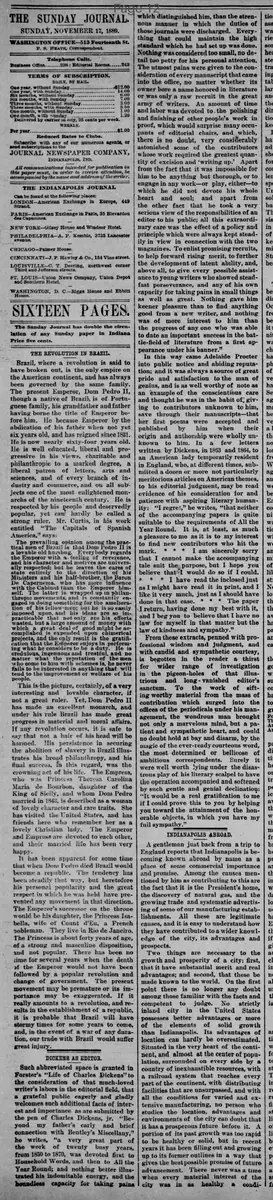
Such abbreviated space is granted in Forster's "Life of Charles Dickens" to the consideration of that much-loved writer's labors in the editorial field, that a grateful public eagerly and gladly welcomes such additional facts of interest and importance as are submitted by the pen of Charles Dickens, jr. "Beyond my father's early and brief connection with Bentley's Miscellany," he writes, "a very great part of the work of twenty busy years, from 1850 to 1870, was devoted first to Household Words, and then to All the Year Round; and nothing better illustrated his indomitable energy, and the boundless capacity for taking pains which distinguished him, than the strenuous manner in which the duties of those journals were discharged. Everything that could maintain the high standard which he had set up was done. Nothing was considered too small, no detail too petty for his personal attention. The utmost pains were given to the consideration of every manuscript that came into the office, no matter whether its owner bore a name honored in literature or was only a raw recruit in the great army of writers. An amount of time and labor was devoted to the polishing and finishing of other people's work in proof, which would surprise many occupants of editorial chairs, and which, there is no doubt, very considerably astonished some of the contributors whose work required the greatest quantity of excision and 'writing up.' Apart from the fact that it was impossible for him to be anything but thorough, or to engage in any work—or play, either—to which he did not devote his whole heart and soul; and apart from the other fact that he took a very serious view of the responsibilities of an editor to his public; all this extraordinary care was the effect of a policy and principle which were always kept steadily in view in connection with the two magazines. To enlist promising recruits, to help forward rising merit, to further the development of latent ability, and, above all, to give every possible assistance to young writers who showed steadfast perseverance, and any of his own capacity for taking pains in small things as well as great. Nothing gave him keener pleasure than to find anything good from a new writer, and nothing was of more interest to him than the progress of any one who was able to date an important success in the battle-field of literature from a first appearance under his banner."
In this way came Adelaide Procter into public notice and abiding reputation; and it was always a source of great pride and satisfaction to the man of genius, and is as well worthy of note as an example of the conscientious care and thought he was in the habit of giving to contributors unknown to him; save through their manuscripts—that her first poems were accepted and published by him when their origin and authorship were wholly unknown to him. In a few letters written by Dickens, in 1863 and 1864, to an American lady temporarily resident in England, who, at different times, submitted a dozen or more not particularly meritorious articles on American themes, to his editorial judgment, may be read evidence of his consideration for and patience with aspiring literary humanity: "I regret," he writes, "that neither of the accompanying papers is quite suitable to the requirements of All the Year Round. It is, at least, as much a pleasure to me as it is to my interest to find new contributors who hit the mark. * * *
I am sincerely sorry that I cannot make the accompanying tale suit the purpose, but I hope you believe that I would do so if I could. * * * I have read the enclosed just as I might have read it in print, and I like it very much, just as I should have done in that case. * * * The paper I return, having done my best with it, and I beg you to believe that I have no law for myself in that matter but the law of kindness and sympathy."
From these extracts, penned with professional wisdom and judgment, and with candid and sympathetic courtesy, is begotten in the reader a thirst for wider range of investigation in the pigeon-holes of that illustrious and long-vanished editor's sanctum. To the work of sifting worthy material from the mass of contribution which surged into the offices of the periodicals under his management, the wondrous man brought not only a marvelous mind, but a patient and sympathetic heart, and could no doubt hold at bay and disarm, by the magic of the ever-ready courteous word, the most determined or bellicose of ambitious correspondents. Surely it were well worth lying under the disastrous play of his literary scalpel to have the operation accompanied and softened by such gentle and genial declination: "It would be a real gratification to me if I could prove this to you by helping you toward the attainment of the honorable objects, in which you have my full sympathy."
Such abbreviated space is granted in Forster's "Life of Charles Dickens" to the consideration of that much-loved writer's labors in the editorial field, that a grateful public eagerly and gladly welcomes such additional facts of interest and importance as are submitted by the pen of Charles Dickens, jr. "Beyond my father's early and brief connection with Bentley's Miscellany," he writes, "a very great part of the work of twenty busy years, from 1850 to 1870, was devoted first to Household Words, and then to All the Year Round; and nothing better illustrated his indomitable energy, and the boundless capacity for taking pains which distinguished him, than the strenuous manner in which the duties of those journals were discharged. Everything that could maintain the high standard which he had set up was done. Nothing was considered too small, no detail too petty for his personal attention. The utmost pains were given to the consideration of every manuscript that came into the office, no matter whether its owner bore a name honored in literature or was only a raw recruit in the great army of writers. An amount of time and labor was devoted to the polishing and finishing of other people's work in proof, which would surprise many occupants of editorial chairs, and which, there is no doubt, very considerably astonished some of the contributors whose work required the greatest quantity of excision and 'writing up.' Apart from the fact that it was impossible for him to be anything but thorough, or to engage in any work—or play, either—to which he did not devote his whole heart and soul; and apart from the other fact that he took a very serious view of the responsibilities of an editor to his public; all this extraordinary care was the effect of a policy and principle which were always kept steadily in view in connection with the two magazines. To enlist promising recruits, to help forward rising merit, to further the development of latent ability, and, above all, to give every possible assistance to young writers who showed steadfast perseverance, and any of his own capacity for taking pains in small things as well as great. Nothing gave him keener pleasure than to find anything good from a new writer, and nothing was of more interest to him than the progress of any one who was able to date an important success in the battle-field of literature from a first appearance under his banner."
In this way came Adelaide Procter into public notice and abiding reputation; and it was always a source of great pride and satisfaction to the man of genius, and is as well worthy of note as an example of the conscientious care and thought he was in the habit of giving to contributors unknown to him; save through their manuscripts—that her first poems were accepted and published by him when their origin and authorship were wholly unknown to him. In a few letters written by Dickens, in 1863 and 1864, to an American lady temporarily resident in England, who, at different times, submitted a dozen or more not particularly meritorious articles on American themes, to his editorial judgment, may be read evidence of his consideration for and patience with aspiring literary humanity: "I regret," he writes, "that neither of the accompanying papers is quite suitable to the requirements of All the Year Round. It is, at least, as much a pleasure to me as it is to my interest to find new contributors who hit the mark. * * *
I am sincerely sorry that I cannot make the accompanying tale suit the purpose, but I hope you believe that I would do so if I could. * * * I have read the enclosed just as I might have read it in print, and I like it very much, just as I should have done in that case. * * * The paper I return, having done my best with it, and I beg you to believe that I have no law for myself in that matter but the law of kindness and sympathy."
From these extracts, penned with professional wisdom and judgment, and with candid and sympathetic courtesy, is begotten in the reader a thirst for wider range of investigation in the pigeon-holes of that illustrious and long-vanished editor's sanctum. To the work of sifting worthy material from the mass of contribution which surged into the offices of the periodicals under his management, the wondrous man brought not only a marvelous mind, but a patient and sympathetic heart, and could no doubt hold at bay and disarm, by the magic of the ever-ready courteous word, the most determined or bellicose of ambitious correspondents. Surely it were well worth lying under the disastrous play of his literary scalpel to have the operation accompanied and softened by such gentle and genial declination: "It would be a real gratification to me if I could prove this to you by helping you toward the attainment of the honorable objects, in which you have my full sympathy."
What sub-type of article is it?
Essay
What themes does it cover?
Moral Virtue
What keywords are associated?
Dickens Editor
Household Words
All The Year Round
Young Writers
Literary Mentorship
What entities or persons were involved?
Charles Dickens, Jr.
Literary Details
Title
Dickens As Editor
Author
Charles Dickens, Jr.
Subject
Charles Dickens's Editorial Labors
Key Lines
Beyond My Father's Early And Brief Connection With Bentley's Miscellany, A Very Great Part Of The Work Of Twenty Busy Years, From 1850 To 1870, Was Devoted First To Household Words, And Then To All The Year Round; And Nothing Better Illustrated His Indomitable Energy...
I Regret, That Neither Of The Accompanying Papers Is Quite Suitable To The Requirements Of All The Year Round. It Is, At Least, As Much A Pleasure To Me As It Is To My Interest To Find New Contributors Who Hit The Mark.
I Am Sincerely Sorry That I Cannot Make The Accompanying Tale Suit The Purpose, But I Hope You Believe That I Would Do So If I Could.
I Have Read The Enclosed Just As I Might Have Read It In Print, And I Like It Very Much, Just As I Should Have Done In That Case.
The Paper I Return, Having Done My Best With It, And I Beg You To Believe That I Have No Law For Myself In That Matter But The Law Of Kindness And Sympathy.